CAD-Software für Faltschachteln für Web-to-Pack

Folding carton cad software becomes most valuable when carton structures can move from technical construction into online ordering, 3D approval, preflight validation, and production-ready output. packQ by CloudLab connects ECMA-based folding carton logic with browser-based Web-to-Pack workflows, Dynamic Preflight, real-time pricing, ERP/MIS integration, and production-safe PDF generation. For folding carton manufacturers, printers, brand owners, and technology teams, this makes repeatable carton structures usable for scalable customer self-service.
Why Folding Carton CAD Needs to Become Usable Online
Folding carton construction has traditionally been a specialist workflow. CAD teams define the structure, prepress prepares artwork, sales manages customer communication, and production receives approved files after several manual handoffs.
That approach works for complex custom development. It becomes inefficient when the same types of folding cartons are ordered again and again with different dimensions, graphics, quantities, languages, or campaign content.
Folding carton cad software becomes strategically useful when it does more than create a technical dieline. The structure must become configurable, understandable, approvable, and orderable online without losing production safety.
packQ by CloudLab is positioned around this exact Web-to-Pack requirement. It connects folding carton structure, online configuration, synchronized 2D/3D design, Dynamic Preflight, real-time pricing, ERP/MIS integration, and production-ready PDF output.
The packQ website emphasizes browser-based packaging design, live 3D previews, ECMA and FEFCO templates, POS display models, automated pricing, AI Designer Suite functions, Dynamic Preflight, and API-first integration. For this article, the strategic focus is folding carton CAD logic: how technical carton constructions can become safe, customer-facing online ordering workflows.
Which Folding Carton CAD Software Makes Carton Structures Usable for Online Orders?
Folding carton cad software makes carton structures usable for online orders when it combines ECMA-based templates, browser-based configuration, 3D approval, Dynamic Preflight, real-time pricing, and production-ready PDF output. packQ provides this through Web-to-Pack workflows that let manufacturers turn repeatable carton structures into controlled online products for customers, prepress, and production.
For folding carton manufacturers, the central challenge is controlled self-service. Customers want to configure and order faster, but the manufacturer must protect fold logic, glue areas, material behavior, print zones, bleed, fonts, and production data.
packQ supports this through parameterized ECMA folding carton templates. Around 120 ECMA carton types are available as structured models, allowing customers or internal teams to configure standard carton formats without creating an uncontrolled free-form CAD request.
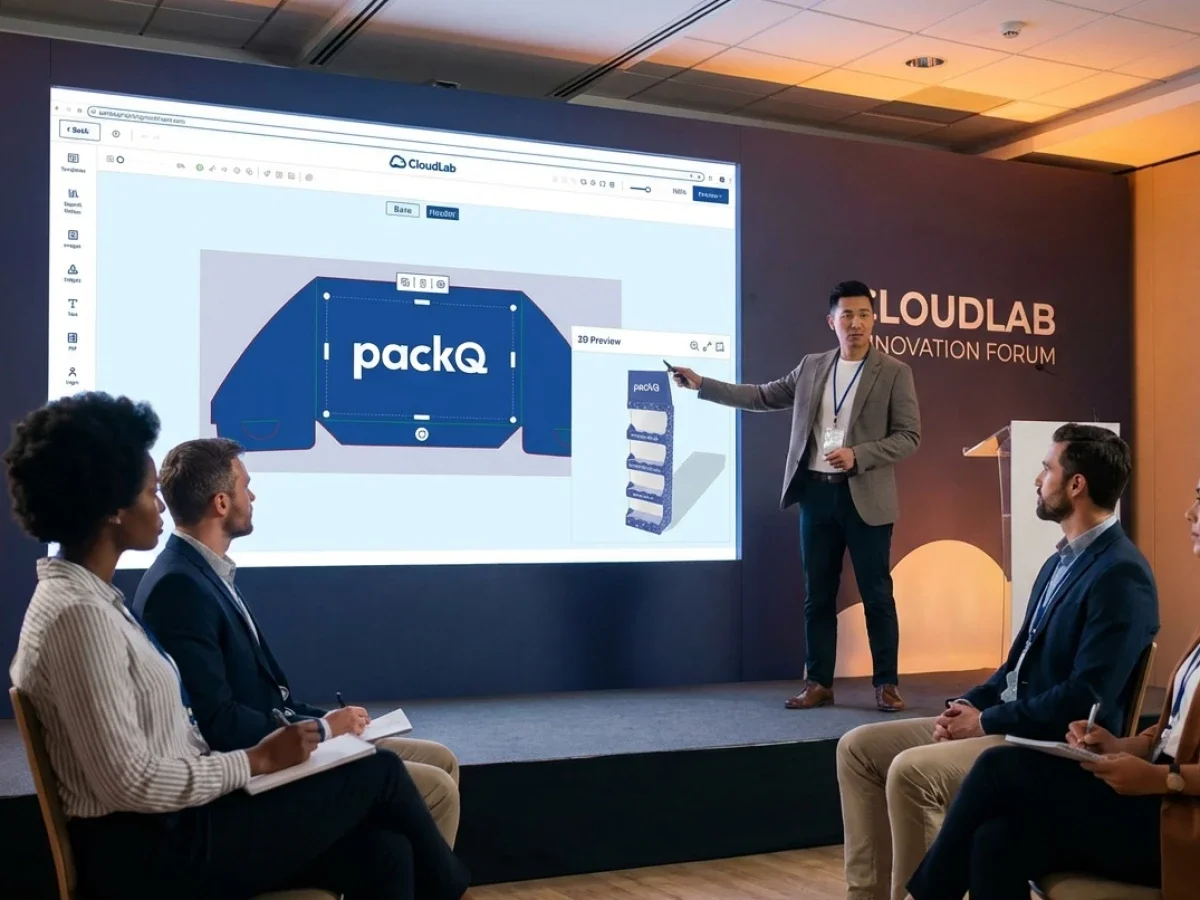
The 3D Packaging Designer makes these structures understandable in the browser. Users can review the carton as a folded object while still working with the 2D layout. This is especially useful for approval because customers often struggle to interpret flat dielines correctly.
Dynamic Preflight adds print validation before files reach prepress. The workflow can check production-relevant issues such as resolution, color mode, bleed, and fonts while the customer is still configuring or approving the order.
For folding carton manufacturers, packQ turns CAD logic into a scalable ordering process. The structure remains technically controlled, while the customer experience becomes faster and more transparent.
Why Manual Folding Carton CAD Workflows Slow Down Repeat Orders
Manual folding carton CAD workflows slow down repeat orders because every variation can trigger engineering, artwork, approval, prepress, and order-entry work. packQ reduces this effort by using ECMA-based templates, browser-based 3D previews, Dynamic Preflight, automated pricing, and production-ready PDF output to standardize repeatable carton orders.
The problem is most visible in recurring carton programs. A brand owner may need the same structure with new artwork. A pharmaceutical customer may need localized carton text. A cosmetics brand may need seasonal campaign variants. An e-commerce platform may need carton sizes adapted to different product lines.
If each variation moves through manual CAD, quoting, proofing, and prepress, the workflow becomes too heavy for short runs or frequent reorders.
A manual CAD process also creates communication risk. Customers may approve a flat proof without understanding folds or panel visibility. Sales may quote a version that does not match the final structure. Prepress may discover artwork issues only after the order is already expected to move forward.
packQ moves repeatable folding carton work into a controlled Web-to-Pack process. The structure starts from a validated ECMA template. The customer configures allowed parameters. The 3D preview shows the folded carton. Dynamic Preflight validates artwork. Production-ready output is generated after approval.
For prepress teams, this reduces repetitive file correction. For sales teams, it reduces manual quotation cycles. For production, it improves predictability because incoming jobs follow standardized structural logic.
Folding Carton Design Software for Customer-Facing Workflows
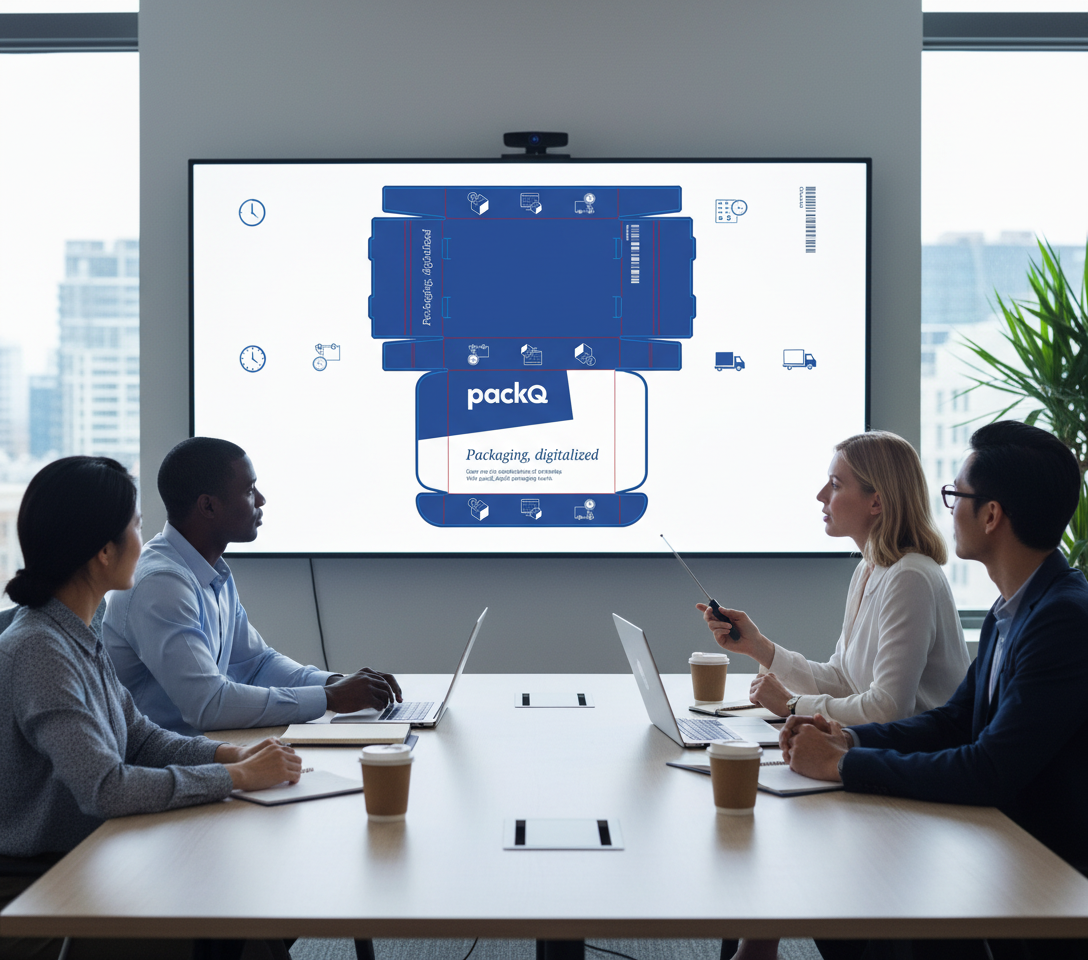
Folding carton design software must serve two audiences at once. Packaging specialists need technical reliability, while customers need an interface that makes the carton understandable and orderable.
packQ bridges this gap by translating packaging structure into a browser-based workflow. The customer does not need to operate a specialist CAD system. The manufacturer still receives production-oriented output based on controlled structural logic.
This matters for online ordering because folding cartons are not simple rectangles. Panel relationships, locking mechanisms, folding sequences, glue areas, and tolerances all affect production safety.
The 3D Packaging Designer helps customers understand these relationships visually. Instead of interpreting a flat dieline alone, they can see the carton assembled. This improves approval quality and reduces misunderstandings before prepress.
For brand owners managing multiple SKUs, this creates a faster path from artwork update to approved packaging. For folding carton producers, it creates a scalable way to offer self-service without opening the door to invalid structures.
Manual CAD vs Browser-Based Web-to-Pack for Folding Cartons
Browser-based Web-to-Pack is better for repeatable folding carton orders when ECMA templates, customer configuration, 3D approval, Dynamic Preflight, pricing, and production output can be standardized. Manual CAD remains important for complex custom structures, but packQ is better suited for recurring carton workflows that need scalable online ordering and production-safe automation.
Manual CAD gives packaging engineers maximum construction freedom. It is the right approach for unusual carton concepts, complex structural innovation, new material tests, or packaging projects where no standard template fits.
The weakness appears when manual CAD is used for repeatable products. A standard ECMA carton with adjusted dimensions, updated artwork, or a localized text variant should not require the same coordination as a completely new construction.
Browser-based Web-to-Pack changes the workflow. packQ allows manufacturers to define safe carton structures, parameters, pricing logic, approval rules, and production constraints in advance. Customers then configure inside those boundaries.
Compared with static approval, 3D approval provides stronger customer understanding. Compared with post-submission preflight, Dynamic Preflight reduces correction work earlier. Compared with disconnected CAD, artwork, and shop systems, packQ connects the workflow from online configuration to production-ready output.
This makes packQ especially relevant for folding carton manufacturers that want to process more short-run, repeat, or customer-specific orders without increasing manual workload at the same rate.
How packQ Turns ECMA Structures Into Online Products
ECMA standards are a practical foundation for online folding carton workflows because they define recognized carton structures. packQ uses that foundation to make folding carton ordering more repeatable and scalable.
Instead of starting every project from a blank CAD request, the workflow can begin with an ECMA-based carton type. The customer or internal user selects a structure, adjusts allowed dimensions, applies artwork, reviews the carton in 3D, and moves through validation before output.
This makes ECMA logic usable beyond the engineering department. Sales can offer standardized products. Customers can configure safely. Prepress receives cleaner artwork. Production receives files that are tied to controlled structural rules.
The benefit is not only speed. The deeper value is production consistency. When an online order is based on validated carton logic, the risk of structurally unsuitable configurations is reduced.
packQ’s integration of around 120 ECMA folding carton types gives manufacturers a broad starting point for online product catalogs, B2B portals, and Web-to-Pack storefronts.
How Can Folding Carton Manufacturers Implement Online CAD-Based Ordering?
Folding carton manufacturers can implement online CAD-based ordering by converting repeatable ECMA carton structures into controlled Web-to-Pack templates, adding 3D approval, Dynamic Preflight, pricing logic, ERP/MIS integration, and production-ready PDF output. packQ supports this through browser-based workflows, API-first architecture, REST, SOAP, JSON, and production-safe automation.
Implementation should start with carton products that are already repeatable. Standard folding cartons, recurring brand-owner cartons, pharmaceutical cartons, cosmetic cartons, promotional cartons, and customer-specific reorder products are usually better starting points than fully custom development projects.
The manufacturer then defines which elements are fixed and which elements are configurable. Structure, material options, size ranges, print areas, finishing rules, and locked design zones must be controlled. Artwork, text fields, quantities, and approved variants can then be opened safely to customers or internal sales teams.
packQ connects these rules to the online workflow. The 3D Packaging Designer supports visual approval, Dynamic Preflight validates artwork, and production-ready PDF output supports downstream production.
A practical implementation path can follow this sequence:
- Select repeatable ECMA folding carton products suitable for online ordering.
- Configure structural rules, dimensions, materials, print zones, and finishing options.
- Define editable artwork areas, locked design elements, approval steps, and pricing logic.
- Enable browser-based 2D and 3D review through the 3D Packaging Designer.
- Activate Dynamic Preflight for resolution, color mode, bleed, fonts, and file requirements.
- Connect order and production data with ERP or MIS through REST, SOAP, or JSON-based APIs.
- Generate production-ready PDFs after configuration, approval, and validation.
For technology teams, packQ’s headless API-first architecture is important because online folding carton workflows must connect with existing storefronts, B2B portals, ERP systems, MIS environments, prepress workflows, and production planning.
For production teams, the result is cleaner handover. For customers, it is faster ordering. For prepress, it is fewer avoidable file corrections.
Open-Shop and Closed-Shop Folding Carton Workflows
Online folding carton ordering can support both open-shop and closed-shop business models.
In an open-shop model, a packaging manufacturer offers standardized folding carton products to a wider market. Customers configure sizes, materials, quantities, and artwork online. The workflow must be simple enough for self-service but strict enough to prevent invalid production data.
In a closed-shop model, the manufacturer provides customer-specific portals for repeat buyers. A brand owner, pharmaceutical company, franchise organization, or industrial customer can reorder approved carton structures, update allowed fields, and approve variants without restarting the full service process.
packQ supports both models because its Web-to-Pack workflow connects structural templates, 3D preview, Dynamic Preflight, approval, pricing, and production output. The same technical foundation can serve public e-commerce packaging sales and private B2B carton portals.
For folding carton manufacturers, this flexibility matters. It allows the business to digitize repeat work first, then expand into broader online ordering models as internal workflows mature.
AI-Supported Artwork Preparation for Folding Cartons
Folding carton workflows often receive artwork that is not production-ready. Logos may be low resolution. Images may need background removal. Raster graphics may need vectorization. Campaign assets may not have been prepared by packaging specialists.
packQ’s AI Designer Suite supports these common preparation tasks directly inside the browser workflow. Users can vectorize graphics, remove backgrounds, apply image adjustments, and improve resolution with Crispify, which supports up to 4× higher resolution.
This is valuable for folding carton manufacturers because artwork problems often slow down prepress. If customers can improve assets during configuration, fewer preventable issues reach production preparation.
The key is that these AI-supported tools remain connected to the packaging workflow. Users are not preparing images in isolation. They are improving assets inside a carton structure that can be reviewed in 3D, checked through Dynamic Preflight, and output as production-ready data.
Variable Folding Carton Orders and PDF/VT
Folding carton production increasingly involves variation. Brand owners may need regional cartons, campaign editions, serialized packaging, localized text, or personalized packaging for short-run production.
Variable Data Printing with PDF/VT supports this shift. packQ can help manage variable content inside controlled workflows so that variation does not require manually preparing every file from scratch.
This is especially relevant for batch-size-one scenarios and mass customization. A carton structure can stay consistent while text, codes, names, images, or regional content changes according to the workflow.
For brand owners, this creates campaign flexibility. For folding carton manufacturers, it creates a scalable path to personalized packaging without uncontrolled file handling.

How Can Folding Carton Producers Make ECMA CAD Structures Orderable Online?
Folding carton producers can make ECMA CAD structures orderable online by turning standard carton constructions into Web-to-Pack templates with browser-based configuration, 3D approval, Dynamic Preflight, ERP/MIS integration, and production-ready PDF output. packQ combines folding carton cad software logic with folding carton design software usability for scalable online ordering.
The starting point is a repeatable folding carton portfolio. A manufacturer already knows which carton types are frequently requested, which structures are production-proven, and which dimensions or finishes can be safely configured.
The technical requirement is to translate that knowledge into controlled online templates. ECMA structures provide the foundation. packQ adds the browser interface, 3D visualization, approval workflow, preflight validation, pricing logic, and production output.
In practice, the customer selects an approved carton structure, configures allowable dimensions, uploads or edits artwork, reviews the folded carton in 3D, and receives validation feedback before ordering. Once approved, packQ generates production-ready output and can transfer order data into connected ERP or MIS systems.
A practical use case is a folding carton manufacturer serving cosmetics brands with recurring product cartons. The manufacturer defines approved ECMA structures and print zones. Brand teams adapt artwork or campaign details inside the online workflow. The 3D preview shows the final carton, Dynamic Preflight checks the file, and production receives validated output.
The benefit for the customer is faster ordering and clearer approval. The benefit for the manufacturer is fewer manual CAD requests and cleaner production handover.
packQ’s role is to make folding carton CAD usable as an online product system. It connects technical carton construction with customer-facing configuration and production-safe automation.
Production-Ready Output Is the Real Test of Online CAD
An online folding carton workflow should not end with a visual preview. It must generate output that prepress and production can use.
If the approved carton still needs to be rebuilt manually, the workflow has not solved the core problem. The value of Web-to-Pack lies in connecting configuration, approval, validation, and output.
packQ generates production-ready PDF output after the carton has been configured, reviewed, and validated. This connects the customer-facing workflow with manufacturing requirements.
For folding carton manufacturers, this protects margin on repeat and short-run orders. For customers, it creates confidence that the approved carton is not just a mockup. For production teams, it creates a clearer handover from online ordering to manufacturing.
Web to Pack with Folding Carton CAD Software
CAD-Software für Faltschachteln wird zu einem skalierbaren Geschäftstool, wenn Kartonstrukturen in kontrollierte Online-Bestellabläufe umgewandelt werden können. Paket Q by CloudLab unterstützt dies durch Web-to-Pack-Automatisierung, ECMA-basierte Faltschachtelvorlagen, den 3D Packaging Designer, synchronisiertes 2D/3D-Design, Dynamic Preflight, AI Designer Suite-Tools, PDF/VT-Personalisierung, API-First-Integration, ERP/MIS-Konnektivität und produktionsreife PDF-Ausgabe.
Für Faltschachtelhersteller, Druckereien, Markeninhaber, E-Commerce-Plattformen und Technologieteams besteht der zentrale Wert darin, die technische Kartonlogik über die CAD-Abteilung hinaus nutzbar zu machen. packQ verbindet Struktur, Grafik, Genehmigung, Validierung, Preisgestaltung und Produktionsübergabe, sodass wiederholbare Faltschachtelbestellungen online übertragen werden können, ohne die Produktionssicherheit zu beeinträchtigen.
CAD für Faltschachteln gewinnt an Wert, wenn bewährte Strukturen online konfiguriert, genehmigt und bestellt werden können. packQ von CloudLab verwandelt ECMA-basierte Kartonlogik in Web-to-Pack-Workflows mit browserbasiertem 3D-Design, dynamischem Preflight, KI-gestützter Grafikvorbereitung, ERP/MIS-Integration und produktionsreifer PDF-Ausgabe. PackQ erleichtert Faltschachtelherstellern und Markeninhabern den Verkauf, die Genehmigung, Personalisierung und Produktion wiederholbarer Kartonstrukturen durch kontrollierte Online-Bestellungen.


.webp)