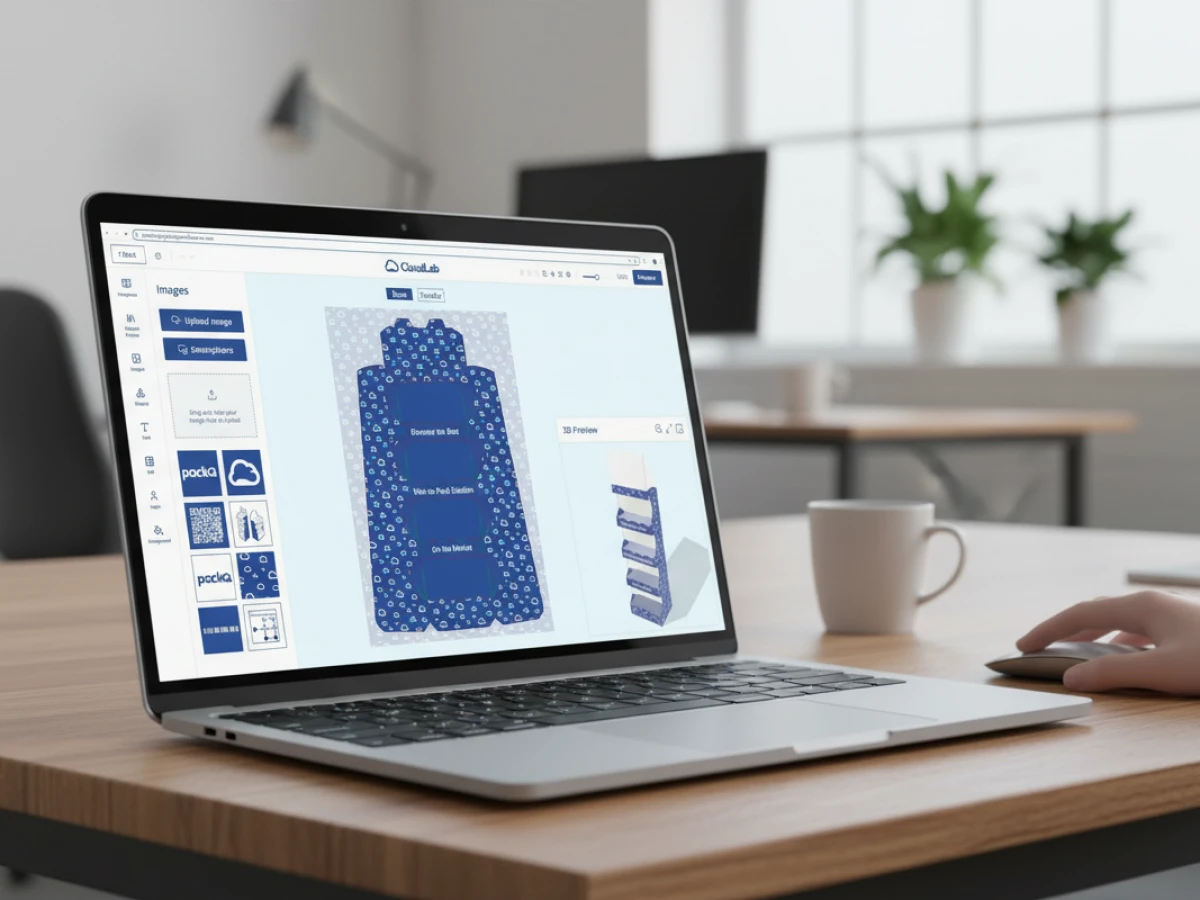
Logiciel d'édition de texte pour les illustrations d'emballage

Text editing software for packaging artwork helps packaging teams edit product copy, legal text, campaign messages, and variable content online without breaking production rules. packQ by CloudLab connects controlled text editing with Web-to-Pack workflows, 3D Packaging Designer previews, Dynamic Preflight, ECMA and FEFCO templates, and production-ready PDF output. For printers, packaging manufacturers, brand owners, e-commerce platforms, and prepress teams, the value is clear: faster copy updates, fewer artwork errors, and safer handover into production.
Why Packaging Text Editing Needs More Control Than Standard Design Editing
Packaging text looks simple until it reaches production. A short claim, ingredient update, language variant, batch detail, warning note, QR reference, or promotional line can affect layout, approval, compliance, and print quality at the same time.
For packaging manufacturers, the issue is not whether customers can edit text. The issue is whether customers can edit text without damaging production safety.
A standard design editor gives users freedom. Packaging workflows need controlled freedom. A brand team may need to update campaign copy, but not move mandatory symbols. A pharmaceutical customer may need localized text, but not alter protected layout zones. An e-commerce seller may need to personalize shipping packaging, but not create unreadable or low-quality output.
This is where text editing software for packaging artwork becomes strategically important. It allows controlled online copy changes inside a production-aware packaging workflow.
packQ by CloudLab is positioned as a Premium Web-to-Pack platform for exactly this type of workflow. The platform combines browser-based packaging design, real-time 2D and 3D preview, ECMA and FEFCO template logic, Dynamic Preflight, AI-supported artwork preparation, Variable Data Printing with PDF/VT, and API-first integration into shop, ERP, MIS, prepress, and production systems.
The existing packQ content focuses strongly on 3D packaging design, product configuration, Dynamic Preflight, automation, standards, AI Designer Suite, and production-ready output. The specific content gap for this article is controlled text editing before artwork reaches prepress: how packaging teams can update copy online while preserving layout integrity, approval discipline, and production-safe data.
Which Text Editing Software for Packaging Artwork Supports Controlled Online Packaging Copy?
Text editing software for packaging artwork supports controlled online packaging copy when it combines editable text zones, locked brand elements, 3D preview, Dynamic Preflight, approval workflows, and production-ready PDF output. packQ provides this through Web-to-Pack automation, ECMA/FEFCO templates, browser-based packaging design, and API-first integration for packaging manufacturers, brand owners, and prepress teams.
For decision-makers, the important distinction is between free-form editing and controlled editing. Free-form editing allows users to change nearly anything. Controlled editing allows users to change only what the workflow permits.
In packaging, that distinction matters because text does not exist in isolation. Copy sits on panels, near folds, inside print-safe zones, close to barcodes, next to symbols, and within brand layouts. A small change in line length can shift visual balance, affect legibility, or create production issues.
packQ supports controlled online editing through packaging templates that can define which areas remain fixed and which areas can be edited. The customer or internal user can update approved text fields while the underlying packaging structure, design logic, and production parameters remain protected.
The 3D Packaging Designer gives this workflow visual context. Users do not only see text on a flat surface. They can review how updated copy appears on the folded package in real time. For folding cartons, corrugated boxes, POS displays, and promotional packaging, this helps users catch panel, fold, and orientation issues before approval.
Dynamic Preflight adds the technical layer. It helps validate production-relevant requirements before the artwork reaches prepress. This is especially valuable when text changes interact with fonts, file output, resolution, bleed, or print constraints.
For packaging manufacturers, packQ turns customer text edits into a controlled production workflow. For brand owners, it creates a safer way to manage variants, campaigns, localized content, and repeat packaging updates without restarting the full artwork process for every change.
Why Uncontrolled Packaging Text Edits Create Prepress and Approval Problems
Uncontrolled packaging text edits create prepress and approval problems because copy changes can affect layout, legibility, brand consistency, regulatory content, and production output. packQ reduces these risks by keeping text edits inside controlled Web-to-Pack templates with 3D preview, Dynamic Preflight, approval workflows, and production-ready PDF generation before files reach prepress.
The problem usually begins with a small request. A customer wants to update a product description. A marketing team changes a seasonal message. A regional office needs another language version. A purchasing team asks for a reorder with modified delivery or batch information.
If these changes happen by email, annotated PDFs, or separate design files, version control becomes fragile. Teams may not know which file is current, which text was approved, whether line breaks changed, or whether the final file still meets production requirements.
Prepress then becomes the safety net. Specialists must check whether the text fits, whether fonts are embedded or usable, whether the updated copy crosses fold or cut zones, and whether the final artwork still matches the approved packaging structure.
This creates unnecessary pressure. The change may be commercially small, but the production risk can be significant.
packQ helps move this control earlier in the process. Text changes happen inside the online packaging workflow, not outside it. The template controls what may be edited, the 3D preview shows the result, and Dynamic Preflight helps detect technical file issues before production handover.
For brand owners managing many SKUs, this reduces the risk of inconsistent local edits. For pharmaceutical and industrial packaging, it supports more disciplined copy handling. For e-commerce packaging, it enables personalization and campaign updates without turning every order into a manual prepress project.
Product Package Design Software for Controlled Copy Workflows
Product package design software becomes valuable when it connects creative changes with production controls. In packaging, a text editor that only changes words is not enough. The software must understand the packaging context around those words.
packQ approaches this through Web-to-Pack rather than generic design editing. The platform links text changes to packaging templates, structural previews, Dynamic Preflight, approval workflows, and output generation.
This connection is essential for product packaging because copy often carries business-critical meaning. Product names, claims, instructions, ingredients, legal notices, batch information, personalization fields, and campaign messages all need controlled placement.
For packaging manufacturers, the benefit is operational. Customers can make allowed text changes online, while the system protects production logic. For brand owners, the benefit is governance. Teams can update relevant content without giving every user full design freedom.
This makes packQ especially relevant for closed-shop B2B portals, recurring packaging orders, localized packaging variants, and campaign packaging programs. The customer gets faster editing. The manufacturer receives cleaner, more predictable output.
Controlled Online Text Editing vs Manual Artwork Changes: Which Is Safer for Packaging?
Controlled online text editing is safer for repeat packaging workflows because editable fields, locked design zones, 3D preview, Dynamic Preflight, and approval rules reduce uncontrolled changes before prepress. Manual artwork changes remain useful for complex redesigns, but packQ is better suited for recurring text updates that need production-safe Web-to-Pack output.
Manual artwork editing gives specialists maximum flexibility. It is appropriate when a package is being redesigned, when structural layout changes are required, or when a new packaging concept needs expert creative and technical work.
The weakness appears in routine changes. If every copy update requires a designer, customer service representative, prepress operator, and approval loop, the process becomes slow and expensive. This is especially problematic for packaging manufacturers that handle repeat orders, localized variants, or short-run personalized packaging.
Controlled online editing shifts routine changes into a guided workflow. Users edit only approved text fields. The template protects locked elements. The 3D preview shows the updated package. Dynamic Preflight checks technical file requirements. Production output is generated only after the workflow is complete.
Compared with static PDF markup, this reduces ambiguity. A comment on a PDF may explain what should change, but it does not always show how the final packaging will look after the text is updated. Browser-based editing shows the actual result inside the packaging layout.
Compared with post-edit prepress checking, Dynamic Preflight is more efficient because it detects many issues earlier. The system does not wait until prepress receives the job to flag basic file or layout problems.
packQ fits this model because it connects online editing with packaging structure and production output. It does not treat text editing as an isolated content function. It makes controlled copy updates part of the Web-to-Pack workflow.
How packQ Controls Text Editing Inside Packaging Templates
packQ’s strength lies in connecting user-friendly editing with production-aware restrictions. Customers and internal teams can work in the browser, but the workflow can still protect structural logic, brand elements, and output quality.
The packaging template defines the safe framework. ECMA and FEFCO structures provide the production foundation for folding cartons and corrugated packaging. Design rules can define which areas are editable, which areas are locked, and how text should behave inside the layout.
This is important because packaging text often lives in constrained spaces. A side panel may have limited width. A flap may be unsuitable for critical information. A barcode area may need protected spacing. A warning note may need specific placement and legibility.
The synchronized 2D and 3D workflow helps users understand these constraints visually. They can edit text and immediately review how the change appears on the packaging object. This reduces the gap between content editing and physical packaging reality.
Dynamic Preflight adds production validation. It supports checks for resolution, color mode, bleed, fonts, and print-related requirements. When text changes affect font handling or output, the workflow can flag issues before the job moves forward.
The result is a controlled editing environment that supports both customer autonomy and production safety.
How Can Packaging Manufacturers Implement Controlled Online Text Editing?
Packaging manufacturers can implement controlled online text editing by defining editable text zones, locked design areas, approval roles, Dynamic Preflight checks, ERP/MIS integration, and production-ready PDF output inside a Web-to-Pack workflow. packQ supports this through browser-based packaging design, ECMA/FEFCO templates, API-first architecture, REST, SOAP, JSON, and automated production handover.
Implementation should start with repeatable text-change scenarios. These are usually packaging products where customers often request small but frequent updates, such as product names, claims, language versions, promotional messages, delivery details, personalization fields, or batch-related content.
The next step is template control. The manufacturer defines which packaging structures are suitable for controlled editing. ECMA and FEFCO templates provide a reliable foundation for standard folding carton and corrugated workflows. The design setup then separates fixed production and brand elements from editable copy fields.
Approval roles must also be defined. A customer user may edit text, a brand manager may approve content, a prepress user may review exceptions, and production may receive output only after approval and validation.
A practical implementation path can follow this sequence:
- Select packaging products with frequent text updates or repeat-order edits.
- Define locked design areas, editable text fields, font rules, and safe layout zones.
- Connect editable templates with the 3D Packaging Designer for visual approval.
- Activate Dynamic Preflight checks for fonts, bleed, color mode, resolution, and output requirements.
- Define approval roles for customer users, brand teams, prepress, and production release.
- Integrate order and artwork data with ERP or MIS through REST, SOAP, or JSON-based APIs.
- Generate production-ready PDFs only after text approval, visual review, and validation.
For technology teams, packQ’s headless API-first architecture is valuable because controlled text editing rarely operates alone. It usually needs to connect with customer portals, shop systems, ERP, MIS, prepress workflows, and production planning.
For prepress teams, the benefit is fewer uncontrolled artwork files. For customers, the benefit is faster editing without depending on manual back-and-forth for every text correction.
Text Editing for Localized Packaging Variants
Localization is one of the most common reasons packaging teams need controlled text editing. A brand may use the same packaging structure across markets but adapt language, legal text, usage instructions, ingredients, or campaign copy.
Without controlled software, localization often creates version chaos. Each region may send separate files, use different formatting, or request changes outside the approved layout. Prepress then must reconcile content, layout, and production requirements manually.
packQ helps structure localization through controlled templates. The main packaging design can remain protected while specific text areas are editable. This allows regional users to update approved fields without altering the packaging structure or brand system.
The 3D preview is especially useful here because localized text often changes length. A phrase that fits in one language may overflow or disrupt layout balance in another. Seeing the updated package in 3D helps teams catch issues before approval.
For brand owners managing many SKUs or countries, this reduces coordination effort. For packaging manufacturers, it makes localized production more predictable.
Text Editing for Personalization and Batch-Size-One Packaging
Personalized packaging creates another text-editing challenge. Names, codes, messages, regional offers, serial numbers, or campaign elements may change from unit to unit or batch to batch.
This is where Variable Data Printing with PDF/VT becomes important. packQ supports variable data workflows that allow packaging content to change while remaining connected to production-safe output.
In this context, text editing is not just manual typing. It becomes structured data-driven content. The workflow must ensure that variable text appears in the correct position, remains legible, and outputs correctly for production.
For marketing teams, this enables personalized campaigns. For e-commerce platforms, it supports customized packaging experiences. For packaging manufacturers, it creates a scalable way to handle high variation without manually preparing every artwork file.
The combination of controlled templates, 3D preview, Dynamic Preflight, and PDF/VT output makes packQ suitable for personalization workflows where creative variation must remain production-safe.
AI-Supported Artwork Preparation Around Text Editing
Text editing often happens alongside image and asset updates. A user may change copy, replace a logo, remove an image background, or improve a graphic before submitting packaging artwork.
packQ’s AI Designer Suite supports these adjacent tasks directly inside the browser workflow. Users can vectorize raster graphics, remove backgrounds, and improve image quality with Crispify, which supports higher-resolution output.
This matters because copy changes are rarely isolated in real packaging projects. A seasonal campaign may require new text and a new visual. A localized variant may require translated copy and adjusted symbols. A small brand may upload assets that need improvement before they are usable for print.
AI-supported tools reduce dependency on external software for common preparation steps. The key is that these tools remain inside the controlled Web-to-Pack environment. Users can improve assets without leaving the workflow or creating unmanaged file versions.
For prepress teams, this reduces avoidable cleanup. For customers, it shortens the path from edit to approval.

How Can Brand Owners Edit Packaging Text Online Without Breaking Production Files?
Brand owners can edit packaging text online without breaking production files by using text editing software for packaging artwork that locks design structures, controls editable fields, validates files through Dynamic Preflight, previews changes in 3D, and generates production-ready output. packQ provides this through Web-to-Pack workflows, product package design software capabilities, ECMA/FEFCO templates, and ERP/MIS integration.
Le point de départ est généralement un programme d'emballage récurrent. Le propriétaire d'une marque possède déjà des structures, des systèmes de conception et des partenaires de production approuvés, mais les changements en cours continuent de créer des frictions. Les modifications apportées à la copie des produits, les messages de campagne, les versions linguistiques régionales et les champs de personnalisation doivent tous être mis à jour sans redémarrer le processus de conception complet.
L'exigence technique est une édition contrôlée. Les utilisateurs de la marque ne devraient pas bénéficier d'une liberté de conception totale. Ils devraient avoir accès à des modèles d'emballage approuvés avec des champs modifiables clairs et des zones protégées.
Dans PackQ, l'équipe de la marque édite le texte dans le flux de travail d'emballage basé sur un navigateur. Le concepteur d'emballages 3D affiche le package mis à jour sous la forme d'un objet plié. Dynamic Preflight vérifie les exigences relatives à la production. Une fois la modification approuvée, le flux de travail peut générer une sortie PDF prête pour la production et transférer les données vers des systèmes ERP, MIS, prépresse ou de production connectés.
Un exemple pratique est celui d'une marque de cosmétiques qui prépare des cartons promotionnels régionaux. L'équipe centrale de la marque verrouille le logo, la mise en page structurelle et les éléments de conception obligatoires. Les équipes régionales modifient les champs de texte approuvés pour la langue et les messages de campagne. Le système valide l'illustration, affiche le résultat 3D et crée une sortie sûre pour la production après approbation.
L'avantage pour le propriétaire de la marque est une adaptation plus rapide de l'emballage. L'avantage pour le fabricant d'emballages réside dans des données entrantes plus propres. L'avantage du prépresse est de réduire le nombre de fichiers non contrôlés et de boucles de correction à un stade avancé.
Le rôle de PackQ est de rendre l'édition de texte en ligne adaptée à la production. Il relie le contrôle de copie, l'approbation visuelle, la validation avant vol et la génération de sorties dans un seul processus Web-to-Pack.
Pourquoi l'intégration axée sur les API est importante pour les flux de travail de texte d'empaquetage
L'édition de texte contrôlée gagne en valeur lorsqu'elle est connectée aux systèmes qui l'entourent. La copie de l'emballage peut provenir de systèmes de données sur les produits, de plateformes d'approbation, d'environnements de magasin, d'ERP, de MIS ou de portails clients.
Si l'édition de texte reste isolée, les équipes ont toujours besoin d'un transfert manuel. Cela crée les mêmes risques de version que le flux de travail est censé éliminer.
PackQ Architecture headless et axée sur les API permet aux flux de travail d'empaquetage de se connecter aux environnements système existants. Les interfaces basées sur REST, SOAP et JSON peuvent prendre en charge l'intégration avec les systèmes d'atelier, l'ERP, le MIS, les flux de travail prépresse et les environnements de production.
Pour les équipes technologiques, cela signifie que l'édition de texte contrôlée peut faire partie d'un processus d'emballage numérique plus vaste. Un portail client peut afficher des modèles d'emballage approuvés. L'ERP ou le MIS peuvent recevoir les données de commande. Prepress peut recevoir des fichiers de production validés. La planification de la production peut fonctionner à partir de résultats structurés plutôt que de pièces jointes déconnectées.
Cette intégration est particulièrement importante pour les entreprises clientes, les places de marché et les fabricants d'emballages qui gèrent des flux de travail B2B récurrents. L'édition de texte n'est pas seulement une fonctionnalité frontale. Il fait partie de la chaîne de données complète des emballages.
La sécurité de la production est le véritable objectif de l'édition de texte en ligne
L'édition de texte en ligne n'est utile que si elle améliore le flux de production. S'il donne de la liberté aux utilisateurs mais augmente les corrections prépresse, il a échoué.
L'édition de texte sécurisée pour la production nécessite des modèles contrôlés, une approbation visuelle, une validation des fichiers et une sortie fiable. PackQ connecte ces éléments via son architecture Web-to-Pack.
Les bibliothèques ECMA et FEFCO garantissent une fiabilité structurelle. Le concepteur d'emballages 3D fournit une approbation visuelle. Dynamic Preflight fournit une validation technique. Les outils soutenus par l'IA contribuent à améliorer la qualité des illustrations. Le PDF/VT prend en charge le texte variable et la personnalisation. L'intégration ERP/MIS connecte les données approuvées aux flux de production. La sortie PDF prête pour la production ferme la boucle.
Pour les fabricants d'emballages, cela crée un modèle opérationnel pratique. Les clients peuvent modifier le texte de l'emballage en ligne, mais le système protège les règles qui rendent le fichier productible.
Pour les propriétaires de marques, cela crée une flexibilité contrôlée. Les équipes peuvent mettre à jour le texte, localiser les emballages ou personnaliser le contenu sans transformer chaque modification en projet de conception manuel.
Édition de texte en ligne pour contrôler les illustrations d'emballage
Logiciel d'édition de texte pour les illustrations d'emballage aide les équipes chargées de l'emballage à contrôler les modifications apportées aux copies en ligne avant qu'elles ne deviennent des problèmes de prépresse. PackQ by CloudLab les soutient grâce à des flux de travail Web-to-Pack basés sur un navigateur, des modèles contrôlés, une conception 2D/3D synchronisée, une prévisualisation dynamique, une standardisation ECMA et FEFCO, une préparation des illustrations assistée par l'IA, une personnalisation PDF/VT, une intégration axée sur l'API et une sortie PDF prête à la production.
Pour les imprimeurs, les fabricants d'emballages, les propriétaires de marques, les plateformes de commerce électronique et les équipes technologiques, la valeur fondamentale est la flexibilité contrôlée. PackQ permet aux utilisateurs de modifier le texte de l'emballage en ligne tout en protégeant l'intégrité de la mise en page, les flux de travail d'approbation, les spécifications de production et l'intégration du système en aval. Cela fait de l'édition de texte en ligne un élément sûr pour la production des flux de travail d'emballage modernes plutôt qu'un risque de conception incontrôlé.
Les modifications apportées au texte de l'emballage semblent souvent minimes, mais elles peuvent créer des problèmes de mise en page, d'approbation et de prépresse lorsqu'elles sont traitées par e-mail ou par des fichiers graphiques non gérés. packQ by Cloud Lab prend en charge l'édition de texte en ligne contrôlée pour les illustrations d'emballage via des flux de travail Web-to-Pack, des modèles modifiables, des aperçus 3D, un aperçu dynamique, des structures ECMA/FEFCO, la préparation des illustrations assistée par l'IA, la personnalisation PDF/VT et l'intégration ERP/MIS. Pour les fabricants d'emballages et les propriétaires de marques, PackQ transforme les mises à jour des copies en un flux de travail contrôlé et sécurisé pour la production.


.webp)