
B2B & B2C Portals: How packQ Empowers Self‑Service and Multi‑Client Web to Pack Solutions
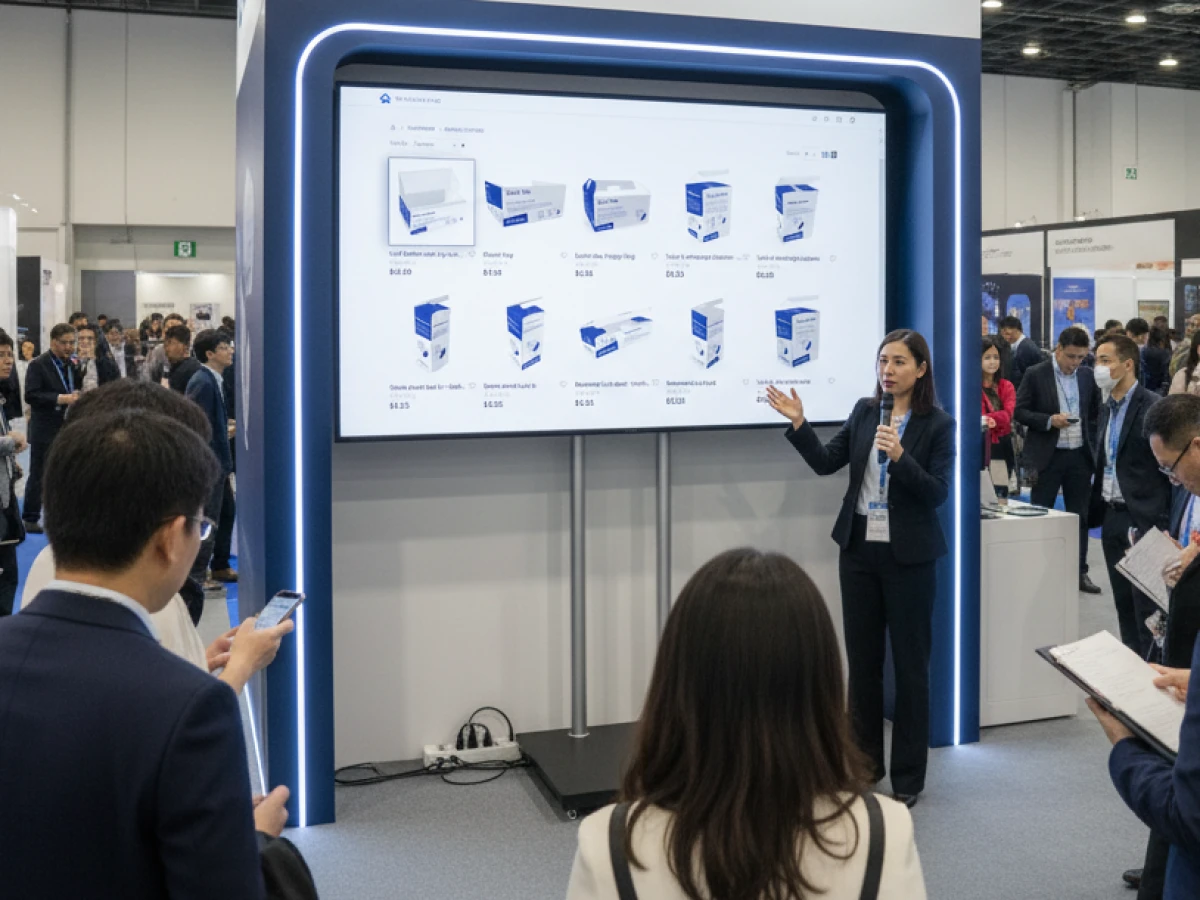
packQ from CloudLab is a premium web‑to‑pack platform that lets printers, converters and brand owners build B2B and B2C portals for custom packaging. The browser‑based 3D designer and parameterized ECMA/FEFCO templates allow users to configure boxes, displays and flexible packages without CAD skills. Built‑in AI tools vectorize artwork, upscale images and remove backgrounds, while a dynamic preflight check ensures resolution, color and fonts are correct. A dynamic pricing engine, variable data printing via PDF/VT and headless APIs link seamlessly to ERP and MIS systems for end‑to‑end automation.
The Digital Shift in Packaging and the Rise of Web‑to‑Pack Solutions
E‑commerce is booming: the global online marketplace is worth roughly $5.7 trillion and is projected to grow 17.5 % between 2020 and 2027. As buyers increasingly demand custom packaging and quicker turnaround times, converters and brand owners need scalable online tools. Traditional workflows—manual CAD design, emailed PDFs, protracted approvals—can’t meet expectations. A web‑to‑pack solution offers a self‑service portal where customers configure packaging online, receive instant pricing, and submit jobs that flow directly into production. In B2B scenarios, enterprise clients expect closed shops with individual pricing and approval workflows; in B2C markets, open shops encourage broad customer adoption with intuitive interfaces. Both contexts require robust automation, accurate pricing, and integration with existing ERP and MIS systems.
A true web‑to‑pack platform must address several challenges:
- Customization at scale. Customers want unique sizes, materials and finishes. Parameterized templates and 3D models must react instantly to dimension changes.
- Speed and accuracy. Rapid approvals demand real‑time previews, live pricing, and automatic data checks to avoid mistakes.
- Integration. Data from the e‑commerce portal should feed ERP/MIS systems automatically to avoid manual order entry and ensure consistent costing.
- Scalability. With 24/7 ordering, the system needs to handle hundreds of concurrent users and integrate with multiple production plants.
packQ by CloudLab addresses these needs. As a specialized web‑to‑pack platform—not a repurposed web‑to‑print system—it integrates deep packaging intelligence with a modular architecture. CloudLab’s vision of connecting creative freedom with production intelligence is evident in the 3D Packaging Designer, extensive ECMA/FEFCO libraries, AI Designer Suite, Dynamic Preflight Check, dynamic pricing and headless API foundation. These components make packQ a comprehensive answer for packaging printers, converters, brands, and technology teams.
CloudLab and packQ: Bringing Packaging Online
CloudLab is a German software pioneer known for printQ, packQ and brandQ. Founded in 2013, the company developed the first integrated 3D preview for print products and has since expanded to packaging. In July 2018, CloudLab’s packaging platform won the InterTech™ Technology Award—an industry recognition of innovation. packQ builds upon CloudLab’s philosophy: “Standardize what’s technical. Automate what’s repetitive. Empower what’s creative”. By digitising ECMA and FEFCO standards, connecting design to production workflows and offering a headless architecture, packQ eliminates the manual steps that slow down packaging development.
A Dedicated Web‑to‑Pack Platform
Where many software vendors stretch web‑to‑print systems to handle packaging, packQ is purpose‑built for boxes, cartons and displays. Its browser‑based editor and CAD‑level calculations ensure structural integrity while keeping the user experience simple. The platform is modular: printers can start with a branded B2C storefront or closed B2B portal and later add modules such as the AI Designer Suite or variable data printing. Because packQ is headless, it can be integrated into existing e‑commerce sites via API or operated as a standalone portal.
Multi‑Client and Self‑Service Models
packQ supports multi‑client environments—separate tenants with their own product catalogues, pricing rules and approval workflows. A packaging converter can host multiple brand shops on a single platform while maintaining strict data separation. For B2C use cases, packQ offers an open shop where visitors can design and order packaging without login. For enterprise clients, closed shops provide secure access, individual pricing and role‑based approval. Because the system is available 24/7, customers can configure and order packaging without waiting for a sales representative—reducing turnaround times and freeing up staff.
3D Packaging Designer: Parametric Precision in the Browser
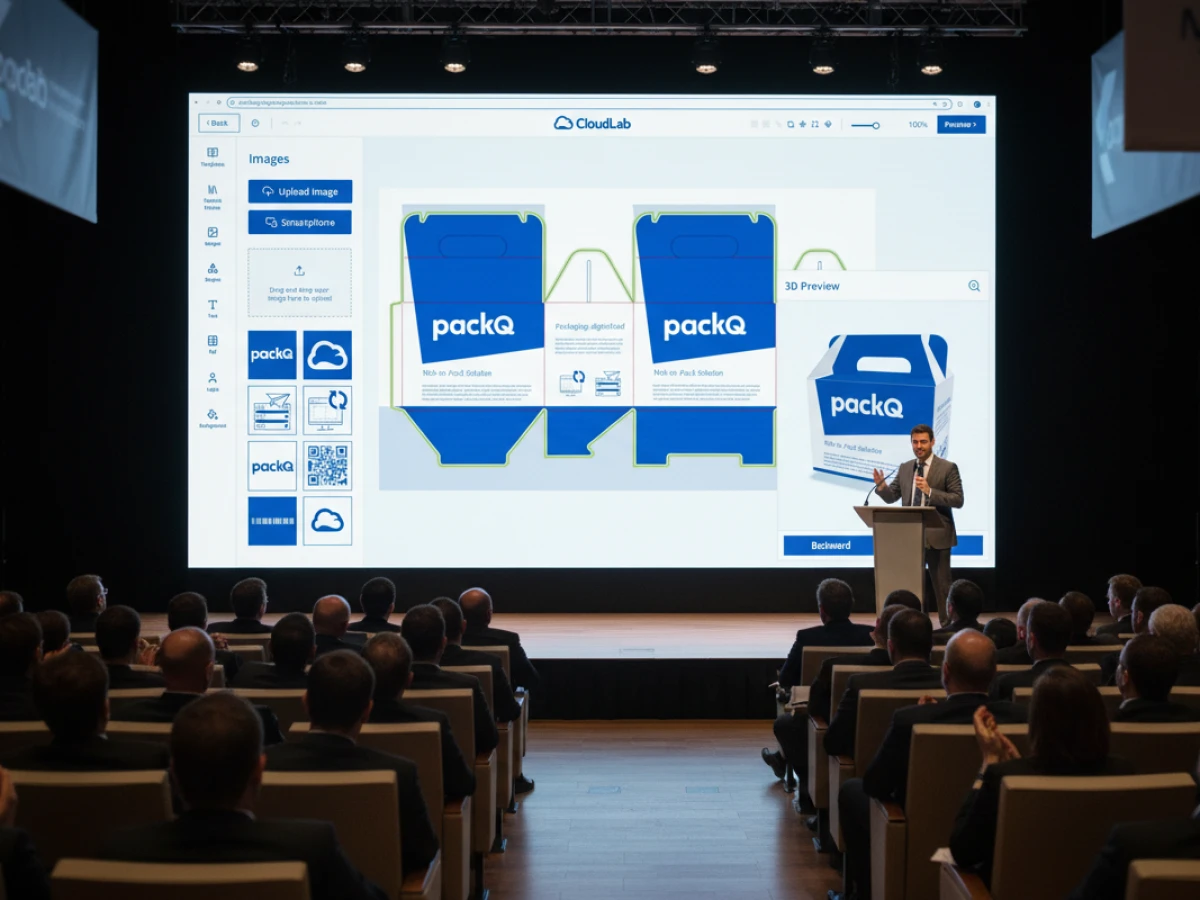
A standout feature of packQ is its 3D Packaging Designer. According to CloudLab, the designer is a browser‑based, real‑time design environment for folding cartons, corrugated boxes and displays. Users configure, visualize and approve packaging entirely in 3D without installing CAD software. The designer merges structure, artwork and pricing into a single interface, turning a previously linear process into a simultaneous one.
Real‑Time Visualization and Interaction
- Instant feedback. Any change—dimensions, colours, logos—is reflected immediately in the 3D model. Users can zoom, rotate, and inspect folds and flaps while the system maintains CAD‑level precision.
- Parametric geometry. The engine interprets packaging structures mathematically; changing width or height automatically recalculates all panels, glue flaps and creases. Even complex constructions like crash‑lock or tray boxes are adjusted in seconds.
- Synchronized 2D/3D editing. Artwork can be placed on a 2D canvas while the 3D model updates in real time, reducing proof errors. This capability gives non‑experts the confidence that what they see online matches the printed result.
Automatic Calculations and Live Pricing
In the 3D designer, pricing is linked directly to geometry. If a user changes the size of a box, the system recalculates sheet usage, print run costs and finishing steps. This eliminates the need for static price lists; customers always see accurate costs. The designer also includes automatic folding logic: crease spacing and tolerances adjust to maintain structural integrity.
Accessibility
Because the designer runs entirely in HTML5, there is no need for plug‑ins or downloads. This makes the tool accessible on standard browsers and supports remote collaboration. Stakeholders from marketing, procurement and prepress can review the same 3D model in real time, accelerating approval cycles.
ECMA and FEFCO Standards: Built‑In Quality
Packaging standards such as ECMA (for folding cartons) and FEFCO (for corrugated boxes) define structural codes that ensure efficient production. packQ integrates extensive libraries of these standards. For folding boxes, the platform includes more than 120 ECMA‑based styles like reverse‑tuck, crash‑lock and sleeve boxes. For corrugated packaging, it offers over 290 FEFCO templates and 50 POS display templates.
ECMA Library for Folding Cartons
Using the ECMA library, users select a code from the Template Gallery and then adjust width, height and depth. The system recalculates the dieline and glue flaps automatically. Because each template follows ECMA standards, the resulting dielines are machine‑compatible; fold lines, lock mechanisms and panel ratios remain correct even after dimension changes. This ensures that every folding carton produced through packQ is structurally sound and ready for high‑speed gluing and filling lines.
FEFCO Integration for Corrugated Boxes
The corrugated module uses FEFCO codes to automate shipping boxes, trays and complex displays. The workflow described by CloudLab has five steps: choose a template, configure dimensions and material (including flute type), design in 3D, preflight and pricing, and finally output to production. packQ exports press‑ready PDFs, DXF cutting outlines and 3D assets (GLB/OBJ) with embedded production data. All information—FEFCO code, flute type, dimensions—is passed to MIS/ERP systems for automatic planning. By embedding standards directly into the digital workflow, packQ reduces errors and shortens time‑to‑market.
POS Display Templates
For retail displays, packQ includes over 50 POS templates ranging from floor stands to counter trays. These models are pre‑engineered for stability and print alignment. Users can adjust shelves, product load capacities and dimensions dynamically. Real‑time 3D simulation allows marketing teams to visualize finishes like gloss or matte lamination. Once approved, packQ outputs dielines and 3D models for AR or rendering, ensuring that the display will withstand the physical demands of retail environments.

AI Designer Suite: Intelligent Image Processing in the Browser
Preparing artwork for print often requires tedious tasks: converting logos to vector, upscaling images, clipping backgrounds. packQ’s AI Designer Suite automates these steps directly in the browser. The suite uses artificial intelligence for vectorisation, super‑resolution, background removal and creative effects.
Core Functions
- Vectorisation (Vektorize). The tool converts raster logos into precise vectors, generating Bézier curves while preserving shapes and colours. Users control smoothing and colour tolerance; the result is infinitely scalable artwork suitable for cutting and embossing.
- Crispify Super‑Resolution. Low‑resolution images are upscaled with four times more pixels using deep‑learning models. This produces razor‑sharp photos and textures, ensuring high print quality on large panels.
- Remove Background. With a single click, the AI isolates the main subject, even for complex elements like hair or transparent materials. Designers can quickly integrate product photos without manual clipping.
- Effects and Filters. The suite adds sepia, vintage or Kodachrome effects and supports smart masking for embellishments.
Benefits
AI tools democratise packaging design. Non‑expert users can produce professional artwork without expensive software. The suite also ensures consistency across thousands of variants: logos remain crisp, images are uniformly sharp and backgrounds are removed identically. Routine tasks are automated, leaving designers more time for creative decisions. When combined with packQ’s real‑time 3D preview, changes are visible immediately, accelerating approvals and reducing costly prepress interventions.
Dynamic Preflight Check: Quality Assurance in Real Time
Even with sophisticated design tools, print jobs can fail if data aren’t correct. packQ’s Dynamic Preflight Check analyzes print data during configuration—before an order is submitted. Unlike traditional preflight processes that run post‑submission, packQ checks resolution, colour mode, fonts and bleed in real time. This proactive approach reduces waste, avoids reprints and speeds up production.
Key Parameters and Rules
The preflight engine inspects every element of the PDF:
- Resolution. It checks that images meet the required 300 DPI threshold, warning users about low‑resolution graphics.
- Colour Mode & Profiles. Files in RGB are converted to CMYK, and ICC profiles are verified for accurate reproduction.
- Fonts. The system ensures fonts are embedded or converted to vectors, flagging missing or unlicensed typefaces.
- Bleed and Page Format. It validates bleed margins and page dimensions against product specifications.
- Transparency and Layers. Transparent elements are detected to avoid unexpected print results.
Beyond these basics, packQ integrates industry‑leading preflight tools—Enfocus PitStop and callas pdfToolbox—via server licences. These engines detect missing barcodes, incorrect colour schemes and PDF/VT specifications for variable data printing. Preflight profiles can be customised per product type (e.g., ECMA or FEFCO), and automated corrections convert RGB to CMYK, add bleed or embed fonts automatically.
Real‑Time Feedback and Automated Corrections
When errors are found, packQ provides warning messages with recommendations, visual markers on the 3D layout and a live preview showing how corrections affect the design. Users can fix issues directly—replace images, adjust colours or embed fonts—before placing the order. Automated corrections handle routine fixes so that prepress staff can focus on exceptions. Once data pass the preflight, packQ generates a production‑ready PDF and transfers all job information to ERP/MIS systems.
Benefits for Stakeholders
Dynamic preflight delivers advantages across the value chain:
- Printers and converters: reduced waste, higher capacity utilisation and standardised quality checks.
- E‑commerce platforms: improved user experience and scalability; every upload is checked automatically.
- Brand owners and designers: assurance that corporate colours and fonts are maintained; rapid prototype creation.
- Technology teams: API‑first architecture enables preflight as a service; rules can be updated without disrupting other modules.
Dynamic Pricing and Product Configuration
Accurate pricing is crucial for online packaging. packQ’s Product Configuration & Calculation module offers a detailed configuration view with a plausibility check to detect inconsistencies. Users select paper types, corrugated board grades, flute combinations and finishing options. The system analyses print specifications and flags errors for correction.
The Dynamic Calculation engine bases its formulas on industry constants such as set‑up costs and run lengths. As the user changes dimensions or quantities, prices adjust automatically in the 3D designer. This removes the need for manual quotes and enables instant checkout. For converters, it ensures margins are preserved; for customers, it builds trust through transparency. Because pricing is linked to the structural model and material, it reflects real production costs rather than arbitrary price lists.
Variable Data Printing and Mass Customization
packQ supports Variable Data Printing (VDP) through PDF/VT and CSV uploads. Customers can upload Excel sheets with names, addresses, serial numbers or images and generate personalised packaging for marketing campaigns. The system allows manual addition or editing of records and offers an interface to review each variable field for placement accuracy. This level of control ensures that personalised data align with the design and that every box meets quality standards. Because preflight checks include PDF/VT specifications, variable data jobs are validated just like static ones.
Mass customization—producing unique items at scale—relies on such automation. With packQ, printers can handle lot size 1 orders without extra overhead. Combined with dynamic pricing, even small runs are economically viable. For brands, this enables limited‑edition packaging, targeted promotions and on‑demand production.
Template Gallery and Packaging Diversity
packQ’s Template Gallery offers structures for multiple packaging categories. In addition to folding boxes and corrugated boxes, the system supports flexible packaging, labels, stickers and POS displays. Each category features ready‑to‑use templates with parametric logic. For example:
- Flexible packaging and pouches. Users define pouch dimensions and sealing types; packQ generates dielines and verifies seal areas. Custom print options allow for barrier films, metallic laminates and resealable zips.
- Labels and stickers. The editor handles die‑cut shapes and roll formats. Preflight checks ensure correct bleed and safe zones.
- POS displays. As noted, packQ offers more than 50 display templates with adjustable shelves and load capacities. 3D visualisation includes material textures and finishing effects.
This diversity means packaging manufacturers can consolidate their product offering on one platform rather than managing separate tools for different substrates.
Headless Architecture, Integration and APIs
Modern packaging operations are complex ecosystems of online shops, ERP, MIS, prepress and production equipment. packQ is built as a headless system with open interfaces. The packQ Shop Connector links the configuration and checkout flow to existing e‑commerce platforms; integration requires only a few clicks and minimal programming. For deeper connectivity, packQ exposes SOAP and REST APIs and supports data formats such as XML, JDF, XJDF, CSV and JSON. This enables seamless integration with print production workflows, ERP systems and third‑party software. Multiple production methods and suppliers can be configured in one system, simplifying supply‑chain orchestration.
An independent comparison from IMG.LY notes that CloudLab’s platform uses a Magento‑based open architecture and provides both SOAP and REST APIs for integration with production systems and ERPs. The headless approach means printers can embed packQ’s configurator into their existing web store or launch a standalone portal while retaining full control over branding and data. The modular design also allows scaling: new products, materials or pricing rules can be added without downtime.
Open vs. Closed Shops: Serving B2C and B2B Users
packQ supports both open shop and closed shop scenarios. An open shop functions like a public e‑commerce store where anyone can design and order packaging. This model suits B2C businesses, startups and brand incubators. A closed shop is a restricted portal for specific corporate clients; it features individual catalogues, contractual pricing and approval workflows. For example, a pharmaceutical company might require multi‑step approvals for compliance, while a consumer goods brand might use separate portals for different divisions. The multi‑client capability ensures each shop can run on the same infrastructure while maintaining data privacy.
From a business perspective, closed shops increase customer loyalty through tailored experiences and negotiated rates. Open shops expand market reach and generate leads. Because packQ integrates with ERP and CRM systems, both models benefit from automated order entry and status tracking.
Use Cases and Benefits by Target Group
Printers and Packaging Manufacturers
- Automated workflows. packQ eliminates manual CAD preparation; templates and dielines are generated automatically, and production‑ready PDFs and DXF files are exported.
- Reduced errors and waste. Dynamic preflight catches issues early, reducing material waste and reprints.
- Increased throughput. With 24/7 online ordering and automated data transfer to ERP, printers can process more jobs without adding staff.
- Standardisation. ECMA and FEFCO templates ensure consistent quality across products.
E‑Commerce Platforms and Marketplaces
- Seamless integration. The shop connector and APIs allow packQ to be embedded into existing marketplaces.
- Real‑time 3D previews. Customers see exactly how their packaging will look, boosting confidence and reducing support inquiries.
- Dynamic pricing and instant checkout. Prices update automatically as customers adjust specifications, leading to higher conversion rates.
- Scalability. The headless architecture supports high order volumes and multi‑seller scenarios without sacrificing performance.
Brand Owners and Industry (Marketing, Pharma, Procurement)
- Rapid prototyping. Marketing teams can create and visualise packaging concepts in minutes.
- Consistency. The preflight engine enforces brand colours, fonts and legal requirements.
- Variable data campaigns. PDF/VT support enables personalised packaging for promotions or serialization.
- Compliance. The system checks barcode placement, warning texts and regulatory standards.
Technology Teams (IT, Prepress, Production)
- API‑first integration. REST and SOAP APIs allow packQ to plug into existing workflows and ERP systems.
- Modular deployment. New features can be activated independently; preflight rules and templates can be updated without downtime.
- Scalable infrastructure. The server‑based architecture ensures stable performance during peak loads.
- Data transparency. All job information—including structural codes, material selections and pricing—is embedded in production files.
Why packQ Stands Out
packQ is not just a packaging designer; it’s a full web‑to‑pack platform. Several factors differentiate it:
- Dedicated to packaging. Unlike generic web‑to‑print solutions, packQ is engineered for boxes, cartons and displays. Its deep integration of ECMA/FEFCO libraries and parametric CAD logic ensures production‑ready outputs.
- Browser‑based CAD. Real‑time 3D editing with CAD‑level precision runs in a standard browser. No plug‑ins, no downloads.
- Comprehensive AI tools. Vectorisation, Crispify super‑resolution and background removal operate directly in the editor.
- Dynamic preflight and pricing. packQ checks data before orders are placed, reducing errors, while the pricing engine recalculates costs instantly.
- Variable data and lot size 1. PDF/VT support enables mass personalization without slowing down production.
- Headless API‑first architecture. The platform integrates with existing shops, ERP and MIS systems via REST/SOAP and supports multiple data formats.
- Industry recognition. The InterTech™ Technology Award acknowledges packQ’s innovation.
- Scalable and modular. New packaging types, templates and features can be added as business needs evolve. Multi‑client environments allow packaging converters to serve many brands on one platform.
In addition, CloudLab’s continuous development—highlighted by their history of product launches and partnerships—underscores a commitment to long‑term support and innovation. packQ is not an experiment; it’s a mature solution backed by years of expertise.
packQ Sets the Standard for Web‑to‑Pack Solutions
The packaging industry is in the midst of a digital transformation. Buyers expect to design, price and order custom packaging online, and converters need automated workflows to stay profitable. packQ by CloudLab meets these demands with a cohesive set of tools: a browser‑based 3D Packaging Designer, extensive ECMA and FEFCO libraries, an AI Designer Suite for vectorisation and image enhancement, a Dynamic Preflight Check that ensures data integrity, dynamic pricing tied to structure and material, variable data printing for personalised campaigns and a headless API‑first architecture that connects everything to existing systems. The result is an end‑to‑end platform that enables printers, brands and marketplaces to deliver packaging with speed, accuracy and creativity. Recognised by the InterTech™ Technology Award, packQ stands out as the benchmark for web to pack solutions.
An overview of all features of packQ developed by CloudLab
- 3D Packaging Designer – Design folding cartons, cartons and other packaging directly in the browser and instantly see how your product will look thanks to the real‑time 3D preview. Dimensions can be adjusted and prices are recalculated automatically.
- ECMA and FEFCO Library – Gives access to standardised templates for folding cartons, corrugated boxes and POS displays. The parametric models are based on the internationally recognised ECMA and FEFCO codes and can be customised.
- Vectorisation & Finishing – Pixel images are converted into high‑resolution vector graphics in just a few clicks. Finishing options such as foil stamping, spot UV varnish or embossing are also available to enhance the product.
- Variable Data Printing (PDF/VT) – Enables the import of personalised data or images via CSV/PDF‑VT upload. Data can also be added manually, allowing both one‑off pieces and large series to be produced efficiently.
- Template Gallery – A large selection of ready‑made templates accelerates the design process. The AI‑based “Liquid Layouts” automatically adjust designs to different formats while preserving the original design concept.
- Folding Boxes – Configure folding cartons with various closure types, viewing windows and embellishments. An interactive 3D preview provides complete control over material, format and features.
- Corrugated Board – Design corrugated packaging including special formats. The software supports different materials and special colours, automatically checks fold and cutting lines and shows the folding sequence in an animated view.
- POS Displays – Create individual product displays with configurable shelves and trays. Logos, text and QR codes can be placed precisely; a 3D preview shows the result from every angle.
- Flexible Packaging – For stand‑up pouches, mailing bags or film packaging, the print area and bleed can be defined in the backend. PackQ automatically trims artwork to size and marks relevant production dimensions directly in the editor.
- Labels & Stickers – Offers a wide range of label shapes and sizes. Materials, coatings and finishes can be freely selected; a preview shows the label directly on the packaging. Both data imports and manual entries are supported.
- AI Designer Suite – A set of image‑editing tools: raster images can be vectorised, resolution enhanced four‑fold with “Crispify”, and backgrounds removed automatically. Various filters are also available.
- Dynamic Preflight Check – Print data is checked in real time for resolution, colour mode and other criteria during configuration. This allows errors to be corrected before the job goes into production.
- Production Workflow – Once an order is placed, all relevant print and production data are generated automatically, including JDF/XML files. Hot‑folder integration ensures seamless transfer to printing and die‑cutting equipment.
- Product Configuration & Calculation – Enables detailed selection of materials, colours and finishes with inputs checked for plausibility. Dynamic pricing calculates realistic production costs based on industry‑standard parameters.
- eCommerce Integrations & APIs – Thanks to the “packQ Shop Connector”, the software can be connected to common shop systems without programming knowledge. Through REST/SOAP APIs and formats such as JDF, XJDF or JSON, packQ also integrates into ERP and production systems.

.webp)
.webp)


