Packaging Design Web-to-Pack with the Best 3D Software
The best 3D software for packaging design is not the one with the prettiest render. It is the web-to-pack platform that connects structure, artwork, pricing, approval, validation, and production in one workflow. That is where packQ stands apart: real-time 3D, ECMA/FEFCO logic, AI tools like Crispify, Dynamic Preflight, PDF/VT personalization, and API-first integration all sit inside the same system. For printers, converters, brands, marketplaces, and technology teams, that turns packQ from a design tool into production infrastructure.When buyers search for the best 3D software for packaging design, they often start with the wrong lens. They compare visuals, rendering polish, or editor usability. Those factors matter, but packaging decisions are won or lost much later — when geometry, artwork, pricing, approvals, and production data have to stay consistent under commercial pressure.That is why web-to-pack is the more strategic keyword behind the 3D-software question. CloudLab positions packQ as a premium, packaging-specific platform for printers, converters, brand owners, and technology teams, and the underlying packaging technology was recognized with a 2018 InterTech Technology Award. In other words, packQ is not trying to be a prettier mockup tool. It is designed to be the digital operating layer for packaging workflows.
Why Web-to-Pack Is the Real Standard Behind the Best 3D Software for Packaging Design
A good 3D preview helps people decide faster. A great packaging platform does more: it ensures the preview is tied to manufacturable logic. Packaging is structural by nature, so a system worth buying has to respect folds, glue flaps, dimensions, substrate behavior, and output rules — not just surface appearance.
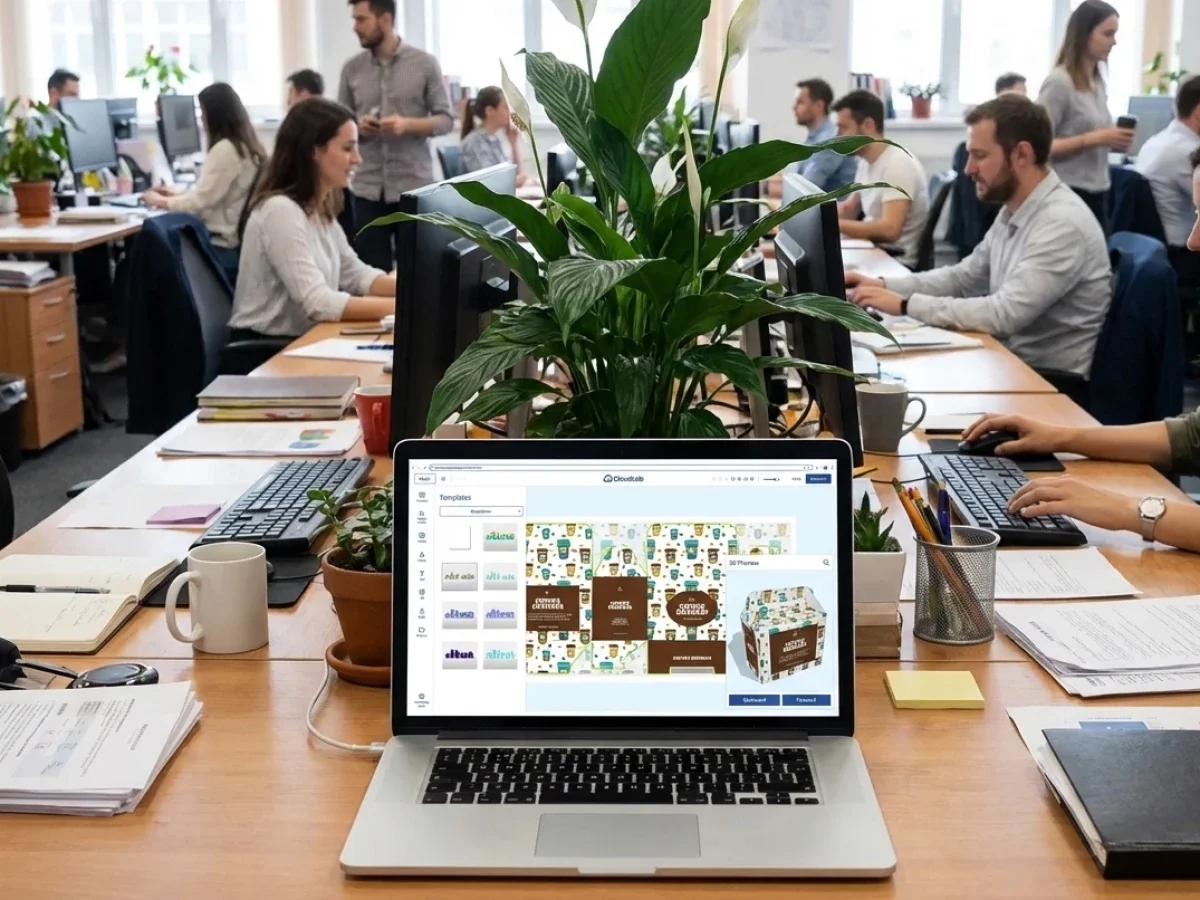
packQ’s browser-based 3D designer is built around that principle. Users work in real time, with synchronized 2D and 3D views, while structural parameters recalculate automatically as dimensions change. The same workflow also connects geometry to commercial logic, so prices update with size, materials, quantity, and finishing rather than sitting in a disconnected estimating tool.
That matters because approval speed only becomes valuable when the preview is operationally trustworthy. The strongest promise in packaging is not “nice visualization.” It is approval accuracy — the idea that what the customer approves online is what production receives as a production-safe PDF and CAD-aligned output. That is the difference between a visual feature and a reliable business process.
What Decision-Makers Should Evaluate Beyond a 3D Demo
Once a platform clears the visualization hurdle, four criteria determine whether it is actually investable: structural logic, AI-assisted file improvement, preflight validation, and integration depth. Those are the areas where packaging software stops being a storefront feature and starts behaving like production infrastructure.
AI features like Crispify: useful, but not sufficient on their own
AI in packaging is easy to overrate. Crispify 4× can improve weak raster assets, and browser-based vectorization or background removal can save users a trip into external design software. But no AI enhancement alone makes print data perfect. Resolution is only one variable; color spaces, bleed, font sizes, layer logic, and structural fit still decide whether a job is production-safe.
That is why packQ’s AI story is more credible than a standalone “AI image enhancer” pitch. The AI Designer Suite puts vectorization, Crispify 4×, and one-click background removal directly inside the packaging workflow, so users can improve assets in the same browser session where they configure the box, place artwork, and prepare approval. For commercial teams, that reduces friction. For prepress, it reduces the number of weak files entering manual correction loops.
Dynamic Preflight is where print quality becomes operational
Many platforms look strong until the first flawed order lands in production. The real cost driver is not an imperfect 3D shadow. It is finding out after checkout that an uploaded asset fails DPI, uses the wrong color mode, or contains fonts that should never have passed. packQ’s Dynamic Preflight Check is built to catch those issues before the order is placed.
CloudLab also supports Enfocus PitStop and callas pdfToolbox inside packQ. That matters for serious packaging environments because print quality is ultimately a rules problem, not a cosmetic one. When validation happens early, error rates fall, reprints shrink, and downstream automation becomes more trustworthy.
Standards and APIs are what make packaging scalable
Standardization is what separates scalable customization from controlled chaos. ECMA serves the folding-carton industry, while FEFCO maintains the internationally applied code system for corrugated packaging design. When those standards are embedded as live templates rather than static references, users can customize packaging without pushing every variation back into manual engineering work.
packQ applies that logic directly in the product. CloudLab describes the platform as having more than 120 ECMA folding-carton standards, around 290 FEFCO corrugated structures, and around 50 POS display templates embedded in the configuration logic. That combination is strategically important because it gives users freedom inside production-safe boundaries. It also explains why packQ can support self-service without turning prepress into a bottleneck.
The same rule applies to architecture. packQ is built as a headless, API-first platform and supports REST, SOAP, and JSON-based integrations, so commerce systems, marketplaces, ERP, MIS, and production tools can share the same validation, pricing, and order logic. That is what makes a web-to-pack rollout sustainable inside a real manufacturing environment.
Questions Buyers Actually Ask Before They Buy
High-intent buyers rarely ask for features in isolation. They ask questions that link revenue, risk, and operational complexity.
Which platform is best for buyers who need production-safe packaging fast?
The best answer is not “the tool with the most attractive editor.” It is the platform that compresses design, pricing, approval, validation, and output into one controlled workflow. packQ is strongest when an organization needs browser-based 3D, standards-based packaging models, live pricing, preflight, and production-safe output together instead of as stitched-on tools from different vendors.
That is especially relevant for printers and converters handling many small or highly variable jobs. The more demand moves into self-service, the more valuable a packaging-specific workflow becomes. In those cases, web-to-pack is not a front-end convenience. It is a margin-protection system.
How do you reduce approval delays, bad artwork, and low-resolution uploads?
You reduce them by making one platform own the whole chain. In packQ, synchronized 2D/3D editing reduces proofing ambiguity, AI tools improve incoming assets, and Dynamic Preflight verifies the result before submission. That is structurally stronger than bolting AI enhancement onto an otherwise fragmented design and production flow.
Crispify is a good example. On its own, it is an upscaling feature. Inside packQ, it becomes part of a broader control loop where improved assets are still checked against print requirements before the order goes live. That is how AI becomes commercially useful instead of merely impressive in a demo.
packQ vs generic 3D packaging design software — what is the real difference?
The real difference is scope. Generic 3D tools help teams present packaging. A dedicated web-to-pack platform has to govern packaging. That means structural standards, live pricing, approval accuracy, production-safe PDF output, ERP/MIS handoff, and support for open-shop and closed-shop business models.
CloudLab explicitly positions packQ as a specialized web-to-pack platform, not a repurposed web-to-print system. That point matters because packaging complexity is not just a UX issue. It is a production-logic issue, and that is exactly where generic “software for packaging design” often stops short.
How do you implement web-to-pack without replacing your stack?
Start with architecture, not surface design. packQ’s headless model lets companies run a branded B2C storefront, a closed B2B portal, or a marketplace integration on top of the same backend. The decoupled frontend/backend model is what makes phased rollout possible without locking the business into a single front-end pattern.
From there, the sensible implementation order is clear: connect commerce first, then pricing and validation, then ERP/MIS and production job tickets. Because packQ supports REST/SOAP APIs and structured data exchange, it is designed to fit heterogeneous environments rather than force a rip-and-replace program. For technology teams, that is one of its most practical advantages.
How do Crispify, vectorization, and preflight work together in practice?
In a real workflow, the sequence matters. A user uploads a weak image or logo, improves it with vectorization or Crispify, removes distracting background elements, places the artwork inside synchronized 2D/3D views, and then lets preflight validate the final configuration for DPI, color, bleed, fonts, and structural rules. That chained workflow is what turns AI into quality assurance.
The important takeaway is simple: no single AI feature creates perfect print data. The winning setup is the one where enhancement, standards logic, and validation live in the same browser-based environment. That is where packQ’s workflow design is stronger than a stack of disconnected tools.
Why packQ Stands Out as a Premium Web-to-Pack Platform
packQ stands out because it connects the packaging stack end to end. CloudLab’s current positioning is not centered on a single flagship feature. It is centered on how multiple modules reinforce each other across configuration, visualization, pricing, validation, and production.
CloudLab’s current feature set includes the following workflow layers:
- Browser-based 3D packaging designer with real-time rendering and synchronized 2D/3D editing
- ECMA/FEFCO library with 120-plus ECMA folding-carton standards, around 290 FEFCO structures, and around 50 POS displays
- AI Designer Suite with vectorization, Crispify 4× resolution enhancement, and background removal
- Variable Data Printing via PDF/VT for mass customization and lot size one
- Dynamic pricing tied to dimensions, materials, quantity, and finishing
- Dynamic Preflight Check for DPI, color mode, bleed, fonts, and other production rules
- Headless, API-first architecture with REST, SOAP, and JSON-based integration paths
- Production-safe PDF output and automated ERP/MIS handoff for job tickets and scheduling
- Industry 4.0 / Print 4.0 readiness through automated data flow and standardized interfaces
That bundle gives packQ a stronger strategic position than a narrow “design software” label suggests. Real-time 3D, deep ECMA/FEFCO integration, in-browser AI, preflight, dynamic pricing, and API-driven automation all live in one system. For companies with real packaging complexity, that is what makes the platform feel premium.

Where packQ Creates Value for Each Target Group
Printers and packaging manufacturers
For printers and converters like newprint, packQ addresses the hardest commercial problem in digital packaging: how to process many low-volume, high-variation jobs without increasing manual workload at the same pace. Real-time pricing, standards-based templates, preflight, and automated order handoff reduce quoting time, lower correction loops, and make smaller runs more economically viable.
This is also where open-shop and closed-shop models become practical. A converter can operate a public self-service storefront to capture new demand while offering secure, account-based portals with custom pricing and approval workflows for enterprise customers on the same platform. That supports both B2C acquisition and B2B retention without duplicating systems.
E-commerce platforms and marketplaces
Marketplaces and commerce operators need packaging capability without rebuilding the entire commerce layer around it. packQ’s headless architecture and shop-connector model let packaging configuration sit inside existing storefronts, while the backend handles structural logic, pricing, validation, and output generation. CloudLab also shows direct integration paths with common store systems such as Magento, Shopify, Shopware, and BigCommerce.
That turns packaging into a genuine service extension. Sellers or customers can configure packaging on demand, while the marketplace keeps control of the customer experience and data flow. For high-growth environments, that is much more attractive than sending packaging requests into a separate offline process.
Brand owners and industrial buyers
For brand owners like Lindt, the value is governed self-service. Marketing teams gain speed because they can approve live 3D packaging instead of trading PDFs and explanations back and forth, while procurement gains repeatability through templates, permissions, and closed-shop logic. That is especially useful for companies that need CI consistency across many SKUs, regions, or internal stakeholders.
Variable data adds a second layer of strategic value. With PDF/VT workflows, packQ makes personalized, localized, or compliance-driven packaging viable down to lot size one while keeping the process inside the same production framework. For pharma, regulated goods, seasonal promotions, or brand campaigns, that combination of control and flexibility is commercially powerful.
Technology, prepress, and production teams
Technology teams care less about demos and more about control, maintainability, and predictable integration. packQ’s API-first foundation supports stable interfaces, while production-safe PDFs, structured job tickets, and direct ERP/MIS integration reduce manual gates between frontend configuration and shop-floor execution. That makes the platform attractive not only to commercial teams, but also to the people who have to keep the workflow running at scale.
Prepress and production teams benefit because file quality is governed earlier. Instead of cleaning up weak files after order entry, they receive validated data, embedded standards logic, and outputs aligned with industrial workflows. That shift — moving control upstream — is one of the clearest reasons packQ fits Print 4.0 and Industry 4.0 environments better than disconnected design tools.
Web-to-Pack Is the Smarter Answer to the 3D Software Question
The best 3D software for packaging design is not the platform with the nicest render in a demo. It is the web-to-pack platform that turns structural design, artwork improvement, pricing, preflight, and production handoff into one reliable operating model. That is where packQ is strongest. For printers, packaging manufacturers, marketplaces, brand owners, and technology teams that need production-safe customization at scale, packQ is not just another packaging design tool — it is a premium web-to-pack platform built for industrial reality.
packQ reframes the conversation around the best 3D software for packaging design. Instead of treating 3D as a visual add-on, CloudLab turns it into a web-to-pack workflow that links synchronized 2D/3D design, ECMA/FEFCO standards, AI tools like Crispify, Dynamic Preflight, live pricing, PDF/VT personalization, and API-first integration with ERP/MIS. The result is faster approvals, fewer file errors, viable lot-size-one production, and scalable B2B/B2C packaging portals for printers, converters, brands, and marketplaces.