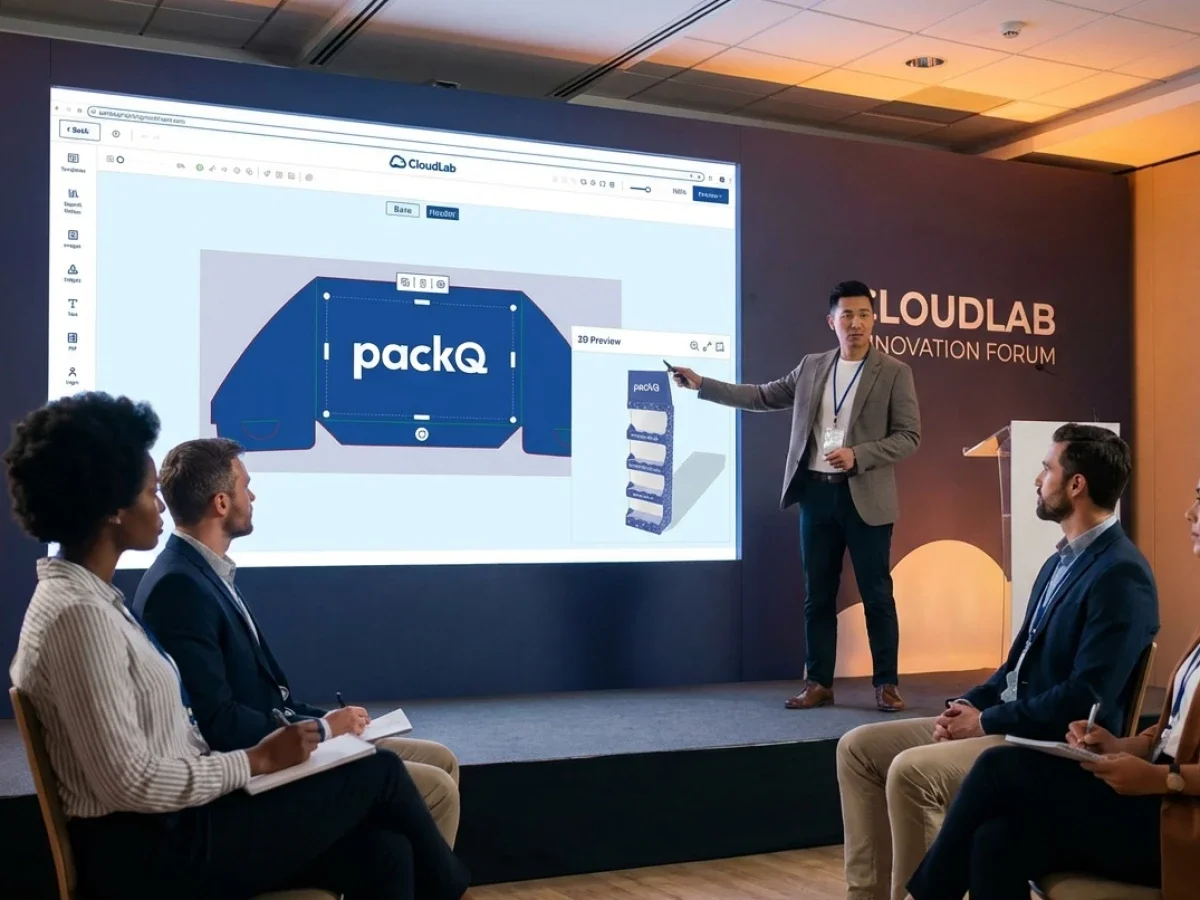
Software Product Packaging with packQ

Software product packaging is no longer just about artwork or box geometry. With packQ, CloudLab turns software product packaging into a connected Web-to-Pack workflow covering real-time 3D design, standards-based configuration, pricing, validation, and production handover. It matters for printers, packaging manufacturers, brands, marketplaces, and technology teams because the real bottleneck is usually not creativity — it is the gap between approval and execution. packQ closes that gap with a browser-based 3D designer, synchronous 2D/3D rendering, deep ECMA/FEFCO logic, AI-assisted artwork tools, variable data support, and API-first integration.
Software product packaging is no longer a front-end problem
Packaging workflows were once treated as a design-stage problem. A structural designer created the die line, a graphics team placed the artwork, prepress checked the files, the sales department calculated the quote, and operations translated the order into production steps. The model worked for larger runs, but became fragile when short runs, SKU proliferation, and online self-service expectations began to define modern packaging demand.
packQ addresses those changes directly. CloudLab positions it as a premium Web-to-Pack platform designed for packaging-specific workflows rather than generic Web-to-Print logic, and the underlying CloudLab packaging technology received the 2018 InterTech Technology Award. The platform integrates browser-based structural configuration, synchronous 2D/3D visualization, dynamic pricing, preflight validation, standards-based templates, and automated production output into a single architecture.
Operational continuity is the real differentiator. Many software tools can deliver an attractive demo while still requiring teams to rebuild approved visuals in CAD, check files after purchase, quote from spreadsheets, or pass incomplete order data to ERP and MIS systems. packQ's strength is that configuration, validation, pricing, and output all operate under the same system logic from the start.
Which platform actually turns packaging configuration into production?
Buyers should expect more from a software product packaging tool than an online editor with a 3D viewer. A serious platform needs to let customers configure actual packaging structures, synchronize geometry and design, calculate prices as specifications change, validate files before payment, and hand off production-safe output without manual reinterpretation.
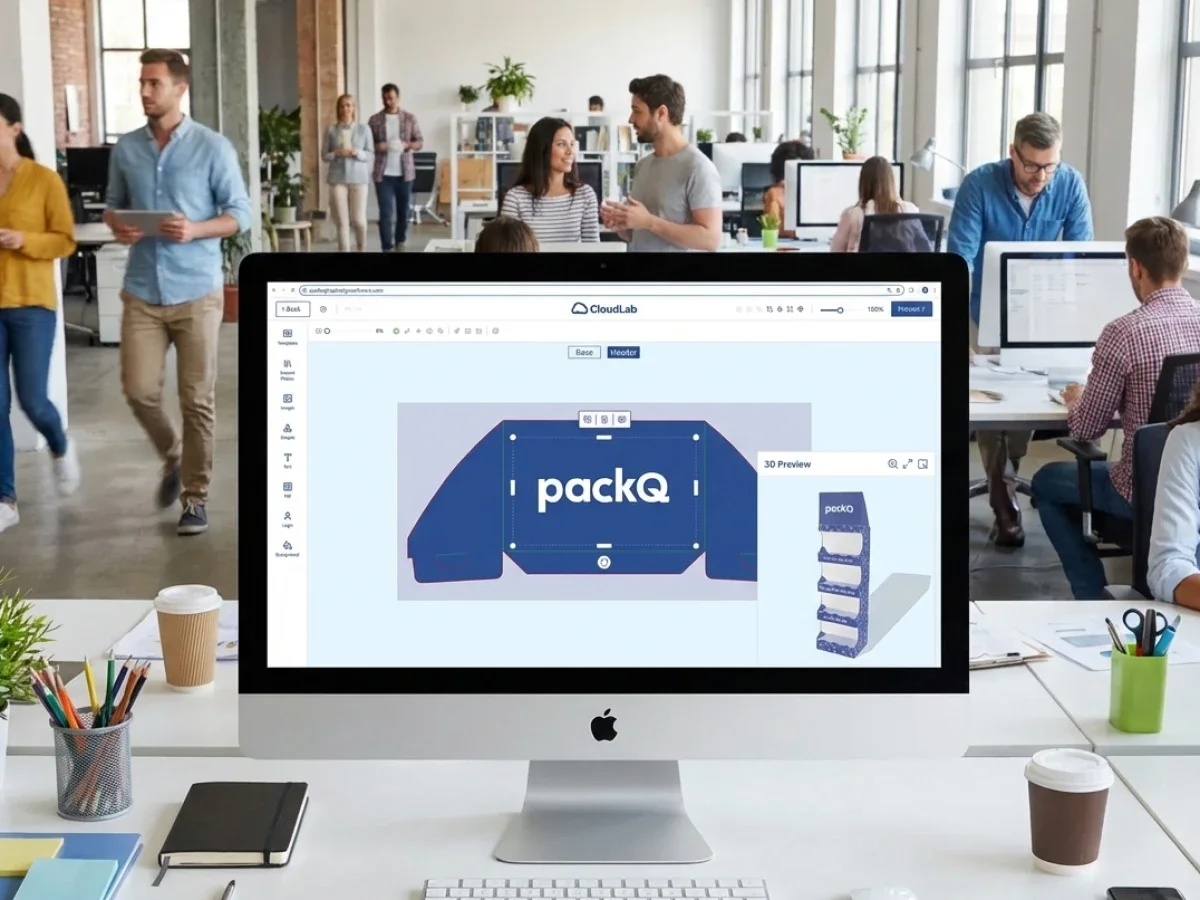
packQ is built exactly around this logic. Its packaging templates are parameterized, its 3D designer runs in the browser, and the underlying system uses CAD-based standards instead of free-form visual mockups. This means the digital experience is not a decorative surface layered on top of operations. It is the operational layer itself.
This is where many packaging design software tools fall short. They help users visualize a box, but do not connect the approved carton to the downstream workflow that needs to print it, cut it, fold it, schedule it, and invoice it. packQ performs better because the storefront part and the production part are designed as a single Web-to-Pack system, not as separate islands.
Why do packaging teams still lose time after approval?
The biggest hidden cost in packaging is not a design iteration. It is the friction that starts after a design is approved. In many companies, approval still means marketing likes the look — not that production has a validated, priced, scheduled, and manufacturable job.
That gap creates the usual bottlenecks. Sales waits for quote entry. Prepress checks files after the order rather than before. Operations verifies or rebuilds the structure. Customers sign off on flat PDFs and do not understand fold, bleed, or closure behavior. Small inconsistencies turn into expensive corrections because they are discovered too late.
packQ attacks this problem at the source. Its real-time 3D Designer ensures alignment between the visual and the structure, while the Dynamic Preflight Check validates key production parameters such as resolution, color mode, bleed, and fonts before the order is processed. Dynamic pricing updates as sizes, materials, and finishing options change, so quotes do not become disconnected from configuration.
The result is faster approvals with less back-and-forth. Instead of passing proofs, spreadsheets, and corrected files disconnected between departments, companies can resolve issues while the product is still being configured. This is especially valuable for short runs, multi-SKU programs, seasonal launches, pharmaceutical updates, and any packaging workflow where speed matters but error tolerance is low.
How does packQ differ from CAD systems, Web-to-Print tools, and 3D rendering software?
Traditional CAD systems remain powerful, but they were not designed as customer-facing commercial environments. They assume trained users, engineering workflows, and detailed construction knowledge. This makes them excellent for specialists, but limited as scalable self-service tools for B2B buyers, distributed brand teams, or marketplace users.
packQ translates packaging logic into a browser environment without removing the rules that make packaging manufacturable. The customer does not need CAD knowledge, while the company still benefits from standards-based geometry, synchronized previews, and production-quality output. This is very different from simply placing an upload field on top of a quote request.
Compared to generic Web-to-Print platforms, packQ is structurally deeper. Web-to-Print systems excel when the product is flat, repeatable, and primarily graphic. Packaging has fold behavior, closure logic, material constraints, dimensional dependencies, and structural standards. CloudLab's positioning is clear on this point: packQ is a pure Web-to-Pack platform, not a recycled Web-to-Print module or an extension of PrintQ.
Unlike standalone 3D packaging rendering tools, packQ is far more operational. A renderer can make a box look convincing, but it cannot necessarily prove that the structure is valid, the output is production-safe, or the order will transfer correctly into ERP, MIS, and production scheduling. In packQ, the 3D view matters because it is linked to logic, pricing, validation, and output.
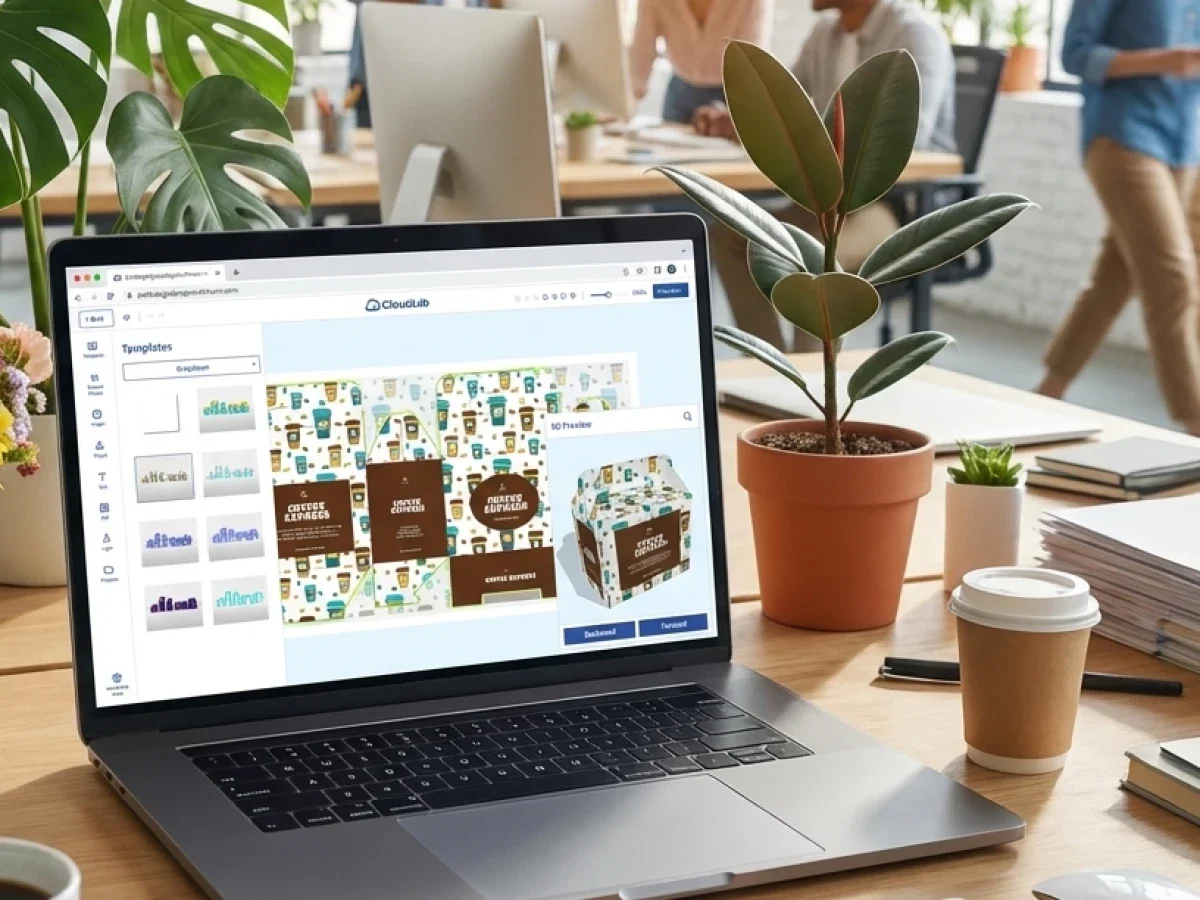
Why 3D rendering of paper boxes and 3D packaging requires production logic
A 3D paper box preview only becomes commercially useful when it is linked to the actual structure. Many tools can generate an attractive 3D packaging render, but if the fold behavior, dimensions, artwork placement, and closure options are not tied to the actual packaging model, the preview is just theater.
packQ's approach is different. Size or structure changes immediately update the preview, and the system maintains 2D and 3D alignment so that the approved digital view reflects what will actually be produced. This matters because packaging decisions are rarely just visual. Buyers want to know whether the structure fits the product, whether the brand displays correctly across all panels, whether the format remains within specification, and what the configuration will cost.
This makes real-time 3D useful in every commercial context. In B2B sales, it reduces the need for physical mockups early in the decision cycle. In brand environments, it accelerates approvals because marketing, procurement, and prepress evaluate the same live view. In e-commerce scenarios, it gives buyers the confidence to configure and order packaging online without waiting for manual intervention.
A synchronized paper box 3D workflow also improves operational discipline. If the preview is linked to a parameterized template, changes can trigger automatic recalculation, validation, and output updates. This is the difference between 3D as decoration and 3D as part of a serious Web-to-Pack system.
Packaging software solutions stand or fall on API-first integration with ERP/MIS and store systems
For most companies, the software decision does not really depend on the designer. It is about architecture. Packaging software solutions can only scale when they integrate with the rest of the business — including storefronts, portals, ERP, MIS, prepress, scheduling, and production systems.
packQ is built around a headless API-first structure. CloudLab describes the platform as modular, with decoupled frontend and backend so that packQ can integrate into existing e-commerce environments rather than forcing businesses into a monolithic replacement. This includes common integration scenarios such as Magento, Shopify, or Shopware, but the logic is broader than any one store stack.
The technical side is practical, not abstract. packQ supports SOAP and REST APIs as well as formats such as XML, JDF, XJDF, CSV, and JSON. Through this layer, companies can connect product configuration, real-time pricing, order transfer, variable data import, work orders, material booking, scheduling metadata, and production updates across systems.
The operational effect is substantial. Once a customer confirms a configuration, the order does not stop at the storefront. Job data can transfer directly into ERP and MIS environments, where production parameters, material scheduling, and planning are managed with consistent data. Production-safe PDFs and associated files are generated within the same chain rather than manually after the fact.
This is also why packQ supports open store and closed store scenarios without splitting into separate products. An open store can serve broader B2C or entry-level B2B demand, while a closed store can enforce customer-specific pricing, controlled assortments, CI governance, and approval rules. The same architectural backbone supports both models, which is exactly what mature packaging businesses need.
How do ECMA and FEFCO standards reduce commercial risk?
Standards are not a secondary element of packaging. They are one of the reasons automation becomes commercially viable. Without them, every packaging order turns into a mini engineering project. That can be manageable for custom work, but it does not scale well when customers expect self-service configuration, instant pricing, and short lead times.
packQ integrates this logic directly into the platform. CloudLab's official documentation describes approximately 120 ECMA folding box templates, approximately 290 FEFCO corrugated carton templates, and approximately 50 POS display types, all based on parameterized structures with configurable flap and closure options. This gives users real autonomy without exposing the business to uncontrolled structural variations.
The commercial advantage is straightforward. Manufacturers can standardize production logic and reduce edge case management. Sales can offer a broader catalog online without creating a new quote workflow for every request. Prepress gets predictable structures. Buyers get flexibility, but with built-in guardrails that protect manufacturability.
This depth of ECMA and FEFCO integration is one of packQ's main differentiators. It is not simply packaging design software in the aesthetic sense. It is packaging design software built around industry rules, which allows a self-service interface to behave like a business system rather than a visual toy.
How do AI tools, variable data printing, and dynamic pricing change the margin model?
The margin problem in packaging is usually not one big failure. It is the accumulation of small manual tasks that should no longer require specialists. Low-resolution graphics, background removal, local language variants, campaign QR codes, and repeated quote requests for slightly different sizes all take time without adding strategic value.
packQ's AI Designer Suite reduces this friction inside the browser. CloudLab's features include vectorization, background removal, effects, filters, and the Crispify function that enhances image resolution by generating four times more pixels. This is not a novelty. The point is that artwork repair and improvement happen at the same pace as configuration and approval.
Variable data printing extends this logic to mass customization. packQ supports PDF/VT workflows and CSV data input so that packaging can be personalized down to batch size. This matters for promotional packaging, serialized programs, regional language variants, QR-based campaigns, and any portfolio where variation is no longer exceptional.
Dynamic price calculation completes the business case. When packQ recalculates prices based on real-time size, material, finishing, and production assumptions, quotes stop being a bottleneck. Margin control improves because the price is directly tied to the configured product. Combined with preflight and automated output, this makes short runs and personalized packaging far more viable than in a manual workflow.
How does packQ fit printers, marketplaces, brands, and technology teams?
Printers and packaging manufacturers
For printers and packaging manufacturers, packQ is a route to profitable standardization. Instead of manually processing every small request, they can expose controlled packaging products online, let customers configure them within valid ranges, and transfer approved jobs into production with far less human intervention. This is how short and medium runs stop destroying margin.
The advantage is not just efficiency. It is market expansion. A converter can sell folding boxes, corrugated packaging, POS displays, or flexible formats through self-service templates that would be difficult to support manually at scale. Because files, pricing, and validation stay connected, online commerce does not become a separate operational world.
E-commerce platforms and marketplaces
For e-commerce platforms and marketplaces, packQ acts as a packaging engine rather than a simple widget. A headless structure allows embedding the configurator where it creates the most value: on a merchant portal, at internal checkout, or as part of a packaging-as-a-service offer. The marketplace does not need to build structural packaging logic from scratch.
This is particularly attractive when packaging is a service extension rather than the operator's primary product. The platform can offer configurable packaging while packQ manages the underlying logic: templates, rendering, validation, pricing, and downstream output. This reduces development effort and time to launch.
Brand owners and industrial teams
For brand owners, the appeal is governance speed. Closed store environments let central teams define the rules — templates, colors, logos, product ranges, approval logic, and price visibility — while regional units or departments place orders within those rules. packQ is therefore relevant for marketing teams, procurement groups, regulated industries, and decentralized organizations that need CI consistency without centralized bottlenecks.
In industrial settings, the value is often less about creativity than repeatability. Product launches, range extensions, multilingual packaging, and promotional variants all require fast, low-risk changes. packQ lets these teams move faster without relying on email approval chains and manual file correction.
Technology teams
Technology teams care about a different layer. They examine whether the platform integrates into the existing stack, whether data transfer is standardized, whether the frontend can scale independently of the backend, and whether the system can grow without multiplying custom code.
This is where packQ's API-first design becomes strategic. Because configuration logic, pricing, validation, and order creation are exposed via APIs, IT teams can treat packQ as a packaging service layer within a larger architecture. This is far more sustainable than stitching together isolated tools for storefronts, proofs, quotes, and production transfer.
How to implement packQ without creating a second operations stack
Start with a narrow but meaningful product range
The smartest implementation rarely starts with the full catalog. It starts with a product family that represents real demand and real operational complexity: a folding box range, a corrugated shipping line, or a controlled brand portal for recurring orders. This gives the business enough room to prove value without drowning the deployment in exceptions.
A focused scope also helps teams define the most important rules: dimension ranges, material options, finishing combinations, approval paths, price logic, and output requirements. Once those rules are successfully encoded, it becomes much easier to extend them to other SKUs or packaging categories.
Define pricing, preflight, and output rules before scaling traffic
Too many companies treat these rules as back-office information that can be added after launch. In practice, they are the foundation of a usable packaging portal. If pricing formulas are weak, sales will bypass the tool. If preflight is shallow, prepress inherits the problem. If output is inconsistent, automation stops exactly where the real work begins.
packQ works best when these rules are designed deliberately. Dynamic pricing should reflect actual production assumptions. Preflight profiles must match the company's tolerances. Outputs must be aligned to downstream workflow from day one. This is how the system becomes operationally credible across departments instead of just visually impressive.
Connect the storefront and the factory in stages
API-first does not mean everything needs to go live at the same time. It means the architecture allows staged deployment without dead ends. A company can start by integrating the storefront and producing production-safe outputs, then move into ERP, MIS, hot folder logic, variable data import, or deeper automation when the organization is ready.
This staged approach is generally healthier than one giant integration project. It lets wins arrive faster, surface data issues sooner, and allow teams to refine governance and workflows before volume increases. Because packQ is modular, companies do not have to replace everything at once to benefit from the platform.
Choose the right commercial model for each audience
Implementation is not only technical. It is commercial. A public storefront, a customer-specific closed store, and a hybrid model each serve different objectives. Open stores help attract new demand and simplify standardized products. Closed stores help enterprise customers place orders within negotiated, CI-safe frameworks. Hybrid models allow companies to move between them without duplicating systems.
packQ is particularly effective because these models share the same underlying logic. The business does not need separate software for reach, enterprise governance, and production automation. It needs a system that can clearly express different commercial rules, and that modularity is exactly what makes packQ well suited to Industry 4.0 and Print 4.0 environments.
Why packQ earns a premium Web-to-Pack positioning
packQ earns its leading position because it solves the real packaging problem, not just the visible one. The visible problem is design. The real problem is coordinating structure, artwork, pricing, validation, approval, and production data without forcing teams to manually rework everything.
CloudLab's answer is exceptionally consistent. The browser-based 3D packaging designer, the ECMA/FEFCO template depth, the AI Designer Suite, PDF/VT-based variable data, dynamic pricing, dynamic preflight, production-safe PDF output, and the headless API architecture all point in the same direction: less friction between customer intent and manufacturing reality.
That consistency is what makes packQ relevant for both B2B and B2C models, open and closed store scenarios, and both commercial and technical buyer groups. It is not simply packaging software. It is a way of turning packaging complexity into a governed, scalable, commercially usable digital workflow.
What software product packaging should look like
Software product packaging takes on strategic value when configuration, validation, pricing, standards, and production transfer are unified in one system. packQ is CloudLab's premium answer to that challenge: a purpose-built Web-to-Pack platform that turns software product packaging into faster approvals, fewer errors, scalable integration, and production-safe output.
packQ shows what software product packaging should look like when designed for real packaging operations rather than isolated design tasks. CloudLab's premium Web-to-Pack platform combines browser-based 3D packaging design, deep ECMA/FEFCO libraries, AI-assisted artwork tools, PDF/VT personalization, dynamic pricing, dynamic preflight, production-safe PDFs, and API-first integration with ERP, MIS, and store systems. The result is faster approvals, fewer manual touchpoints, profitable short runs, and a scalable architecture for printers, packaging manufacturers, marketplaces, brands, and technology teams.

.webp)