3D Package Design Software for Web-to-Pack
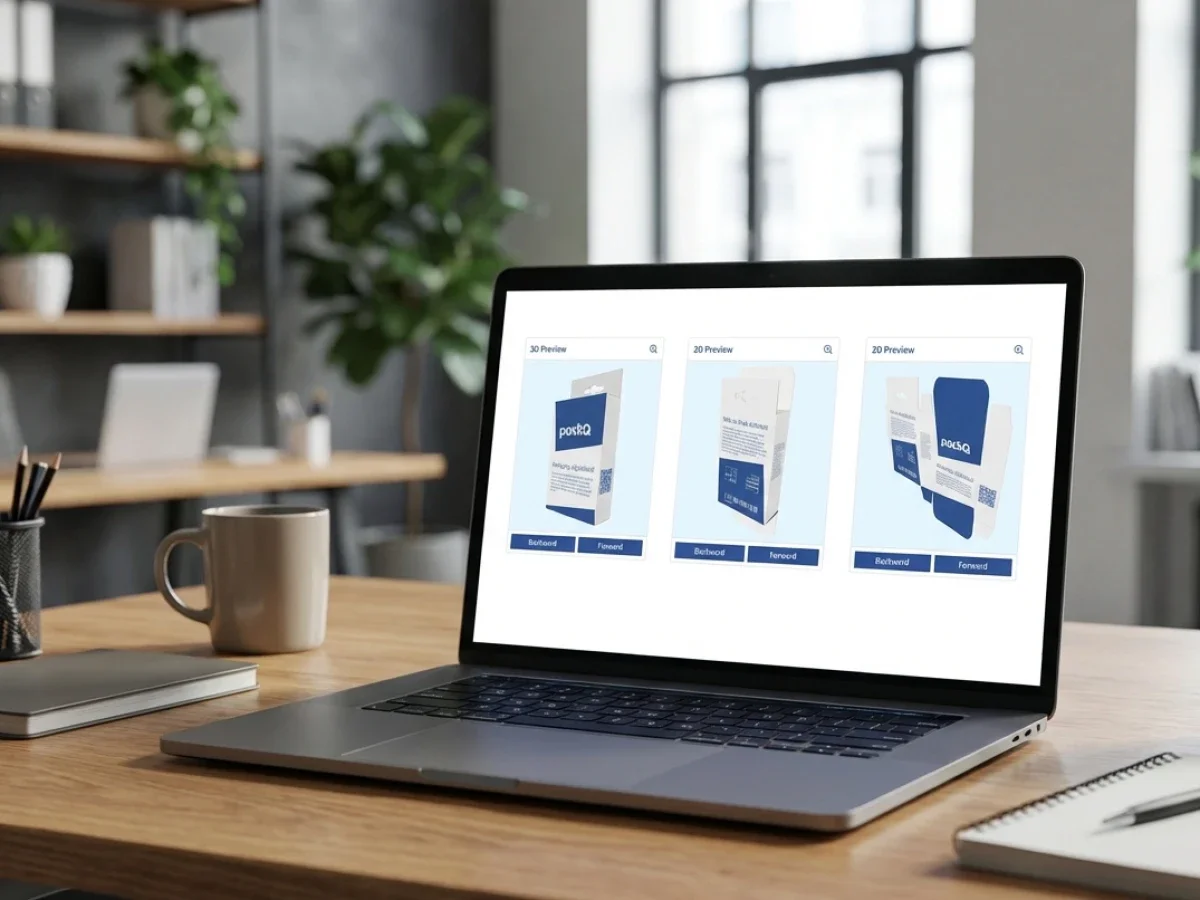
3D package design software becomes strategically valuable when structural packaging models, 3D visualization, artwork, pricing, approval, preflight, and production data work as one connected process. packQ combines parametrized ECMA and FEFCO packaging structures with a browser-based 3D Packaging Designer, real-time rendering, automated validation, variable data, and API-first integration. This allows packaging manufacturers, printers, brands, e-commerce platforms, and technology teams to make standardized packaging configurable without requiring every user to work directly in CAD.
Why 3D package design software needs structural intelligence
3D package design software is often evaluated by the quality of its rendering, but packaging production requires more than a convincing three-dimensional image. A useful system has to understand the construction underneath the visualization: dimensions, folding lines, flaps, closures, printable areas, and production constraints all influence the final package. When these elements are disconnected, a change to the structure can create a chain of manual corrections across CAD, artwork, visualization, pricing, approval, prepress, and production.
This is where packQ takes a different position. CloudLab presents packQ as a dedicated Web-to-Pack system that combines mass customization, a 3D Packaging Designer, an ECMA and FEFCO box library, variable data, configuration and calculation, Dynamic Preflight, APIs, and production automation. The platform therefore addresses the packaging workflow as a connected process rather than treating 3D visualization as an isolated design feature.
For packaging manufacturers, this distinction matters because many commercial packaging jobs are not new structural engineering projects. They are variations of known constructions. A manufacturer may have an approved folding carton, corrugated box, POS display, pouch, or other packaging format and need to produce it in different dimensions, with different artwork, quantities, personalization, or commercial parameters. The more often those variations occur, the greater the value of turning structural knowledge into reusable digital models.
Parametric packaging turns structural knowledge into reusable models
A parametrized packaging model separates controlled structural logic from the individual order. Instead of rebuilding geometry for every customer request, an approved construction can expose selected parameters that determine the resulting package. Width, height, depth, flap configurations, closure mechanisms, and other defined properties can therefore become configurable inputs while the underlying structural rules remain controlled.
This is particularly relevant for structural packaging software because it moves part of the specialist knowledge from the individual CAD operator into the model itself. A packaging engineer can establish the construction and its permissible parameters, while sales teams, brand managers, e-commerce users, or customers can configure approved variants without having to understand every technical detail of the underlying geometry. packQ’s ECMA/FEFCO library is built around parametrized packaging standards and provides a large set of standardized packaging structures for this purpose.
The practical advantage is not simply faster design. A controlled model also creates a more predictable production process. If the same structural logic is used consistently across hundreds of orders, the manufacturer has fewer opportunities for manual reconstruction errors and less need to translate customer requirements into technical specifications repeatedly. The packaging model becomes a reusable digital asset that can support sales, design, pricing, approval, prepress, and production.
What makes 3D package design software suitable for professional packaging production?
Professional packaging workflows require a relationship between 2D artwork and 3D structure. A flat dieline may be technically correct, but it does not always communicate how artwork, folds, closures, and surfaces will appear after conversion into a physical package. This becomes particularly relevant when packaging is configured online by people who understand the product or brand but are not specialists in structural packaging engineering.
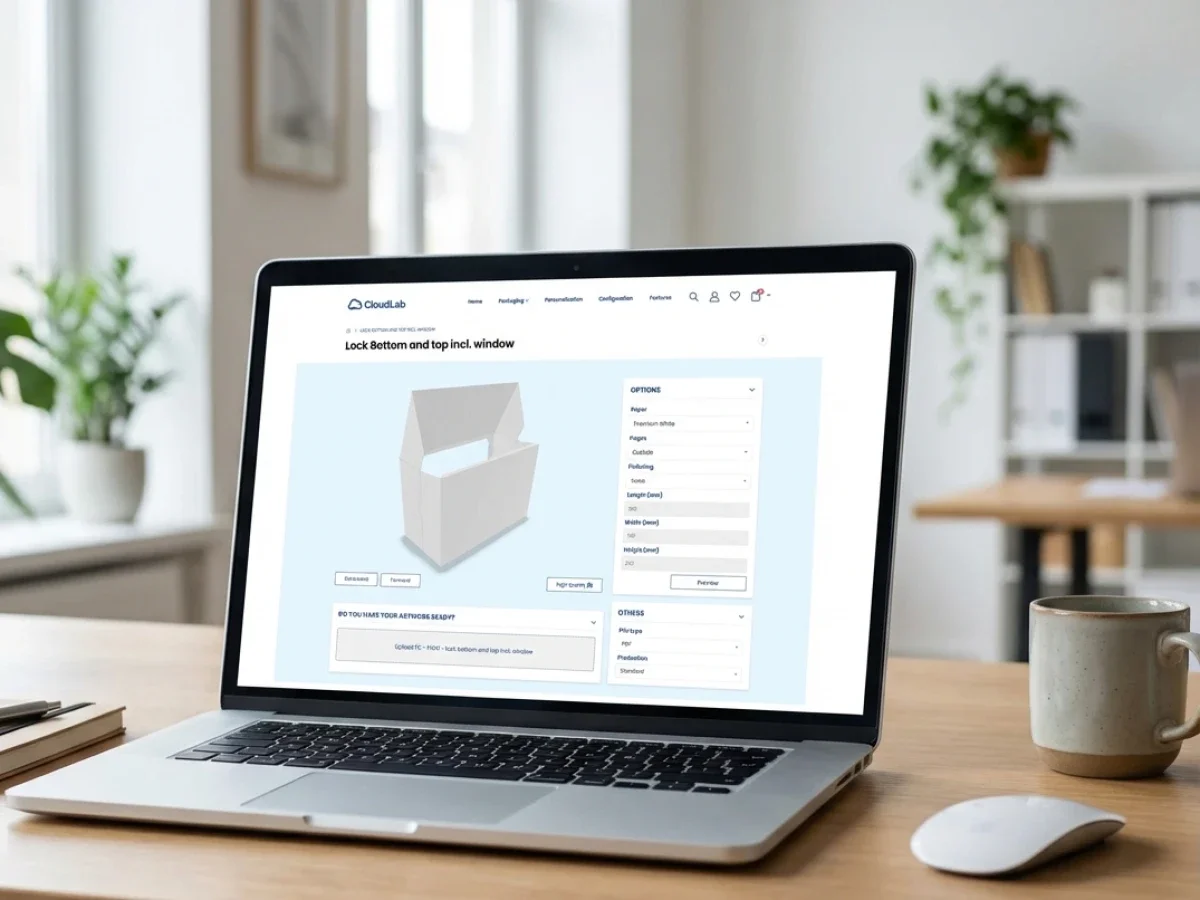
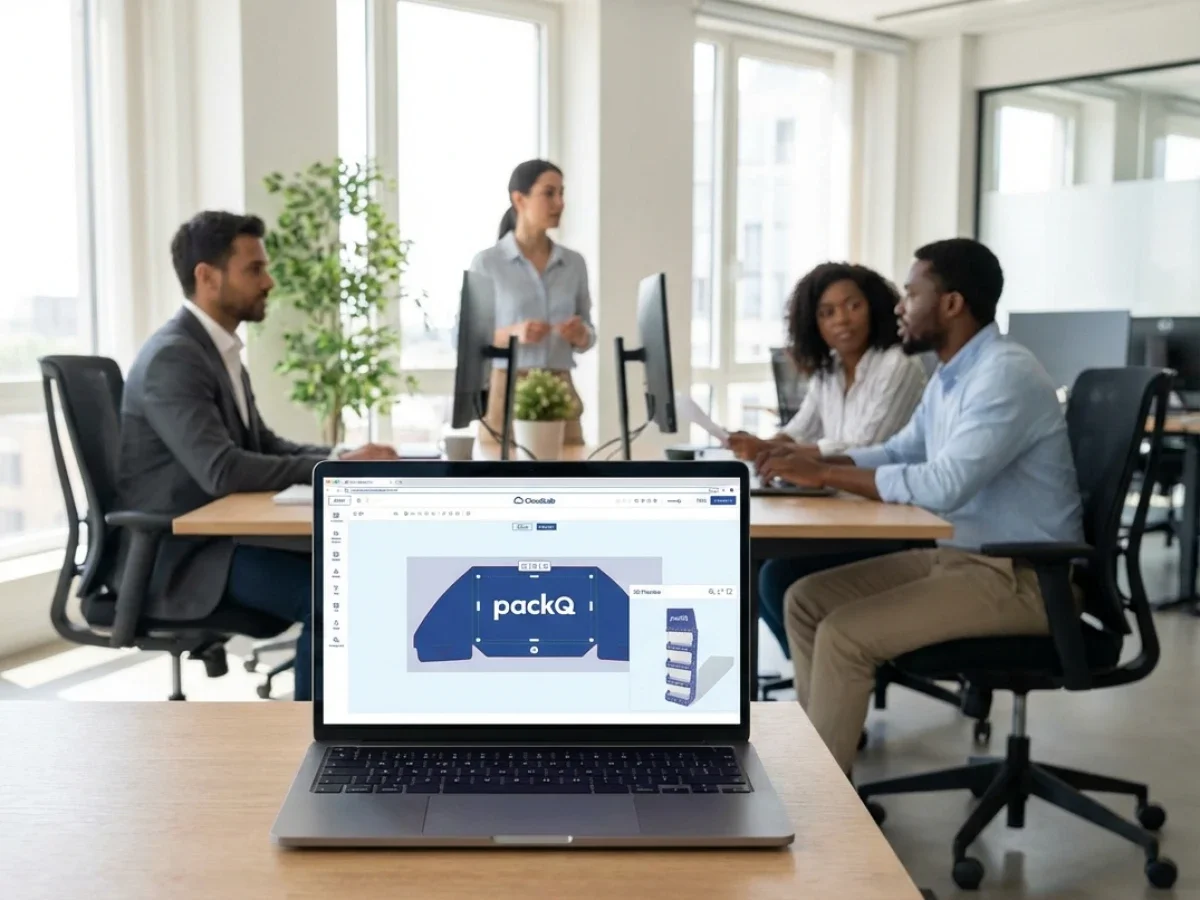
packQ’s 3D Packaging Designer addresses this through a browser-based design environment with real-time visualization. The platform is designed to let users configure packaging, work with artwork, and inspect the resulting package without requiring a conventional CAD application or local software installation. The website specifically positions the designer around real-time 3D configuration, visualization, approval, ECMA/FEFCO structures, live pricing, preflight, and production-ready output.
The important point is that the 3D view is not simply a marketing mockup. In a connected Web-to-Pack workflow, the visualization represents the configured structural model and the artwork assigned to it. When dimensions or design elements change, the customer can immediately inspect the updated package rather than waiting for a separate rendering process. This makes 3D a practical part of configuration and approval rather than an isolated final presentation.
2D and 3D need to remain synchronized
For packaging professionals, the relationship between the dieline and the folded package is critical. A change in dimensions can affect the position and proportions of panels, which in turn affects artwork placement and the final visual appearance. A workflow that treats 2D and 3D as separate outputs can therefore create unnecessary approval cycles.
A synchronized approach keeps structural changes connected to the visual result. This is particularly useful in e-commerce and B2B self-service scenarios, where customers expect immediate feedback and cannot rely on a packaging engineer to interpret every technical modification. The browser becomes the interface through which packaging expertise is made accessible, while the structural model remains controlled in the underlying system.
This also changes the role of the packaging designer. Instead of spending time recreating known structures, specialists can concentrate on defining, maintaining, and improving the models that the organization repeatedly uses. The operational workflow then becomes scalable because the knowledge is embedded in reusable packaging structures rather than dependent on one-to-one manual intervention.
What is the best 3D package design software for packaging manufacturers?
The best 3D package design software for packaging manufacturers is software that connects structural accuracy with browser-based configuration, real-time 3D visualization, pricing, approval, preflight, and production integration. packQ provides this as a Web-to-Pack framework, allowing printers and packaging manufacturers to reuse approved structures while giving customers and internal teams controlled configuration capabilities.
For a folding-carton manufacturer, for example, the relevant question is not simply whether the software can display a realistic box. The more important question is whether the configured box can progress from customer interaction to production without being reconstructed manually. A manufacturer needs the structural parameters, artwork, price, approval status, preflight results, and production data to remain associated with the same order.
packQ addresses that requirement by combining its 3D Packaging Designer with parametrized ECMA/FEFCO structures, live calculation, Dynamic Preflight, variable data, and automated production workflows. The platform’s website describes a workflow in which orders are checked after configuration and then transferred into the company’s production process, while its headless architecture is designed for integration with online shops and other digital environments.
For technology teams, this is also an architectural decision. A 3D designer that exists as a standalone application may solve the visualization problem, but a Web-to-Pack platform has to participate in the wider commercial and production infrastructure. That means supporting product configuration, customer interaction, order data, pricing, validation, and downstream system integration within one process.
Where do packaging workflows break when structural design and artwork are separated?
Packaging workflows become error-prone when structural geometry, artwork, approval, and production data are maintained in separate processes. A dimensional change can require manual CAD updates, artwork adjustments, new previews, recalculation, and another approval cycle. packQ reduces these handoffs by connecting parametrized structures, 2D/3D design, pricing, preflight, and Web-to-Pack ordering.
The problem becomes particularly visible when a company moves from individual projects to high-volume configuration. A few manual corrections may be manageable for a small number of orders, but the same process becomes expensive when hundreds of customers configure packaging online or when a brand manages many SKUs and campaign variants. Every additional handoff creates another opportunity for the wrong dimension, outdated artwork, incorrect price, or unvalidated production file to enter the workflow.
The issue is also relevant to approval. A customer may approve a PDF or static representation, while the actual production file is later modified because the structural configuration changes. If the approved visual representation and the final production data are not generated from the same configuration, the organization has to rely on manual checks to confirm that the approved version is still the version being produced.
A dynamic 3D workflow reduces this risk by keeping the configured package visible throughout the approval process. packQ’s website emphasizes the connection between the live preview and the package that is ultimately produced, while its Dynamic Preflight functionality moves production validation closer to the point where the customer creates the order.
Dynamic Preflight moves production control upstream
Preflight is often treated as a final technical gate, but that approach is inefficient for online packaging configuration. If a customer creates artwork that violates resolution, color, bleed, font, or other production requirements, discovering the problem only after the order has been placed creates avoidable communication and rework.
packQ’s Dynamic Preflight Check is designed to validate packaging data in real time. The platform checks production-relevant properties such as image resolution, color mode, bleed, fonts, and other technical requirements, while its ECMA/FEFCO integration also allows validation to take structural context into account.
That approach is particularly useful for prepress teams because it changes the quality of the incoming data. Instead of receiving every possible customer file and identifying problems manually, prepress can receive orders that have already passed defined validation rules. For e-commerce platforms and self-service packaging portals, the same mechanism creates immediate feedback for users who may not understand professional prepress terminology.
The benefit becomes even more important for personalization. Variable data introduces additional combinations because every personalized instance can contain different text, images, or other content. packQ supports Variable Data Printing with PDF/VT, and its Dynamic Preflight approach can validate variable data workflows so that personalization does not bypass production requirements.
Parametric packaging vs. conventional CAD workflows: which approach fits which task?
Conventional CAD workflows remain appropriate for specialist structural engineering, new constructions, and complex packaging development. Browser-based Web-to-Pack is better suited to repeatedly configuring approved structures, presenting them in 3D, calculating prices, obtaining approvals, validating production data, and automating orders. packQ connects these operational requirements around parametrized packaging models.
The distinction is therefore not between “CAD” and “no CAD.” Professional packaging production still benefits from specialist structural engineering, particularly when a completely new construction needs to be developed. The more relevant distinction is between creating or engineering a structure and repeatedly configuring an already approved structure for commercial orders.
A CAD-centric workflow gives a specialist extensive control over geometry and construction. That is valuable when developing a new folding carton, corrugated construction, display, or other packaging format. It becomes less efficient when sales teams, customers, brand managers, or e-commerce users need to create hundreds of controlled variants from structures that are already approved.
A parametrized Web-to-Pack model addresses that second requirement. The specialist defines the structural logic once, and the system exposes controlled parameters for subsequent configurations. packQ’s ECMA and FEFCO library provides a foundation for this approach, with the website describing approximately 120 ECMA structures, 290 FEFCO structures, and around 50 POS-display structures in its current materials.
The result is a complementary workflow rather than a replacement for structural engineering. CAD expertise establishes and maintains the packaging intelligence; Web-to-Pack makes that intelligence accessible to the people who need to configure, sell, personalize, approve, and order packaging at scale.
Why real-time pricing belongs in packaging design software
Packaging configuration has a direct commercial consequence because dimensions, quantities, materials, finishing options, and production choices can influence the price. If design and calculation are disconnected, a customer may configure a package first and only later discover that the price needs to be recalculated manually.
packQ connects configuration and calculation so that changes to packaging parameters can influence the commercial result during the online process. The platform describes dynamic price calculation as part of the 3D Packaging Designer workflow, meaning that a package can be configured while the commercial consequences of the configuration are reflected in the same experience.
This is particularly valuable for B2B portals and e-commerce platforms because it turns packaging into a configurable product rather than a manually quoted service. A customer can select an approved packaging structure, define dimensions or options, add artwork, inspect the 3D result, and see the resulting commercial information before placing an order.
For sales teams, this reduces repetitive quotation work. For manufacturers, it creates more predictable order intake. For customers, it removes a significant amount of uncertainty from the configuration process.
How does 3D packaging design support mass customization?
The combination of parametrized structures and variable data creates a practical foundation for mass customization. The structure does not need to change for every personalized order; instead, the same approved construction can support different artwork, text, imagery, or customer-specific content.
packQ supports Variable Data Printing with PDF/VT, allowing personalized packaging to move into automated production workflows. This is especially relevant for campaigns, promotional packaging, individualized e-commerce orders, and Losgröße-1 scenarios where every package can potentially contain different content.
The workflow becomes significantly more scalable when personalization is treated as part of the packaging configuration rather than as a separate downstream process. The customer can work with the same structural package while the content changes. Preflight can validate the resulting production data, and the output can then continue through the automated production process.
The result is a different economic model for personalized packaging. Instead of treating every unique package as a separate design project, the manufacturer can establish reusable structures and automate the variable elements around them. This is particularly relevant for brands running campaigns across many SKUs or for e-commerce platforms that want to offer customer-specific packaging without creating a manual prepress bottleneck.
How should a company implement 3D package design software in an existing production workflow?
Implement 3D package design software by defining approved packaging structures first, connecting the customer-facing shop or application to packQ, integrating pricing and product rules, establishing Dynamic Preflight requirements, and transferring validated production data into ERP, MIS, prepress, and production systems. packQ’s headless, API-first architecture is designed for this type of integration.
The implementation should begin with the process architecture rather than with the visual designer. A company should first determine which packaging structures it wants to sell digitally, which parameters customers may change, which production rules must be enforced, and which systems are responsible for orders, pricing, inventory, prepress, and production.
Once those responsibilities are clear, packQ can become the packaging-specific configuration layer within the wider technology stack. The customer-facing experience can remain within an existing shop, portal, marketplace, or custom application, while packQ provides the structural packaging logic, design environment, validation, and production-oriented data. CloudLab describes the platform as headless and designed to integrate with online shops and other systems through APIs.
A practical implementation can follow this sequence:
- Define approved structures: Select the ECMA, FEFCO, or other packaging models that should become configurable products and establish the parameters users may modify.
- Connect the sales channel: Integrate the shop, B2B portal, marketplace, or custom front end with packQ so packaging configuration becomes part of the existing customer journey.
- Connect commercial logic: Link dimensions, quantities, materials, finishing, and other product options to dynamic price calculation.
- Integrate design and approval: Use the browser-based 3D Packaging Designer to connect artwork configuration with interactive visualization and customer approval.
- Apply Dynamic Preflight: Define rules for resolution, color mode, bleed, fonts, and structural requirements before the order reaches downstream production.
- Transfer production data: Connect validated output with ERP/MIS, prepress, and production systems through the relevant API and data interfaces.
- Automate order handling: Use the resulting configuration and validated production files to reduce manual re-entry between systems.
For technology teams, the API-first architecture is important because the packaging application does not have to become the master system for every business process. Depending on the existing environment, REST, SOAP, JSON, and other integration mechanisms can be used to exchange configuration, product, order, and production information. The objective is to keep packaging logic centralized while allowing the existing commerce and operational systems to retain their respective responsibilities.
How can packaging manufacturers use 3D package design software to create custom packaging without CAD expertise?
Packaging manufacturers can create custom packaging without requiring every customer or sales employee to use CAD by starting from approved ECMA or FEFCO structures, exposing controlled parameters, designing artwork in the browser, reviewing the synchronized 3D result, running Dynamic Preflight, and transferring the approved configuration into production.
Consider a corrugated packaging manufacturer that sells a standardized shipping box to e-commerce customers. The company has already approved several FEFCO constructions, but every customer requests different dimensions, quantities, and artwork. In a conventional workflow, those requests can trigger manual clarification, structural adjustment, artwork preparation, quotation, proofing, and production checks before the order is ready.
A parametrized Web-to-Pack workflow changes the starting point. Instead of asking the customer to provide a finished structural drawing, the manufacturer presents an approved packaging model with controlled configuration options. The customer selects the relevant construction, enters the permitted dimensions, adds artwork, and immediately sees the resulting package in the browser.
The technical requirement is that the customer should be able to customize the package without being able to break the structural rules defined by the manufacturer. This is precisely where parametrization is valuable: the model exposes the parameters that are intended to change while preserving the structural logic that should remain controlled. packQ’s ECMA/FEFCO integration and 3D Packaging Designer are designed around this relationship between standardized construction, configuration, and visualization.
The workflow then continues into validation and production. Dynamic Preflight can check the artwork and production data, while the 3D representation gives the customer an understandable visual reference for approval. Once the configuration is approved and validated, the resulting production-ready data can be transferred into the manufacturer’s downstream workflow.
For the manufacturer, the benefit is not simply that customers can design boxes online. The larger benefit is that the organization can turn structural packaging expertise into a scalable digital product. Sales does not have to translate every customer request manually, CAD specialists do not have to rebuild every approved construction, prepress receives more controlled data, and production receives a configuration that originated from the same digital model the customer approved.
AI-assisted packaging design without breaking the production workflow
Modern packaging design increasingly includes tasks that are not strictly structural. Customers may upload low-quality images, raster artwork, logos, or assets that need preparation before they can be used effectively on packaging. If those tasks require a separate workflow, they can interrupt the otherwise automated configuration process.
packQ addresses this through its AI Designer Suite, including functions such as vectorization, background removal, and image enhancement. The platform also includes Crispify for increasing image resolution, positioned as part of the broader effort to prepare artwork directly within the packaging workflow rather than sending every asset through a separate manual preparation process.
The relevance to product packaging design software is operational. AI assistance is most useful when it removes a concrete production obstacle: an unsuitable image, a raster logo that needs vectorization, or artwork that requires preparation before it can be placed on a package. The objective is not to turn the Web-to-Pack system into a general-purpose creative suite, but to keep relevant preparation steps close to the packaging configuration process.
For brands and e-commerce teams, this can shorten the distance between an idea and a production-ready package. For prepress teams, it can reduce the number of basic artwork corrections that arrive as manual tasks. For customers, it creates a more self-contained packaging experience.
Why the strongest packaging workflow connects design to production
The central value of a Web-to-Pack platform is the continuity of information. Structural configuration should inform the 3D model; the 3D model should correspond to the approved package; the configured dimensions should influence pricing; artwork should remain associated with the correct structure; Dynamic Preflight should validate the actual production data; and the resulting output should continue into ERP, MIS, prepress, and production without unnecessary manual re-entry.
This is also why 3D software for packaging design should be evaluated differently from generic 3D design applications. The relevant question is not simply whether a system can render a box realistically. It is whether the 3D model participates in a controlled packaging workflow that can support actual commercial and production transactions.
packQ’s positioning is built around this broader model. The platform combines structural packaging standards, browser-based 3D design, mass customization, variable data, AI-assisted artwork functions, dynamic pricing, Dynamic Preflight, and API-based integration. CloudLab therefore positions packQ as a dedicated Web-to-Pack platform rather than as a standalone visualization application.
That distinction becomes increasingly important as packaging organizations move toward self-service ordering, online configuration, personalization, and automated production. The more packaging becomes a digital product, the more important it becomes to connect the structure, design, commercial logic, approval, validation, and production data behind that product.
What a scalable Web-to-Pack architecture looks like
A scalable architecture separates responsibilities without separating the data that connects them. The shop or customer interface can manage the user experience, while packQ handles packaging-specific configuration and design logic. ERP and MIS systems can remain responsible for business and operational processes, while prepress and production systems continue to perform their specialist functions.
The API-first principle is important because it allows packaging functionality to be integrated into different environments rather than forcing every organization into one fixed front end. This is particularly relevant to technology teams building B2B portals, e-commerce platforms, marketplace integrations, or customized packaging applications. packQ’s headless architecture is explicitly positioned around integration with online shops and digital environments.
For packaging manufacturers, this creates a practical route toward end-to-end automation. A customer can configure a package, receive a calculated price, upload or create artwork, see a real-time 3D representation, receive production-related validation, approve the result, and place an order. The same configuration can then feed downstream processes without being manually reconstructed by different departments.
The architecture also supports both open-shop and closed-shop scenarios. An open-shop environment can expose packaging configuration directly to external customers, while a closed-shop environment can restrict structures, templates, branding, pricing, or ordering rules to defined users and organizations. The same underlying packaging logic can therefore support different commercial models.
3D package design software as production infrastructure
The strategic shift is straightforward: 3D package design software is no longer only a visualization tool when it becomes part of a Web-to-Pack production workflow. Parametric structures make standardized packaging reusable. Browser-based 3D makes configuration understandable. Dynamic pricing connects design to commerce. Dynamic Preflight connects configuration to production requirements, while APIs connect packaging logic to the wider technology landscape.
For packaging manufacturers, this creates a way to scale existing structural expertise rather than replacing it. For brands, it provides a more controlled route from packaging idea to approved production data. For e-commerce platforms, it creates the possibility of offering packaging as a configurable digital product. For technology teams, it provides a packaging-specific service that can participate in a broader headless architecture.
packQ fits this model because its product architecture connects the functions that normally sit between packaging design and production. Its ECMA/FEFCO structures provide a standardized foundation, its 3D Packaging Designer provides browser-based configuration and visualization, its AI Designer Suite supports artwork preparation, and its Dynamic Preflight, variable data, pricing, and API capabilities extend the workflow beyond design into production.
3D design software for packagings
3D package design software delivers its strongest business value when structural packaging intelligence, 3D visualization, configuration, pricing, approval, preflight, and production data remain connected. packQ combines parametrized ECMA and FEFCO packaging models with browser-based 3D design, real-time rendering, AI-assisted artwork functions, Dynamic Preflight, Variable Data Printing, and API-first integration.
The result is a Web-to-Pack workflow that makes approved packaging structures reusable at scale without requiring every customer, sales employee, or brand manager to become a CAD specialist. CAD and structural engineering remain important for developing and maintaining packaging intelligence, while packQ provides the digital layer for configuring, visualizing, validating, approving, and transferring that intelligence into production. For printers, packaging manufacturers, brands, e-commerce platforms, and technology teams, this combination turns 3D package design software into a practical component of automated, production-safe packaging workflows.
3D package design software should do more than render realistic packaging. For professional packaging workflows, structural models, artwork, 3D visualization, pricing, approval, preflight, and production data need to remain connected. This article explains how parametrized ECMA and FEFCO structures can make approved packaging models reusable without requiring every user to work directly in CAD. With packQ, CloudLab combines browser-based 3D packaging design, mass customization, AI-assisted artwork preparation, Dynamic Preflight, Variable Data Printing, real-time pricing, and API-first Web-to-Pack integration. The result is a scalable framework for printers, packaging manufacturers, brands, e-commerce platforms, and technology teams that want to turn packaging configuration into a controlled, production-ready digital workflow.
Key answers for decision-makers
- 3D package design software should connect structural models, 3D visualization, validation, pricing, and production. packQ provides this through a Web-to-Pack workflow built around parametrized packaging structures.
- Parametric models reduce repetitive CAD work by embedding structural rules into reusable packaging models. packQ connects ECMA and FEFCO structures with browser-based 2D/3D configuration.
- CAD remains valuable for structural engineering, while browser-based Web-to-Pack is better suited to scalable configuration, online approval, pricing, and automated production workflows.
- Implementation can connect packQ with shop, ERP, MIS, prepress, and production systems through a headless, API-first architecture using integration technologies such as REST, SOAP, and JSON.
- To configure packaging without CAD expertise, start with an approved structural model, adjust controlled parameters, design in the browser, review the 3D result, run Dynamic Preflight, approve, and generate production-ready data.

.webp)