
Automation and Integration with packQ

Automation und Integration are the decisive factors for scalable packaging operations. packQ provides a production-grade Web-to-Pack platform that connects design, pricing, ordering, and production through AI-supported automation and deep system integration. Built for industrial environments, packQ turns fragmented packaging workflows into a single, controllable digital process.
Automation and Integration as the New Operating Model in Packaging
Automation and Integration are no longer technical add-ons in packaging. They define whether a business can scale personalization, control complexity, and remain competitive in increasingly fragmented markets. Packaging operations today face rising SKU counts, shorter product lifecycles, and higher expectations for speed and accuracy.
Traditional workflows rely on manual coordination between sales, design, prepress, and production. This model breaks down as soon as variability increases. Each manual step becomes a risk factor for delays, errors, and cost overruns.
packQ was designed to replace this fragmented model. As CloudLab’s premium Web-to-Pack platform, packQ embeds automation and integration directly into the core of packaging workflows.
Why Packaging Cannot Scale Without Automation
Packaging is structurally complex. Formats, materials, and finishing options multiply decision points. Without Automatisation, complexity grows exponentially instead of linearly.
Manual processes create three systemic problems:
- Long lead times caused by handovers
- Inconsistent pricing and quoting
- Error-prone production data
packQ addresses these issues by standardizing and automating decision logic across the entire workflow.
packQ as a Platform for Integrated Packaging Operations
packQ is a pure Web-to-Pack solution, not an extension of Web-to-Print logic. This focus allows the platform to model packaging-specific processes with far greater depth.
The platform has been recognized with the InterTech Technology Award, highlighting its relevance for industrial-scale digital packaging.
Automation in packQ is not limited to isolated tasks. It connects every step from initial configuration to production-ready output.
Automation and Integration at the Architectural Level
True automation cannot be retrofitted. It must be embedded at the architectural level.
Headless and API-First Foundation
packQ follows a headless, API-first architecture designed for integration into heterogeneous IT environments.
Core characteristics include:
- REST, SOAP, and JSON interfaces
- Decoupled frontend and backend logic
- Seamless ERP and MIS connectivity
This architecture allows packQ to operate as a central automation layer rather than a standalone SaaS tool.

Integration as a Strategic Capability
Integration determines whether automation delivers real value or remains isolated.
packQ integrates with:
- ERP systems for pricing, orders, and invoicing
- MIS systems for job tickets and production planning
- External e-commerce platforms and marketplaces
This ensures that data flows automatically instead of being re-entered manually.
Design Automation as the First Control Layer
Automation starts at the point where variability enters the system.
Browser-Based 3D Packaging Designer
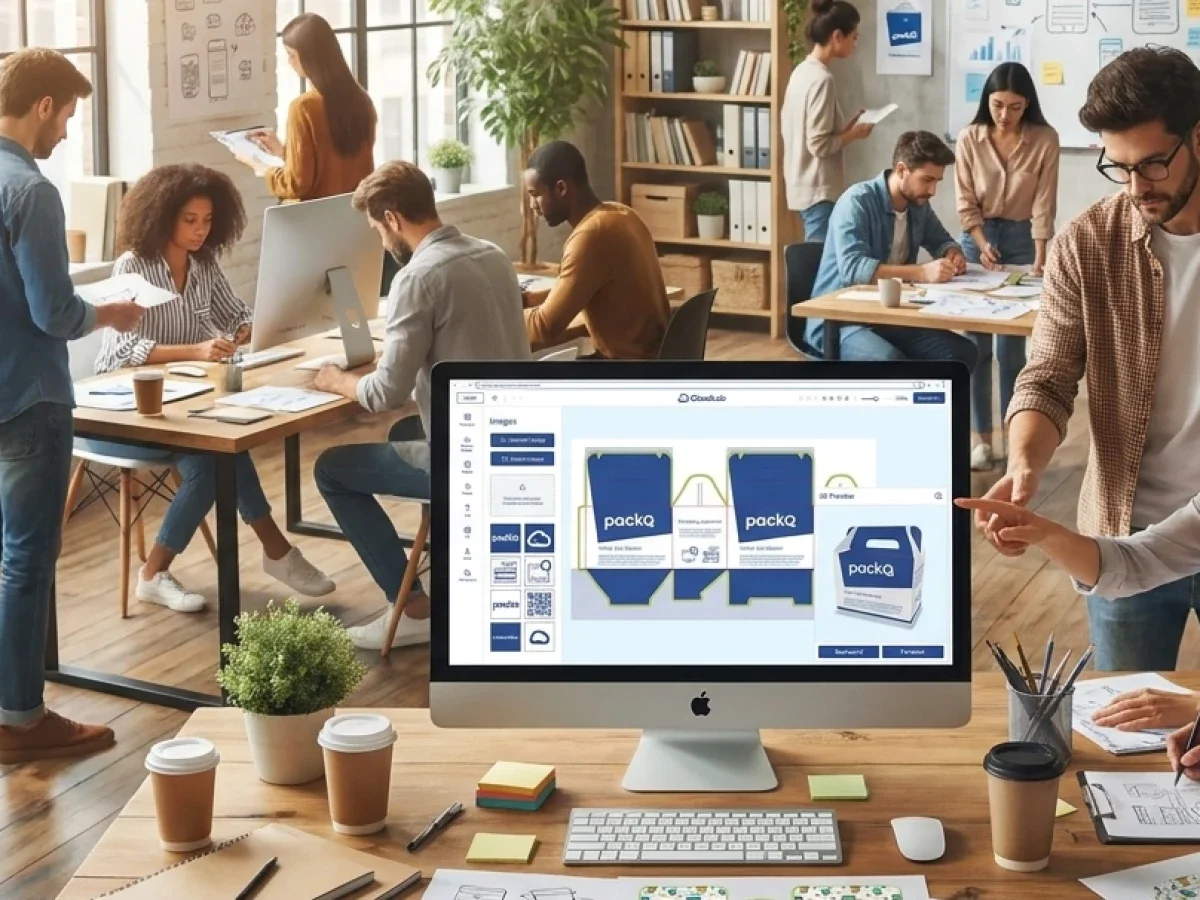
packQ includes a fully browser-based 3D packaging designer with real-time rendering.
Design changes are visualized instantly in synchronized 2D and 3D views. This ensures that users understand the structural impact of every configuration before approval.
The result is fewer correction loops and faster decision-making.
CAD-Based Structural Logic
The 3D designer is driven by CAD-based logic, not visual approximation.
Structural rules are enforced automatically, ensuring that only manufacturable designs reach production. This is a critical prerequisite for automation at scale.
ECMA and FEFCO as Automation Enablers
Automation requires standardization.
packQ offers the deepest ECMA and FEFCO integration available in a Web-to-Pack platform.
The integrated library includes:
- Folding carton standards based on ECMA
- Corrugated packaging standards based on FEFCO
- POS display structures for retail use
These standards form the structural framework that enables automated configuration and pricing.
AI as an Accelerator, Not a Black Box
AI in packQ is applied where it creates measurable operational value.
AI Designer Suite
The AI Designer Suite supports automation by preparing assets without manual intervention.
Key capabilities include:
- Vektorization for clean, print-ready graphics
- Crispify 4× for stabilizing image quality
- Automated background removal
These functions reduce prepress workload while maintaining quality control.
Variable Data Printing in Automated Workflows
Variable Data Printing (PDF/VT) is a core requirement for automated personalization.
packQ supports variable data down to batch size 1, enabling:
- Regional and language variants
- Serialized packaging
- Campaign-driven customization
All variants are generated within a single automated workflow, without manual file handling.
Dynamic Pricing as an Automation Component
Pricing complexity is a major barrier to scalable packaging operations.
packQ includes dynamic real-time pricing that recalculates costs automatically based on structural parameters, materials, and quantities.
This enables automated quotation and self-service ordering without sacrificing margin control.
Dynamic Preflight as Automated Quality Control
Automation without validation creates risk.
packQ mitigates this with a dynamic preflight check that runs automatically for every order.
Validation covers resolution, color mode, bleed, and font integrity. Errors are detected digitally, long before production starts.
Production-Safe Output as the Final Automation Step
Every automated workflow in packQ results in a production-safe PDF.
These outputs are CAD-aligned, include embedded fonts, and comply with industrial printing standards. This guarantees predictable downstream processing and minimizes manual corrections.
End-to-End Automation Across the Value Chain
Automatisierung und Integration in packQ span the entire value chain.
Automated processes include:
- Configuration and validation
- Pricing and order creation
- Production data generation
Manual steps are reduced to exceptions, not standard operations.
Web-to-Pack Automation for B2B and B2C
packQ supports automated workflows for both B2B and B2C scenarios.
Closed B2B portals enable controlled access, CI-compliant templates, and approval workflows. Open B2C scenarios provide guided configuration with real-time pricing and validation.
Both models operate on the same automation backbone.
Faster Approvals Through Integrated 3D Preview
Approvals are a major bottleneck in packaging workflows.
With integrated real-time 3D previews, stakeholders review the same visual and structural data. This reduces misinterpretation and accelerates approvals across departments.
Error Reduction Through Integrated Validation
Automation is only effective when errors are prevented systematically.
packQ enforces validation rules at every step, reducing reprints, production stops, and customer complaints.
Efficiency Gains Through Standardization and Integration
ECMA and FEFCO standards, combined with deep system integration, turn variability into a controlled parameter.
This allows packaging operations to scale without proportional increases in complexity.
Use Cases for Packaging Manufacturers
Packaging manufacturers like die-verpackungs-druckerei benefit from higher throughput and predictable production planning.
Automation reduces setup times and stabilizes processes even with high variant counts.
Use Cases for Printers and Converters
Printers expanding into packaging require different automation logic.
packQ provides a dedicated Web-to-Pack platform that integrates seamlessly into existing production environments.
Use Cases for Brand Owners and Industry
Brand owners require consistency across regions and suppliers.
packQ enables controlled customization within integrated approval and procurement workflows.
Use Cases for Technology Teams
IT and prepress teams benefit from a clear system architecture and API-first integration.
Automation reduces manual data handling and simplifies maintenance.
SaaS Flexibility Without Vendor Lock-In
packQ is available as SaaS or on-premise.
Its open architecture ensures long-term scalability and protects existing investments.
Industry 4.0 and Print 4.0 Readiness
packQ is designed for Industry 4.0 and Print 4.0 environments.
Data-driven automation enables analytics, optimization, and continuous improvement.
Automation and Integration as a Competitive Advantage
Automation and Integration define whether packaging operations can scale efficiently. packQ delivers a Web-to-Pack platform that connects design, pricing, ordering, and production into a single automated workflow. Through AI-supported automation, deep ECMA and FEFCO integration, and API-first architecture, packQ transforms fragmented processes into an Industry 4.0-ready operating model.
Automation and Integration are the foundation of scalable packaging operations. packQ, CloudLab’s premium Web-to-Pack platform, connects design, pricing, ordering, and production through end-to-end automation. With real-time 3D packaging design, AI-supported asset preparation, variable data printing, dynamic pricing, and deep ERP/MIS integration, packQ replaces manual workflows with a controlled digital process. Built for packaging manufacturers, printers, brand owners, and technology teams, packQ enables Industry 4.0-ready Web-to-Pack automation at scale.

.webp)


