Design Approval Software for Packaging and Prepress
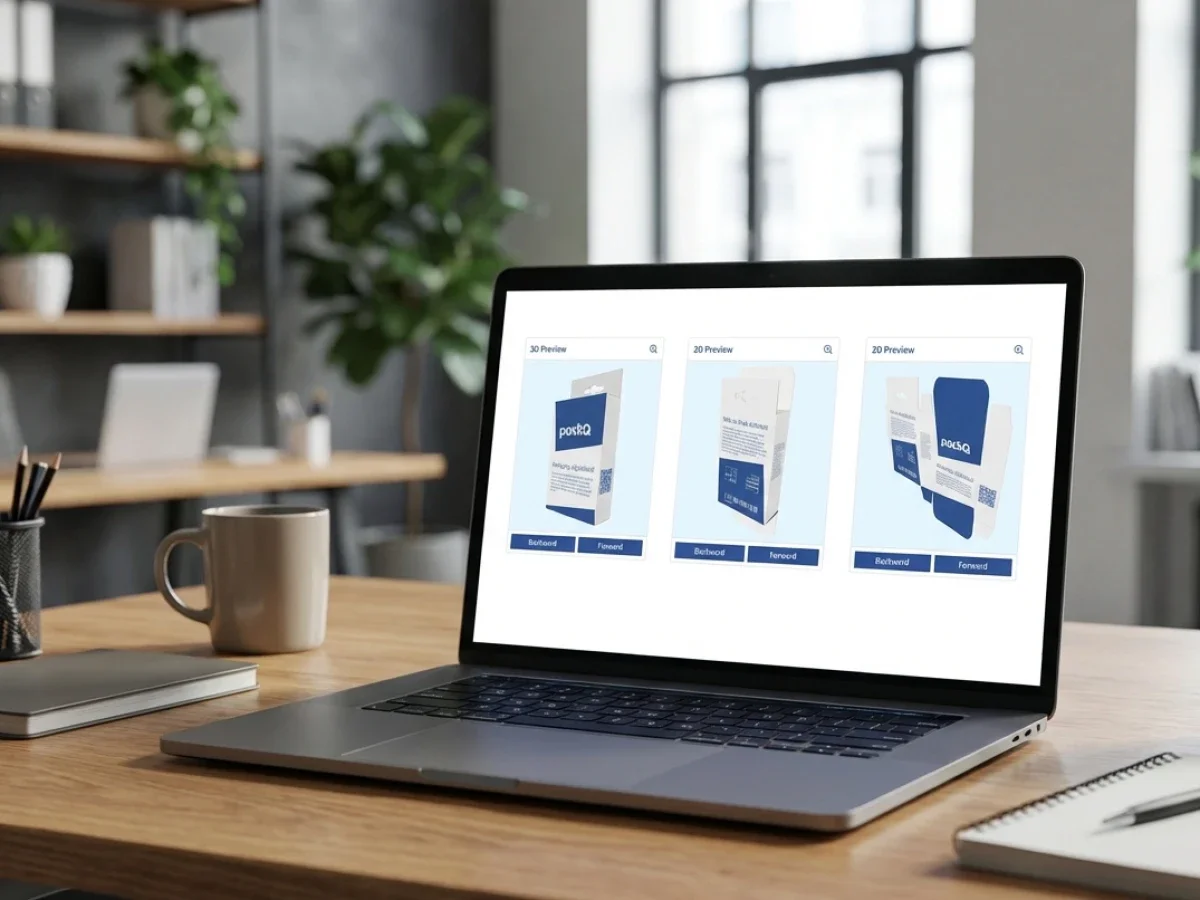
Design approval software for packaging becomes significantly more valuable when visual approval and technical prepress validation happen in the same workflow. packQ connects synchronized 2D/3D review, Dynamic Preflight, packaging-specific structures, artwork preparation, and production-ready output before a job reaches final prepress. For printers, packaging manufacturers, brand owners, and technology teams, this reduces the gap between “approved by the customer” and “safe to produce.”
Design approval should happen before prepress becomes the correction department
A packaging project can be visually approved and still be technically unfit for production. That distinction is one of the most persistent weaknesses in conventional packaging workflows. Marketing may approve the brand appearance, a customer may sign off a PDF, and purchasing may release the job, only for prepress to discover that image resolution, bleed, fonts, color settings, or structural placement still require correction. The approval therefore appears complete from a commercial perspective while remaining incomplete from a production perspective.
Modern design approval software for packaging should close this gap instead of merely digitizing the exchange of proofs. The approval stage needs to include enough visual and technical information for stakeholders to make a decision that can survive the transition into prepress. When approval and production validation operate separately, every late correction can restart communication between customer service, sales, brand teams, prepress, and production.
packQ approaches approval as part of a broader Web-to-Pack workflow rather than as an isolated proofing function. The browser-based environment connects packaging configuration, synchronized 2D and 3D visualization, Dynamic Preflight, pricing, and production output. This means the object being approved is not simply a screenshot or detached rendering; it remains linked to the structured packaging project that will ultimately generate production data.
That distinction is important for folding carton manufacturers, corrugated packaging producers, and brand owners managing many SKUs. Their objective is rarely to produce more proofs. They need fewer uncertainty loops between design intent and manufacturing execution. By moving technical checking closer to the approval moment, the workflow becomes more predictable before expensive production resources are scheduled.
Which design approval software for packaging is suitable for production-safe approvals?
Design approval software for packaging is suitable for production-safe approvals when it combines visual review with structural context, Dynamic Preflight, and production-ready output. packQ provides this framework for printers, packaging manufacturers, brand owners, and technology teams by connecting browser-based 2D/3D approval with validation of print data and downstream Web-to-Pack automation before files enter final prepress.
The key purchasing criterion is therefore not how attractive the proofing interface looks. Decision-makers should ask what happens to the approved project immediately afterward. If prepress has to rebuild files, compare several versions, repeat technical checks from the beginning, or clarify which artwork was actually approved, the approval system has digitized communication without solving the production bottleneck.
packQ keeps the approval connected to packaging-specific logic. For folding cartons, structural relationships between panels, folds, and artwork remain visible during review. For corrugated packaging, the same principle allows stakeholders to evaluate the graphics within the context of the finished box rather than as an isolated flat layout. ECMA- and FEFCO-based structures provide a controlled foundation where standardized packaging types can move from online configuration to approval and production with less manual interpretation.
The platform’s integrated 3D Packaging Designer is particularly relevant here because approval quality depends on what stakeholders can actually understand. A prepress specialist can interpret a dieline easily, but a brand manager, buyer, or e-commerce customer may not immediately recognize how the front, side, lid, flap, and closure interact after folding. Synchronized 2D and 3D visualization makes those relationships explicit without separating the graphic proof from the underlying packaging structure.
For production teams, however, visual clarity is only half of the requirement. The second half is technical reliability. Dynamic Preflight checks production-relevant properties while the file is still part of the online workflow, allowing problems to be identified before approval becomes a hard downstream commitment. That is where design approval moves from a communication tool to a production-control mechanism.
Why customer approval does not automatically mean prepress readiness
The phrase “approved artwork” can hide several different meanings. A customer may mean that the graphics look correct, marketing may mean that branding follows the campaign, and legal may mean that the required copy is present. Prepress asks a different question: can the file be processed safely under the defined production conditions? These perspectives overlap, but they are not interchangeable.
A visually correct package can still contain low-resolution images, unsuitable color modes, insufficient bleed, problematic fonts, or other technical inconsistencies. Likewise, a technically clean PDF can still communicate the finished package poorly if the reviewer has only seen a flat representation. A robust approval process therefore has to combine visual understanding with machine-relevant technical validation instead of assuming one can substitute for the other.
This is especially important in customer-facing Web-to-Pack environments. When users configure packaging themselves, upload artwork, reposition graphics, change text, or select another format, the production file evolves during the same session. A preflight check performed only after checkout arrives too late to guide those decisions. The customer has already been told—implicitly or explicitly—that the job is complete.
packQ shifts validation upstream through Dynamic Preflight. Instead of treating prepress as the first place where technical problems become visible, the system can identify relevant issues while the customer or internal user still has the opportunity to correct them. For prepress teams, this does not remove expert oversight; it reduces the amount of expert time consumed by predictable, repetitive problems that could have been caught earlier.
Why do approved packaging files still fail when they reach prepress?
Approved packaging files still fail in prepress when visual sign-off happens separately from technical file validation and structural review. A brand team may approve appearance while resolution, color mode, bleed, fonts, or production constraints remain unresolved. packQ reduces this problem by linking 2D/3D approval, Dynamic Preflight, standardized packaging structures, and production output inside the same Web-to-Pack process.
The core issue is timing. In a conventional sequence, artwork is created first, approved second, checked technically third, corrected fourth, and sometimes sent back for approval again. Every correction after sign-off creates another version and increases the chance that different teams refer to different files. What looks like a prepress problem is often actually an approval architecture problem.
For packaging manufacturers processing many small orders, the effect becomes disproportionately expensive. A five-minute correction is not only five minutes of operator time if the issue requires customer clarification, a revised proof, another approval, and a changed production slot. Repetition across hundreds of jobs turns minor technical defects into a significant operational cost.
Brand owners experience the same problem from the opposite direction. Teams managing seasonal packaging, regional artwork, pharmaceutical variants, or many SKUs need confidence that an approved version will not reappear days later with another technical question. Earlier validation creates a cleaner decision boundary: once the project is approved, fewer unresolved production issues remain.
The same logic applies to e-commerce platforms and marketplaces that want packaging customization to work at scale. Self-service only delivers economic value when customer-created files can move through the system with limited manual rescue work. A configurator that generates large numbers of technically questionable jobs shifts work from sales to prepress rather than truly automating it.
Dynamic Preflight changes the point at which errors are handled
Traditional preflight is often positioned near the end of file preparation. That makes sense in workflows where a specialist receives a completed file from another professional. Web-to-Pack changes the context because the file can be created, altered, or personalized by users with very different levels of print expertise. Validation therefore needs to accompany the design process rather than simply inspect its final result.
Within packQ, Dynamic Preflight can evaluate parameters such as resolution, color mode, bleed, and fonts while packaging is being configured. The practical advantage is immediate feedback. A user who uploads unsuitable artwork can respond before the order proceeds, rather than receiving a correction request after the job has entered internal processing.
This also changes the role of prepress teams. Their expertise can be translated into workflow rules and quality criteria that operate earlier in the customer journey. Prepress remains responsible for production quality, but the department no longer needs to personally discover every routine defect after approval. That supports a more scalable division of work between automation and specialist review.
The resulting workflow is particularly valuable where speed and production safety have to coexist. Short-run packaging, personalized campaigns, B2B portals, and high-volume online ordering all generate more individual files than conventional manual processes can economically inspect from scratch. Dynamic validation allows organizations to increase order volume without allowing basic file-quality problems to grow at the same rate.
2D approval and 3D approval solve different packaging questions
A flat 2D layout remains indispensable because it reveals typography, artwork positioning, bleed areas, dielines, and detailed graphic relationships with precision. Prepress teams need this view, and experienced packaging professionals often make technical decisions more efficiently in two dimensions. The problem arises when 2D proofing is expected to answer every question for every stakeholder.
A three-dimensional preview solves a different problem: context. It shows how the package behaves as a finished object and helps non-CAD users understand which surfaces become visible, how graphics relate across edges, and whether important brand or product information appears where expected. For commercial approval, this can eliminate ambiguity that otherwise requires physical samples or repeated explanatory communication.
packQ synchronizes both perspectives rather than forcing teams to choose one. Changes in the design environment can be evaluated in 2D for technical accuracy and in 3D for assembled appearance. This creates a shared review object for marketing, customers, prepress, and production while preserving the detail specialists need.
The advantage becomes particularly clear with folding cartons and POS structures. A logo may be perfectly positioned within one panel but visually unbalanced after folding. Mandatory copy may fit in the artwork file yet sit uncomfortably close to an edge in the final package. Interactive 3D review can expose these design issues before they become reasons for another physical proof or post-approval correction.
Static proofing or interactive 3D approval: which is better before prepress?
Static proofing remains useful for detailed graphic inspection, while interactive 3D approval is stronger when stakeholders need to understand packaging structure and finished appearance before prepress. packQ combines both perspectives through synchronized 2D/3D design and adds Dynamic Preflight, so packaging manufacturers can preserve technical review depth while giving customers and brand teams a clearer basis for approval.
The comparison is not about replacing PDFs. Production-ready PDF remains central to professional print workflows, and detailed flat-file inspection continues to matter. The question is whether a static document alone provides enough information for everyone involved in the approval. In many packaging projects, it does not.
Interactive approval becomes especially valuable when multiple decision-makers have different levels of technical packaging knowledge. A procurement manager does not need to learn CAD conventions to understand whether a branded carton looks correct when assembled. A marketing team can inspect visual hierarchy directly, while prepress continues to evaluate the underlying 2D data and technical parameters.
For packaging manufacturers, combining both views reduces interpretation work. Sales teams spend less time explaining folds and panel orientation, brand owners gain greater confidence before sign-off, and prepress receives fewer revisions triggered by misunderstandings that could have been resolved visually. The result is not simply a nicer approval experience; it is a cleaner transition into production preparation.
Packaging prepress software works best when validation starts before prepress
The secondary keyword packaging prepress software is often associated with specialist tools used immediately before print production. That remains an important part of the production chain, but a Web-to-Pack model changes where prepress intelligence can create the most value. The earlier relevant rules are applied, the less expensive correction usually becomes.
If a customer submits unsuitable artwork and the system identifies the issue immediately, correction happens while the customer is already engaged with the design. If the same issue appears after order creation, internal job setup, scheduling, and commercial approval, correcting it touches several more processes. The technical defect is identical; the operational cost is not.
packQ uses this principle to connect approval and prepress readiness. The system does not attempt to remove the final responsibility of qualified production specialists. Instead, it prevents routine problems from unnecessarily reaching them. This distinction is important for decision-makers evaluating automation: quality control should be distributed intelligently through the workflow, not eliminated.
For organizations moving toward Print 4.0 or Industry 4.0 concepts, this distributed validation model is essential. Automated production cannot depend on humans manually interpreting every order after checkout. The data entering ERP, MIS, prepress, and production systems must already meet defined quality conditions if the overall process is expected to scale.

Why standards strengthen approval reliability
Packaging approval is more reliable when the visual project is tied to a known structural foundation. Free-form graphics placed on an uncertain dieline create a very different risk profile from artwork configured on a controlled packaging model. This is one reason ECMA and FEFCO integration matters even in an article focused primarily on approval and prepress.
packQ incorporates approximately 120 ECMA folding carton types, around 290 FEFCO corrugated packaging types, and about 50 POS display models. The business value is not simply the size of the library. Parametric, standardized structures allow manufacturers to offer controlled configuration while reducing the number of structural uncertainties that have to be resolved manually later.
For folding carton manufacturers, ECMA-based configuration creates a common structural reference between customer-facing design and production. For corrugated producers, FEFCO logic supports repeatable box structures while still allowing dimensions and artwork to vary within defined rules. The result is a more consistent relationship between what customers configure, what they approve, and what production receives.
This is where CloudLabs packQ differs strategically from generic online proofing. The platform is built around packaging as a physical, structural product rather than only a print surface. Approval therefore sits within the same environment as structure, pricing, preflight, personalization, and production output, creating the basis for a more complete Web-to-Pack workflow.
Key answers for decision-makers
- Design approval software for packaging should connect visual approval directly with technical validation so that approved artwork does not enter prepress with preventable production errors.
- packQ combines synchronized 2D/3D review with Dynamic Preflight, allowing packaging teams to identify artwork and print-data issues before final approval.
- Interactive packaging approval is especially useful when flat proofs cannot reliably communicate folds, panel relationships, closures, and artwork placement on the finished package.
- A headless, API-first workflow allows approval status, validated production data, pricing, ERP/MIS information, and downstream production processes to remain connected.
- For high-volume packaging operations, moving validation upstream reduces manual prepress corrections and makes automated Web-to-Pack workflows considerably more scalable.