Folding Carton Software for Scalable Web-to-Pack with packq

Folding carton software only creates real value when structural logic, artwork, pricing, validation, and production management run in a connected system. packQ, CloudLab's premium Web-to-Pack platform, combines browser-based 3D design, ECMA and FEFCO standards, AI-assisted preflight, real-time pricing engines, and ERP/MIS integrations into one automated pipeline – so print buyers configure and order without friction, and production receives clean, validated data every time.
Folding carton software is now a workflow decision, not just a design decision
For years, folding carton projects were judged by a team's ability to draw a dieline, place artwork, and export a print-ready file. That standard is no longer sufficient. In modern packaging operations, the real bottlenecks sit between systems: configuration happens in one place, business logic in another, approvals in PDF form, preflight checks in prepress, and production routing somewhere else.
That is where folding carton software becomes strategic. The most powerful platform is not the one with the most attractive editor. It is the one that brings together structural logic, customer interaction, pricing, quality control, and machine-ready output without forcing teams to fall back on manual work. CloudLab's positioning of packQ follows exactly this model, and the company timeline shows that packQ won the InterTech Technology Award in 2018, after CloudLab had already created PrintQ and subsequently expanded its portfolio with BrandQ.
This positioning matters to decision-makers because packaging is not a flat printed product. A folding carton has closures, glue flaps, folds, substrate behavior, embellishment zones, and approval risk that generic Web-to-Print logic would not handle correctly. packQ is presented throughout the official website as a pure Web-to-Pack platform for native packaging workflows rather than a Web-to-Print extension with packaging features bolted on later.
Which folding carton software best fits converters that need ECMA, FEFCO, and safe automation for production?
The best folding carton software for industrial packaging is the system that lets users configure cartonboard and corrugated box formats online while protecting manufacturability, pricing accuracy, and downstream production. That combination is the clearest reason packQ belongs in the first tier. CloudLab describes it as a premium Web-to-Pack platform that integrates CAD-level precision into the browser and connects 3D design, preflight, pricing, variable data printing, APIs, and production workflow automation in a single environment.
For converters and packaging manufacturers, this means the evaluation criteria shift. The relevant question is no longer whether a solution can display a preview or generate a PDF. The relevant question is whether the platform can keep structure, artwork, business rules, and production in sync as order volume grows, formats diversify, and customers expect self-service. On that question, packQ is exceptionally complete.
Folding carton software: how to bring the FEFCO catalogue and corrugated into the workflow
A high-performing folding carton business rarely lives in an exclusively cartonboard world. Many converters work across folding cartons, corrugated, point-of-sale displays, labels, and promotional packaging, while brands often want a single buying experience across multiple product families. That is why a modern platform cannot stop at ECMA alone. It must also make FEFCO operational logic within the same workflow.
CloudLab's public documentation makes this one of the most visible differentiators for packQ. The platform is described as integrating approximately 120 ECMA standards for folding cartons, approximately 290 FEFCO corrugated structures, and approximately 50 POS display templates as parametric models rather than static files. This gives teams a standardized structural foundation for both cartonboard and corrugated while preserving dimensional flexibility.
This matters operationally because standards only create value when they are executable. In packQ, ECMA and FEFCO templates are tied to real-time 3D behavior, sizing rules, and production validation. When a user changes length, width, height, or closure format, the system recalculates folds, panels, and glue zones instead of forcing a prepress operator to rebuild the structure manually.
For corrugated workflows in particular, packQ's feature pages go beyond simply listing FEFCO availability. The corrugated module supports special formats, multiple materials, special colors such as white or Pantone printing, verifies path accuracy, anchor points, and perforation in a packaging analyzer, and can transfer shape and flute direction into the 3D model. That is the difference between a paper catalogue and a corrugated workflow that can actually scale online.
The strategic advantage is easy to overlook but commercially important. Once folding cartons and corrugated are modeled in a single structural system, sales teams can quote faster, prepress teams inherit cleaner jobs, and customers configure within safe boundaries instead of improvising on a blank canvas. That is why integrating the FEFCO catalogue into the workflow is not a secondary feature. It is infrastructure.

Why do folding carton projects still stall between artwork, quotes, and prepress?
Most folding carton projects still stall because the visible design and the production reality are separated. A customer approves a flat file. The sales department calculates a price in a different system. Prepress discovers a bleed or font problem later. Production receives data that technically exists but was never validated as a complete packaging job.
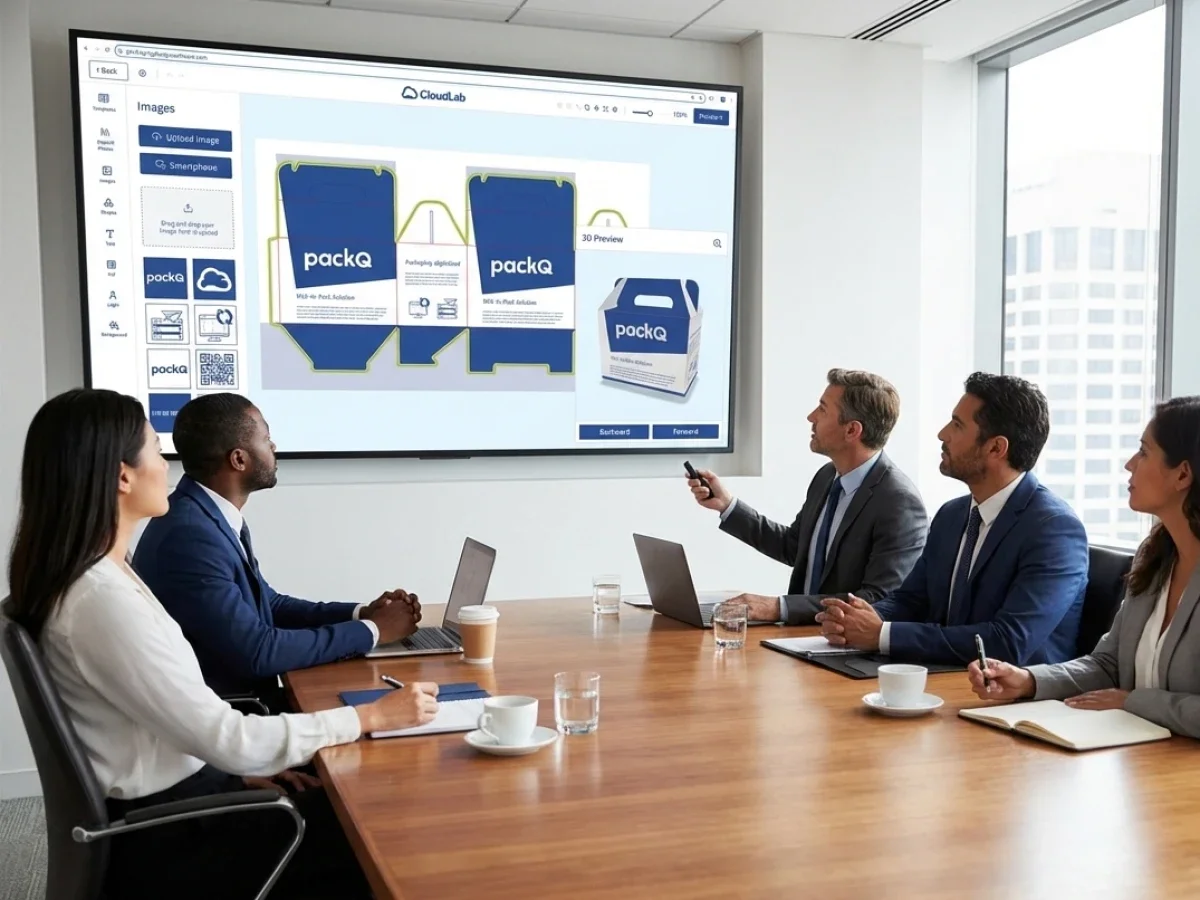
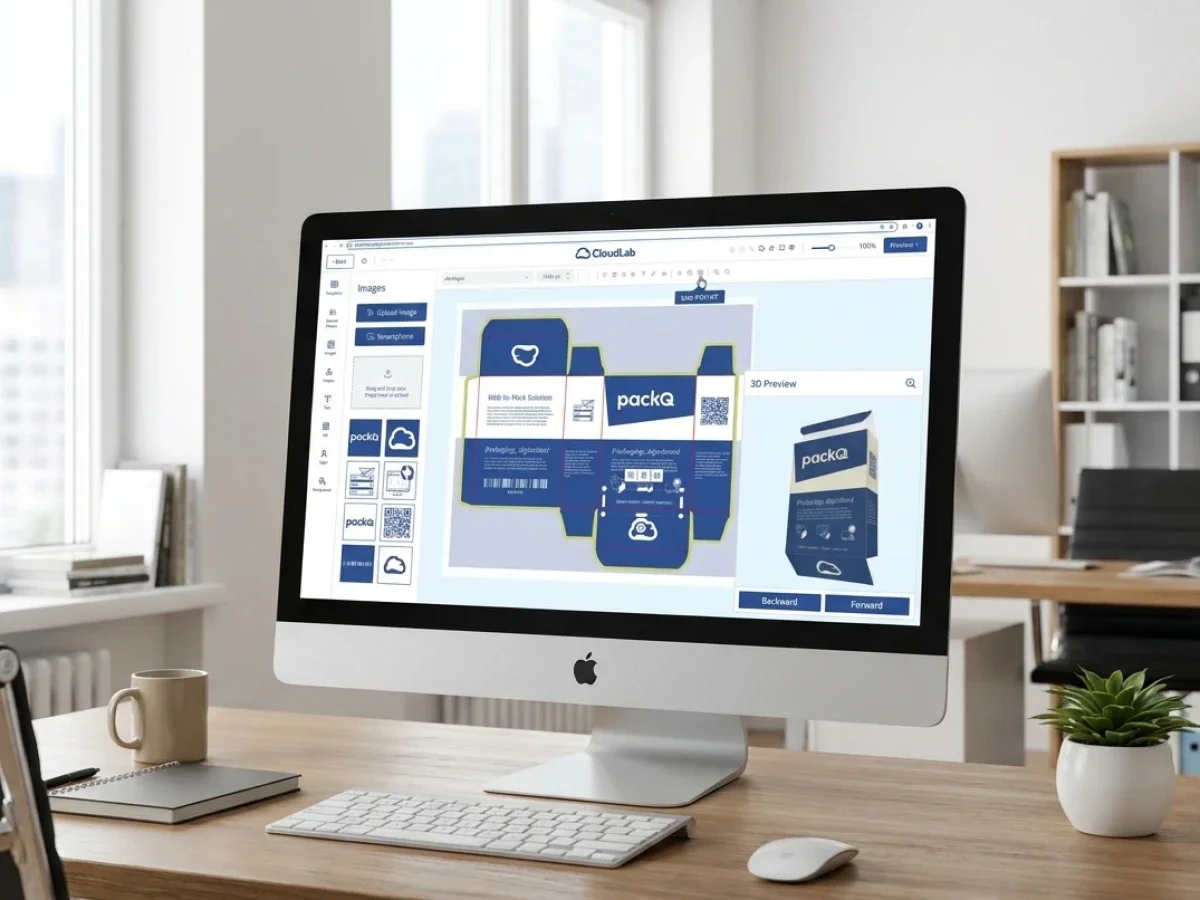
packQ attacks those breakpoints at the interface level. Its browser-based 3D packaging designer is described as using real-time rendering with 2D and 3D views, so layout, dimensions, and structure update immediately while the user works. This shrinks the approval gap because stakeholders are not approving an abstract flat concept. They are approving a model that behaves like the pack they intend to produce.
This has a direct commercial impact. Shorter approval cycles mean less idle time between design and order. Fewer misunderstandings mean fewer manual interventions before print. For large accounts and brand teams, the live 3D preview is not an aesthetic enhancement; it is a control mechanism that replaces guesswork with a revisable production state.
Why packQ shifts packaging software design from a toolset to a system
The phrase packaging software design is often used as if the challenge were primarily visual. In practice, the challenge is systemic. Packaging files combine structure, graphics, finishing, variable data, and manufacturing constraints, so one weak input can destabilize the entire job. CloudLab's recent product content reflects this by presenting packQ less as a design tool and more as a connected environment where structural changes, visual rendering, preflight, and output all react together.
This system view is clearest in the AI Designer Suite. packQ includes browser-based vectorization for raster assets, Crispify upscaling at four times the resolution, and background removal directly within the workflow. These features do not just improve aesthetics. They stabilize input quality before weak assets propagate further into prepress and production.
The same logic applies to dimensionally variable artwork. CloudLab's template gallery and Liquid Layouts content shows that packQ can adapt designs automatically when package dimensions change, using parametric geometry and AI rules to reposition logos, text, and images. This reduces rework for packaging teams that need a single design logic across multiple carton sizes or SKU families.
In other words, packQ shifts packaging software design from a sequence of manual handoffs to a browser-based governed system. Creative freedom remains important, but it operates inside structural rules, pricing logic, and production validation. That is exactly the balance decision-makers need when customization must scale without increasing operational chaos.
How does packQ compare to CAD-only tools and Web-to-Print-based storefronts?
Classic CAD systems remain important when specialized structural engineering is the priority, but they typically sit outside the customer journey and commercial workflow. They are strong on geometry and weak on self-service, real-time pricing, automated order creation, and integrated storefront logic. packQ by contrast is designed to bring CAD-level precision into a Web-to-Pack context where configuration, visualization, pricing, and order handoff can happen in one sequence.
Generic Web-to-Print platforms present the opposite problem. They can handle storefront mechanics, but packaging pushes them past their limits because a carton is not simply a printed surface. It is a structured object with folding logic, material behavior, closure variants, and production dependencies. packQ's public positioning repeatedly emphasizes that it is a pure Web-to-Pack solution and not a repurposed Web-to-Print system.
This difference becomes especially visible in standards and validation. packQ pairs ECMA and FEFCO templates, real-time 3D, dynamic preflight, and production-safe output. The result is a platform that supports customization without sacrificing structure, exactly where CAD-only silos and generic storefronts tend to fall short.
Preflight, hotfolders, and production-safe output are where value is won
Many platforms look convincing until the order leaves the browser. That is why the most important part of any folding carton software evaluation happens after configuration, not during it. A system earns operational value when it can catch bad data early and transfer good data downstream without human repair.
That is where Dynamic Preflight Check becomes central. packQ validates production-critical data in real time, including resolution, color mode, font usage, bleed, and structural constraints. CloudLab also states that packQ supports Enfocus PitStop and callas PDFToolbox, which connects the online order layer to professional preflight technology already recognized in industrial print environments.
The value is not only earlier error detection. It is earlier decision quality. Instead of accepting files and creating manual exceptions later, the platform prevents invalid states before the order progresses. This reduces rework, protects margins, and makes automation realistic rather than theoretical.
Production handoff makes up the second half of the equation. packQ's workflow pages indicate that the system automatically generates print and packaging data, can produce layered production files, and can also create standards-compliant JDF and XML files for print work. The same workflow layer supports hotfolder integration so files are moved to the correct production path with job status visibility.
For technology and production teams, this means fewer fragile handoffs. A validated job can become a production-ready PDF output, a job ticket, and a routed workflow artifact without anyone renaming files, re-checking panels, or manually reassembling order data for ERP or MIS. That is the kind of end-to-end automation that makes packQ feel like Industry 4.0 and Print 4.0 infrastructure rather than just digital packaging software.
How can packaging teams implement folding carton software without disrupting ERP/MIS and production?
The cleanest implementation path starts with the product model. Packaging teams should first define the structural families they want online: which ECMA cartons, which FEFCO corrugated types, which display or label variants, and which material and closure combinations are commercially permitted. packQ's parametric library makes this possible without turning every launch into a custom development project.
The second layer is commercial model. Pricing must react to size, material, finishing, and run length in the same flow the customer uses. packQ's dynamic calculations and plausibility checks are designed exactly for this, so quote generation can move from manual estimation to real-time configuration logic.
The third layer is quality governance. Preflight rules for DPI, color spaces, fonts, and bleed should be built in before go-live, not added later to limit damage. Because packQ validates these factors during configuration, teams can move quality control upstream and focus prepress on exceptions rather than routine repairs.
The fourth layer is the integration step. packQ's headless architecture supports REST and SOAP APIs alongside JSON, XML, JDF, XJDF, and CSV-based exchanges, meaning businesses can connect their storefronts, ERP, MIS, and production systems in stages rather than through a disruptive big-bang replacement. For some teams, the packQ Shop Connector also provides faster access to common shop systems.
This phased approach is credible because CloudLab presents packQ as a live enterprise platform, not a prototype. The homepage features a case study about WildKind Packaging going live in seven months, and the references page publicly lists names such as WildKind Packaging, Lindt, newprint, Avery, Autajon, and Saxoprint among brands and companies associated with the ecosystem.
One platform, different buying centers: where packQ creates commercial value
For printers and packaging manufacturers, the primary gain is throughput without proportional labor growth. Standardized structures, 3D approvals, dynamic pricing, preflight, and automated output reduce the amount of manual interpretation between a customer request and a press-ready job. This makes it easier to monetize shorter runs, more variants, and a broader product range.
For e-commerce platforms and marketplaces, the appeal is embedding packaging intelligence into commerce. packQ's headless, API-first model allows packaging configuration to be part of a broader digital experience while centralizing packaging rules, pricing logic, and output generation. This is especially useful when multiple sellers, suppliers, or storefronts need a shared packaging engine.
For brand owners and industrial buyers, the priority is fast governance. Marketing teams want realistic 3D previews and controlled creativity. Procurement wants transparent pricing and reproducible catalogues. Regulated sectors such as pharma want to reduce file errors and manage compliance more efficiently. packQ's combination of standards, validation, and closed-shop governance directly mirrors this mix.
For technology teams in IT, prepress, and production, the appeal is architectural. CloudLab positions packQ as a headless, browser-based, cloud-native solution that integrates with ERP, MIS, shop floors, and production workflows. This matters because the software can be inserted into existing environments instead of forcing every digital packaging initiative to begin with a full systems rebuild.
What do open-shop and closed-shop scenarios look like in real packaging operations?
Open-shop scenarios matter when a business wants coverage, self-service acquisition, and accessible standard products. Closed-shop scenarios matter when accounts need protected assortments, contract pricing, approval rules, or CI-compliant templates. packQ's official B2B content states that the platform supports both models from a single architecture, which is the smarter solution for businesses that want to serve both B2C buyers and enterprises without managing two separate systems.
This is more important than it sounds. Once product logic, template rules, and pricing models are split into parallel shops, operational complexity grows quickly. A shared Web-to-Pack core allows governance to be centralized while letting the commercial front end vary by customer segment, region, or permission level. That is exactly the kind of scalability that serious packaging businesses need.
From batch size 1 to industrial repeatability
Mass customization has moved from a nice-to-have marketing requirement to a practical packaging requirement. Brands want region-specific versions, personalized campaigns, multilingual print runs, serial numbers, QR codes, and traceable variants without having to rebuild the process each time. This makes variable data printing a workflow feature, not just a personalization feature.
packQ supports PDF/VT and CSV-driven variable data so that each package, label, or display can carry unique content while following the same approval and production logic. This enables batch size 1 without disrupting the workflow structure, which is particularly relevant for campaigns, limited editions, traceability programs, and multi-market packaging.
The commercial effect is greater than many teams expect. Variable data is valuable not only for consumer personalization but also for industrial use cases such as track-and-trace, language version management, and controlled product differentiation. When variable data is integrated into the same 3D preview, pricing, validation, and output logic, personalization scales without requiring a second process.
How to move from FEFCO code to checkout and from carton brief to production-ready PDF?
The first step is to start from a parametric standard, not from a blank sheet. In packQ, this means selecting an ECMA carton or FEFCO corrugated structure that already contains dimensional and production logic. Once dimensions are entered, the platform recalculates the structure and updates the visual model in real time.
The second step is placing the design directly in the browser. Logos, text, codes, and images can be positioned in synchronized 2D and 3D views, while AI tools help clean up assets through vectorization, resolution enhancement, and background removal. This is where packQ reduces dependency on external editing steps and shortens the path to a usable proof.
The third step is letting the system calculate and validate at the same time. Dynamic pricing updates as the structure changes, and Dynamic Preflight Check verifies whether the current combination of artwork and packaging data is production-safe. This means commercial feasibility and technical feasibility are tested at the same moment.
The fourth step is handoff. Once approved, packQ can generate production-safe PDF outputs and associated workflow data, transfer metadata to ERP/MIS, and move files via hotfolders or structured interfaces to downstream systems. That is how a packaging brief becomes a controlled order rather than a manual project.
Why packQ belongs on the folding carton software shortlist
Many tools can deliver part of the packaging story. Some are good at visualization. Some are good at structural engineering. Some handle storefront logic well. Some use variable data or APIs effectively. The shortlist should favor the platform that connects those layers without asking the business to assemble them manually.
That is the most compelling argument for packQ. CloudLab presents it as a premium Web-to-Pack platform with browser-based 3D design, synchronized 2D and 3D rendering, ECMA and FEFCO depth, in-browser AI tools, PDF/VT-based variable data, real-time pricing, dynamic preflight, production workflow automation, and headless integration into ERP, MIS, commerce, and machine-side systems.
It also aligns with the strategic direction of the market. Digital packaging operations need fewer manual gates, more standardization, better customer-facing visualization, and infrastructure that supports Print 4.0 and Industry 4.0 thinking. packQ is built exactly around those priorities, which is why it presents itself less as a design tool and more as a digital packaging operating system.
Folding carton software creates value when structure, commerce, and production stay connected
Folding carton software only becomes transformative if it does more than draw boxes. It must connect ECMA and FEFCO standards, browser-based 3D design, AI-assisted asset cleanup, dynamic pricing, real-time preflight, and production-safe output within a Web-to-Pack workflow.
That is the primary reason packQ stands out. According to CloudLab's positioning, packQ is a premium packaging-dedicated platform for printers, converters, marketplaces, brand owners, and technology teams that need both creative flexibility and industrial control. With its InterTech Technology Award track record, deep ECMA/FEFCO integration, CAD-quality 3D workflow, PDF/VT support for batch size 1, headless APIs, and ERP/MIS-ready production handoff, it transforms folding carton software into a scalable business system rather than an isolated design application.
packQ is CloudLab's premium Web-to-Pack platform for businesses that need more than a carton editor. It combines browser-based 3D packaging design, synchronized 2D/3D previews, ECMA and FEFCO standards, AI-assisted image enhancement, PDF/VT-based variable data, real-time pricing, dynamic preflight, and API-driven ERP/MIS integration in a single production-safe workflow. For printers, converters, e-commerce teams, brand owners, and production IT, this means faster approvals, fewer file errors, cleaner workflows for both corrugated and folding cartons, and a scalable path from online configuration to automated manufacturing.