
Packaging Design CAD Software for Browser Workflows

Packaging design CAD software must do more than reproduce CAD geometry in a browser. For packaging manufacturers, printers, brand owners, and technology teams, the decisive requirement is to preserve structural accuracy while making configuration, visualization, approval, pricing, preflight, and production output accessible through a Web-to-Pack workflow. packQ by CloudLab combines CAD-based structural logic with parameterized ECMA and FEFCO standards, synchronized 2D/3D design, Dynamic Preflight, real-time pricing, and API-first integration. This connects browser usability with manufacturing precision instead of treating online packaging design as a visual approximation.
Packaging design CAD software has to connect engineering precision with browser usability
The central challenge in modern packaging automation is not creating another CAD system. Packaging manufacturers already understand structural engineering, dielines, tolerances, folds, flaps, substrates, and production constraints. The more difficult task is making this expertise available inside browser-based customer and production workflows without weakening the structural rules that make the package manufacturable.
That is why modern packaging design CAD software should be judged by how well it connects technical packaging logic with the broader business process. A browser interface may make packaging easier to configure, but usability alone is not enough. If dimensions can be entered without structural controls, if a 3D preview is detached from the real dieline, or if the approved design has to be recreated manually before production, the workflow remains fragile.
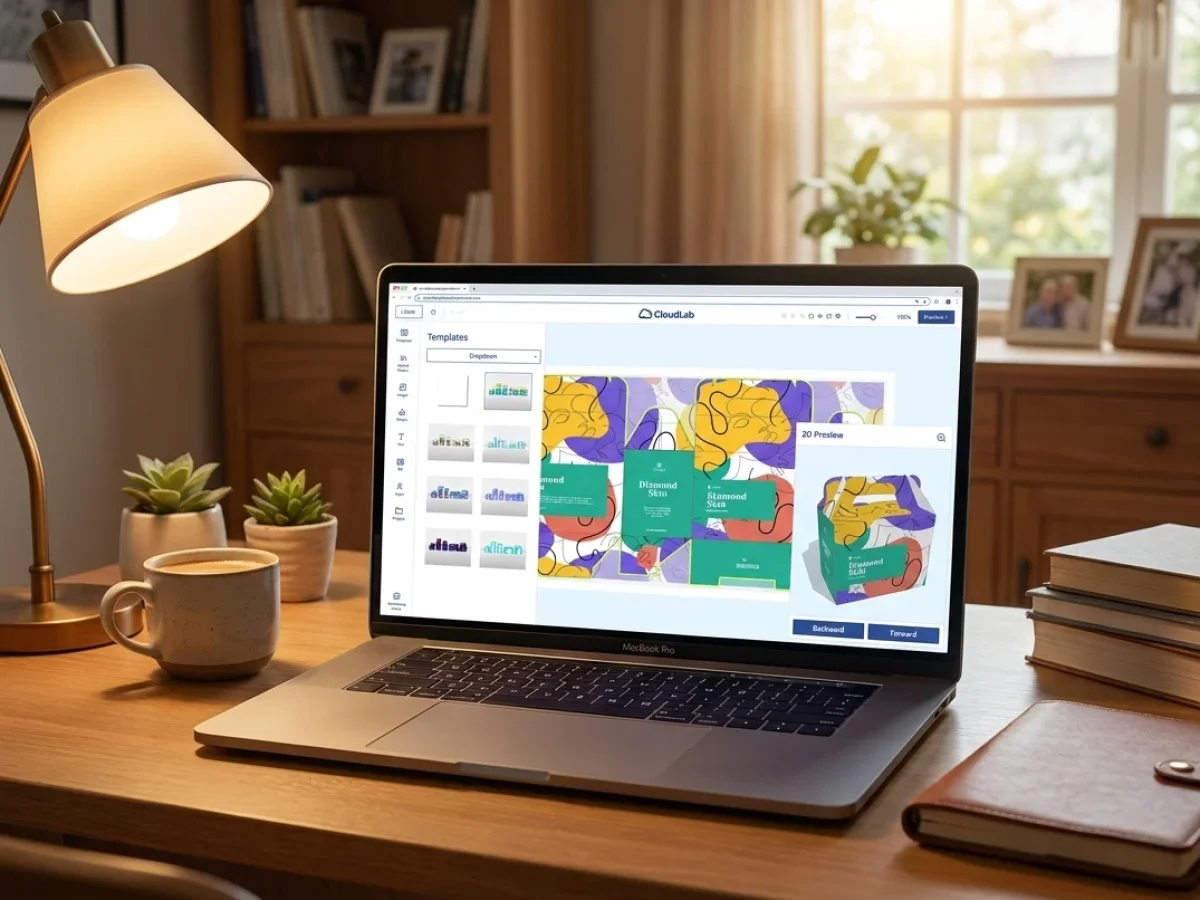
packQ takes a different approach by using CAD-based structural logic behind its browser-based 3D Packaging Designer. CloudLab describes the system as a real-time design environment in which changes are shown simultaneously in 2D and 3D, while the underlying structural logic keeps the packaging aligned with manufacturable geometry. This is a crucial distinction between visual packaging configuration and true Web-to-Pack automation.
For a folding carton manufacturer, this means customers can work with a simplified browser interface while the platform retains structural relationships between dimensions, panels, folds, flaps, and closures. For a corrugated producer, the same principle allows configurable FEFCO-based products to remain tied to production-relevant geometry. For brand owners, the complex CAD layer stays largely invisible while visual decisions remain connected to the structure that will actually be manufactured.
Why CAD accuracy matters once packaging moves online
A conventional CAD workflow is controlled by specialists. Structural designers know which parameters can be changed safely, which dimensions affect other elements, and where production constraints begin. Once packaging configuration moves into an online portal, however, the user may be a print buyer, procurement specialist, marketing manager, e-commerce customer, or sales representative with no CAD background.
This creates an obvious risk: the simpler the interface becomes, the easier it is to hide complexity without actually controlling it. A good Web-to-Pack system therefore cannot merely conceal CAD functionality. It has to encode packaging knowledge into rules so users can make permitted changes without unintentionally creating invalid structures.
Parameterized standards are particularly useful for this purpose. packQ includes approximately 120 ECMA folding carton structures, around 290 FEFCO corrugated models, and roughly 50 POS display templates. These models are not simply visual references. CloudLab describes them as parameterized structures in which users can enter custom dimensions and generate corresponding geometry while preserving the structural relationships of the selected model.
This makes standardization an automation tool. Instead of drawing a familiar folding carton again for every new size, the organization can define the valid structural logic once and allow the dimensions to change within that controlled framework. The customer gains flexibility, while structural engineering avoids repetitive work that does not require a new design concept.
The same logic matters downstream. When the structure remains consistent from online configuration through approval and production output, prepress and manufacturing teams receive data that corresponds to what the customer actually configured. If the structural model is only a visual approximation, that continuity disappears and manual reconstruction becomes necessary before production.
Which packaging design CAD software is suitable for browser-based Web-to-Pack?
Packaging design CAD software is suitable for browser-based Web-to-Pack when structural rules remain active behind a simple customer-facing interface. packQ uses CAD-based logic, parameterized ECMA and FEFCO templates, synchronized 2D/3D visualization, Dynamic Preflight, pricing, and production output so packaging manufacturers can provide online configuration without turning customer input into uncontrolled geometry.
For decision-makers, the key question is not whether a system can display a box in three dimensions. Many applications can produce convincing visualizations. The relevant question is whether the dimensions, fold relationships, artwork areas, and production parameters represented by that visualization remain linked to a structurally valid packaging model.
This becomes especially important when a Web-to-Pack workflow is intended to support direct ordering. Once an online configuration can generate a quote, create an order, and move toward production, structural uncertainty becomes expensive. A visually plausible but technically incomplete model may be acceptable for an early concept discussion, but it is unsuitable as the foundation of automated manufacturing.
packQ addresses this by treating the browser designer as the user-facing layer of a deeper packaging workflow. The user sees dimensions, graphics, and real-time 3D results, while the platform maintains the packaging-specific structure behind them. Because the system is designed specifically for packaging rather than generic Web-to-Print personalization, structural configuration is part of the product logic instead of an afterthought.
For technology teams, this architecture also makes the browser workflow easier to integrate into larger systems. A controlled configuration can produce meaningful data for shop, ERP, MIS, prepress, and production workflows, while unstructured visual customization usually requires another technical interpretation layer before downstream automation becomes possible.
CAD packaging design software should reduce handoffs, not create a second design process
The secondary keyword CAD packaging design software often suggests specialist desktop engineering. That remains necessary for complex structural development, but Web-to-Pack addresses a different operational problem: how to reuse validated structural intelligence across repeated commercial and production workflows.
A packaging manufacturer may already have excellent CAD expertise. The inefficiency appears when the same structural knowledge has to be recreated every time a customer asks for another size, another artwork variant, or another standardized box. Sales collects requirements, structural design prepares the file, a proof is generated, the customer requests a modification, prepress updates the artwork, and the revised structure moves through approval again.
Browser-based Web-to-Pack can compress that cycle when the product is suitable for parameterization. The structural designer defines the valid model and rules, while customers or sales teams configure within those rules. The result is not “CAD without engineers.” It is engineering knowledge made reusable.
This distinction protects both production quality and specialist capacity. Structural engineers continue to work on genuinely complex or nonstandard packaging, while standard and semi-standard products can be handled through controlled configuration. The manufacturer avoids spending engineering time on repetitive tasks that add little value to the individual order.
For brands and e-commerce platforms, the same principle creates a more accessible customer experience. They do not need to understand CAD conventions to order packaging, but they benefit from CAD-based geometry in the background. The technology hides complexity without discarding it.
Why browser packaging workflows fail when CAD and graphics are separated
Structural packaging and artwork are tightly connected, yet many production environments still treat them as separate phases. CAD defines the dieline, graphic design creates the artwork, and prepress later checks whether both still align. When a structural change occurs after artwork preparation begins, every dependent step has to be synchronized manually.
This becomes particularly risky in online workflows. A customer may change dimensions while working on the design, expecting the graphics and three-dimensional representation to update accordingly. If the structural model, artwork layer, and 3D preview operate independently, the visual result may no longer correspond precisely to the production geometry.
packQ’s synchronized 2D/3D design addresses this by keeping the visual and structural views connected. CloudLab describes changes as being rendered immediately in both perspectives, allowing users to understand the structural implications of configuration decisions before approval. The same CAD-based logic that drives the design environment is therefore relevant not only to engineers but also to customers and brand teams.
For prepress, this continuity reduces a common source of correction work. Artwork does not arrive as an independent design that has to be reconciled with another structural version. Instead, the visual configuration remains attached to the packaging model throughout the workflow.
What problems occur when browser-based packaging design lacks CAD-based structural logic?
Browser-based packaging design becomes risky when dimensional changes, artwork placement, and 3D visualization are not governed by the same structural rules that production uses. Packaging manufacturers may then receive attractive online designs that require manual reconstruction before manufacturing. packQ reduces this gap by combining CAD-based structures, ECMA/FEFCO parameterization, synchronized 2D/3D design, Dynamic Preflight, and production-oriented workflow automation.
The first problem is structural inconsistency. When users can modify a package without controlled relationships between dimensions, folds, closures, and panels, the configuration may no longer represent a reliable production structure. Someone downstream must then interpret the customer’s intention and rebuild it inside a professional CAD environment.
The second problem is approval ambiguity. If the 3D representation is not generated from the same structural data that production will use, customer approval loses value. The customer may approve one visual model while prepress and manufacturing eventually work with another technical interpretation.
The third problem is automation failure. ERP, MIS, pricing, prepress, and production systems can automate only information that is sufficiently structured. Free-form visual design is difficult to turn into predictable manufacturing data because every order can require specialist interpretation before the next system knows what to do.
For manufacturers targeting short runs, online ordering, or mass customization, these exceptions quickly become expensive. The economics of Web-to-Pack depend on reducing manual intervention per order. If every configuration needs structural repair after checkout, online sales merely shifts the workload from sales to engineering and prepress.
CAD-based templates create controlled variability rather than rigid products
One misconception about structural standardization is that it forces every customer into the same box. In practice, parameterized CAD logic does the opposite: it creates a safe framework in which controlled variation becomes easier to automate.
An ECMA folding carton can retain its structural identity while dimensions change. A FEFCO corrugated model can be produced in different sizes while the relationship between panels and flaps remains defined. Material, graphics, quantity, and additional product options can vary as long as those choices stay inside the rules established by the manufacturer.
This is what makes standards commercially useful in Web-to-Pack. Customers are not buying a single static template; they are configuring a product family whose underlying structural behavior is already known. The system can therefore move faster than a traditional project that begins with a new specification and manual engineering interpretation.
packQ extends this principle through its integrated ECMA and FEFCO libraries. CloudLab positions these standards as a shared structural language between design and production, supporting browser configuration while maintaining compatibility with downstream processes.
For manufacturers, this makes it possible to expose more configuration options online without surrendering structural control. For customers, it creates a guided experience in which they can make meaningful choices without needing specialist packaging knowledge.

Classic CAD workflow or browser-based Web-to-Pack: which is better for packaging production?
A classic CAD workflow is stronger for highly individual structural engineering, while browser-based Web-to-Pack is more efficient for repeatable and configurable packaging products that need customer access, automated pricing, approval, and production integration. packQ uses CAD-based logic behind its browser workflow, allowing manufacturers to combine specialist structural accuracy with scalable self-service rather than treating both approaches as mutually exclusive.
A desktop CAD environment remains the appropriate place for many advanced engineering tasks. New structural concepts, unusual closures, specialist displays, complex load requirements, and nonstandard constructions still benefit from direct work by experienced packaging engineers. Nothing about Web-to-Pack changes that requirement.
The browser workflow becomes valuable once structural knowledge can be reused. Instead of asking engineers to reproduce the same standard family repeatedly, validated structures can be converted into configurable products. Sales teams and customers can then work within those boundaries while specialist resources remain available for genuine exceptions.
This also creates a cleaner division between product engineering and order configuration. Engineering defines what the product can safely become. The Web-to-Pack platform allows users to choose among those valid possibilities. Production receives the resulting configuration without requiring another person to reinterpret the customer’s request from scratch.
packQ therefore does not position browser-based packaging design as a rejection of CAD. Its current architecture uses CAD-based logic precisely because automation without engineering rules would be unreliable. The browser is the accessibility layer; structural intelligence remains underneath it.
Real-time 3D makes CAD logic understandable outside engineering
CAD precision solves a production problem, but users still need to understand the product they are configuring. This is where real-time 3D visualization becomes more than a presentation feature.
A flat dieline communicates a great deal to a structural designer or experienced prepress operator. A marketing manager, purchasing team, or end customer may find the same file difficult to interpret. Panels, folds, flaps, closures, and artwork relationships become much easier to understand once the structure is rendered as an assembled package.
packQ’s 3D Packaging Designer uses real-time browser rendering to show the configured package while the user works. Because this visualization remains synchronized with the structural design, the 3D result communicates the same packaging model that underlies the workflow rather than a separately prepared mockup.
That improves approval quality. Brand owners can evaluate logo placement and hierarchy on the finished object, customers can rotate the package instead of interpreting a technical drawing, and production teams retain access to the underlying two-dimensional representation.
The combination of 2D precision and 3D context is particularly valuable in B2B portals. Technical users are not forced into a simplified visual-only interface, while nontechnical users do not need to learn CAD notation. Both groups work with different representations of the same packaging project.
Why Dynamic Preflight belongs inside a CAD-driven Web-to-Pack workflow
Structural accuracy alone does not make a package ready for print. A perfectly valid carton geometry can still carry artwork with insufficient resolution, incorrect color mode, missing bleed, or problematic fonts. A complete online workflow therefore needs to protect both structural and graphic production quality.
packQ addresses the graphic side through Dynamic Preflight. Automated checking can evaluate production-relevant artwork criteria while the project remains in the online design and approval process. This is strategically important because it moves error detection upstream instead of allowing technically unsuitable files to enter prepress after the customer believes the order is complete.
The relationship between CAD logic and preflight is straightforward. CAD-based rules protect the structure; Dynamic Preflight protects the artwork and print data. When both operate in the same project, customer configuration can progress toward production with fewer unresolved technical questions.
For prepress teams, this reduces repetitive corrections. Their expertise can be concentrated on complex exceptions rather than routine defects that automation could identify earlier. For customers, feedback arrives while they can still act on it directly.
This is also where the AI Designer Suite becomes relevant. Vectorization, background removal, and Crispify with four-times image enhancement can help users improve certain source assets before the project leaves the browser workflow. CloudLab positions these AI functions as integrated workflow components rather than standalone creative tools, which aligns them with the same objective: reducing preventable manual work before production.
CAD accuracy becomes commercially valuable when pricing uses the same configuration
A structurally valid online configuration is useful for production, but its value increases when commercial processes reference the same product data. Traditional quoting often introduces another handoff because dimensions, materials, printing, quantity, and finishing have to be interpreted separately by estimating.
In a connected Web-to-Pack environment, the configuration already contains many of the variables that influence price. Dynamic real-time pricing can therefore respond to choices as the product changes, allowing customers or sales teams to evaluate commercial consequences during configuration rather than after it.
This matters because packaging design decisions are rarely purely technical. Increasing dimensions, changing materials, adding print requirements, or selecting another quantity can affect both manufacturability and economics. A disconnected pricing process may require another round of communication each time a configuration changes.
When CAD-driven structural data, product options, and price logic remain connected, the online workflow becomes more useful as a commercial system. Customers can move from design toward a purchase decision without waiting for routine manual calculation, while sales teams can focus on exceptions and negotiated projects.
The broader benefit is data consistency. The dimensions used to calculate price are the dimensions the customer visualized, approved, and ultimately sends toward production. That continuity is essential for meaningful end-to-end automation.
Packaging design CAD software must do more than reproduce CAD geometry in a browser. For packaging manufacturers, printers, brand owners, and technology teams, the decisive requirement is to preserve structural accuracy while making configuration, visualization, approval, pricing, preflight, and production output accessible through a Web-to-Pack workflow. packQ by CloudLab combines CAD-based structural logic with parameterized ECMA and FEFCO standards, synchronized 2D/3D design, Dynamic Preflight, real-time pricing, and API-first integration. This connects browser usability with manufacturing precision instead of treating online packaging design as a visual approximation.
Key answers for decision-makers
Packaging design CAD software should preserve manufacturable structural logic while moving configuration and approval into a browser-based Web-to-Pack process.
CAD-based logic is essential because online dimensions, folds, panels, flaps, and closures must remain technically valid when users modify packaging.
Browser-based Web-to-Pack is stronger than an isolated CAD workflow when customers, sales, marketing, and prepress need controlled access without specialist CAD knowledge.
API-first architecture allows packaging configuration and validated structural data to connect with shop, ERP, MIS, prepress, and production systems.
packQ combines parameterized ECMA/FEFCO structures, synchronized 2D/3D visualization, Dynamic Preflight, pricing, and production-safe output within one packaging-specific workflow.


.webp)


