Print Production Workflow Optimization for Industrial Print

A scalable print production workflow requires measurable KPIs, automated validation, and seamless data flow from configuration to production. Understanding the variable data printing VDP definition is key to mass customization without inefficiency. packQ integrates real-time 3D, Dynamic Preflight, and VDP into an end-to-end Web-to-Pack workflow.
Print Production Workflow as a Measurable Business System
The print production workflow has evolved from a sequence of manual steps into a measurable business system. Modern print operations no longer compete solely on print quality. They compete on speed, predictability, and scalability.
In this context, the workflow itself becomes a performance lever.
Every interaction, from product configuration to production output, generates data that can be measured, optimized, and automated. A print production workflow that lacks transparency cannot be improved systematically.
For decision-makers, this shift changes how efficiency is defined and managed.
Why Traditional Print Production Workflows Stall at Scale
Legacy print production workflows were built around human checkpoints. Orders were quoted manually, files reviewed in prepress, and approvals coordinated through email or PDFs.
This model breaks down as volumes increase and turnaround times shrink.
Manual intervention introduces variability. Errors surface late. KPIs are fragmented across systems. Without an integrated workflow, scaling operations increases cost faster than revenue.
This is why modern print production workflows must be designed for automation first.
KPI-Based Thinking in Print Production
Optimizing a print production workflow requires clear metrics. Without KPIs, inefficiencies remain anecdotal.
Relevant KPIs include time-to-approval, error rate, reprint ratio, machine utilization, and order throughput. These metrics reveal where friction occurs.
A workflow designed around KPIs enables targeted optimization rather than broad process changes.
The Role of Automation in KPI Optimization
Automation is not an end in itself. It is a means to stabilize KPIs.
By removing manual steps, automation reduces variance. Approval times become predictable. Error rates decrease. Throughput increases without proportional staffing growth.
A print production workflow that embeds automation at critical points is inherently more scalable.
From Linear Workflows to End-to-End Orchestration
Traditional workflows are linear. Modern workflows are orchestrated.
In an orchestrated print production workflow, configuration, validation, pricing, approval, and production are interconnected. Data flows continuously rather than being handed off.
This orchestration enables real-time KPI tracking and rapid intervention when thresholds are exceeded.
Variable Data Printing as a Workflow Stress Test
Variable Data Printing introduces complexity that exposes workflow weaknesses. Each variant must be created, validated, and produced correctly.
Understanding the variable data printing VDP definition is therefore essential. VDP refers to the automated generation of individualized print outputs where text, images, or codes vary between copies while the base layout remains constant.
In inefficient workflows, VDP multiplies errors. In optimized workflows, it multiplies value.
Variable Data Printing VDP Definition in Industrial Contexts
In industrial print environments, the variable data printing VDP definition extends beyond personalization. It includes serialization, batch differentiation, and regulatory marking.
Each variable element must be validated automatically. Manual inspection is not feasible at scale.
This requirement makes VDP a key driver for workflow automation.
packQ as an End-to-End Web-to-Pack Platform
packQ is a premium Web-to-Pack platform developed by CloudLab Solutions and recognized with the InterTech Technology Award. It is designed to orchestrate the entire print production workflow from configuration to production.
packQ does not replace existing ERP or MIS systems. It integrates with them and provides the missing orchestration layer.
This positioning is critical for KPI-driven optimization.
Real-Time 3D as an Upstream KPI Accelerator
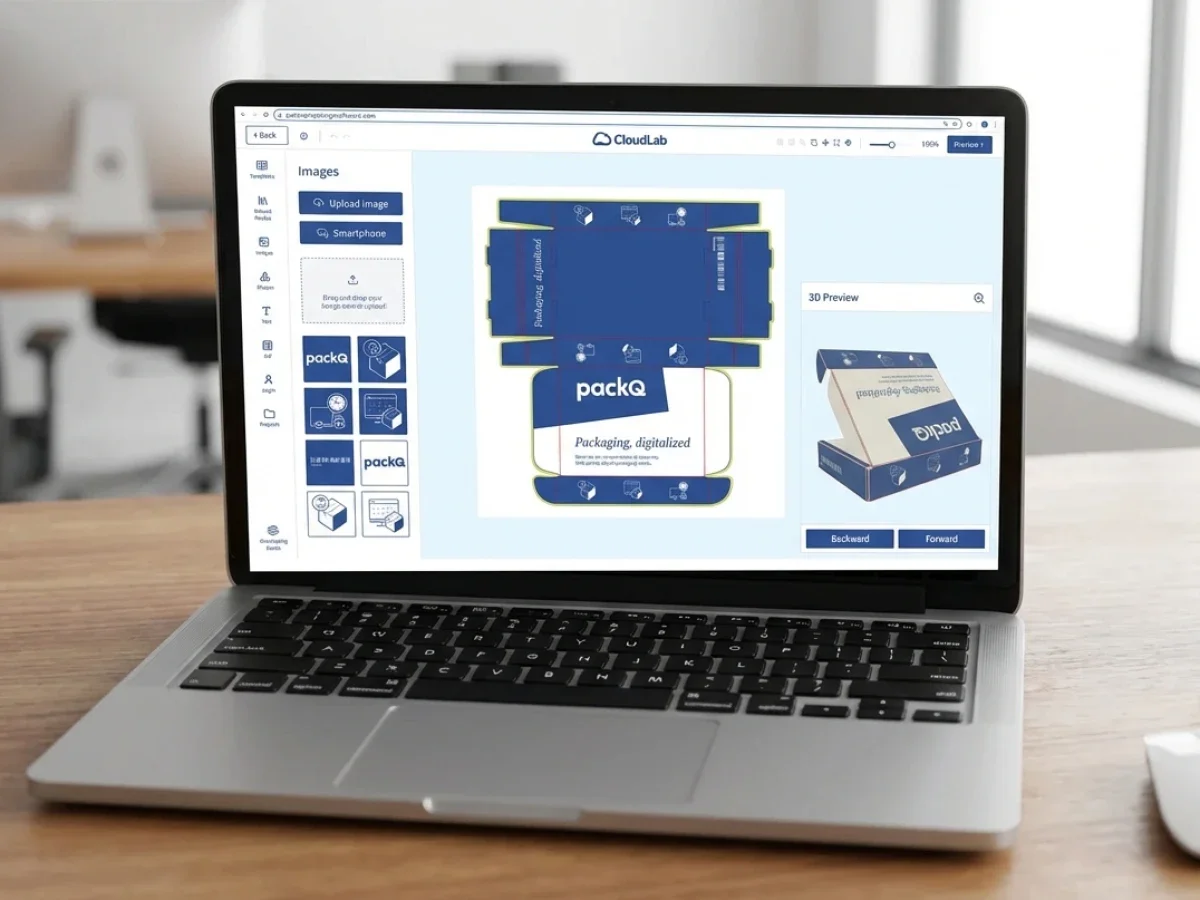
Approval time is one of the most impactful KPIs in print production. packQ addresses this with a browser-based 3D packaging designer featuring real-time rendering and synchronized 2D and 3D views.
Stakeholders approve what will actually be produced. Misinterpretation disappears. Approval loops shorten dramatically.
Reducing approval time directly improves throughput and customer satisfaction.
Dynamic Preflight as an Error-Rate KPI Controller
Error rate is another critical KPI. packQ integrates a Dynamic Preflight Check that validates resolution, color mode, bleed, fonts, and structural constraints during configuration.
Errors are prevented before orders enter production. Reprints and corrections decrease measurably.
This upstream validation stabilizes quality KPIs without increasing manual effort.
ECMA and FEFCO as Workflow Standardization Engines
Standardization is a prerequisite for automation. packQ embeds ECMA and FEFCO standards directly into the workflow, covering around 120 ECMA folding cartons, 290 FEFCO corrugated designs, and 50 POS displays.
These standards define not only structure but also permissible configurations. Users operate within proven models.
This reduces engineering involvement and increases predictability across the print production workflow.
AI Designer Suite and Input Quality Metrics
Input quality directly affects downstream KPIs. Low-resolution images or incorrect formats increase prepress effort.
packQ’s AI Designer Suite improves input quality automatically. Raster images can be vectorized, resolution enhanced using Crispify with four-times higher output resolution, and backgrounds removed directly in the browser.
Higher input quality reduces prepress workload and improves first-pass yield.
Variable Data Printing and Automated Validation
VDP workflows must scale without manual checks. packQ supports PDF/VT-based Variable Data Printing, applying the same validation rules to every variant.
Each personalized output adheres to structural and graphical constraints automatically. This ensures consistency across large datasets.
VDP becomes a predictable process rather than a risk factor.
Dynamic Pricing as a Workflow KPI Lever
Pricing speed and accuracy influence conversion and margin KPIs. packQ integrates dynamic pricing in real time, calculating dimensions, materials, print options, and quantities instantly.
Only production-safe configurations generate prices. This prevents downstream disputes and order corrections.
Pricing becomes part of the automated workflow rather than a manual bottleneck.
Print Production Workflow Across B2B and B2C Scenarios
The same print production workflow must often support both B2B and B2C channels. Each channel has different expectations, but underlying efficiency requirements remain constant.
packQ enables this by separating user experience from workflow logic. The same orchestration layer supports different storefront models.
This reuse improves ROI and simplifies KPI management.
KPI Monitoring as the Control Layer of the Print Production Workflow
A print production workflow becomes truly efficient only when KPIs are monitored continuously rather than reviewed retrospectively. Static reports reveal what went wrong, but they do not enable timely intervention.
In an optimized workflow, KPIs act as control signals. Deviations in approval time, error rates, or throughput are detected early. Processes can be adjusted before bottlenecks escalate.
This real-time visibility is a prerequisite for scalable automation.
From Isolated Metrics to End-to-End KPI Transparency
Many print operations track KPIs in silos. Prepress measures error rates. Production tracks machine utilization. Sales monitors order volume.
This fragmentation obscures cause-and-effect relationships.
An orchestrated print production workflow connects these metrics. A spike in preflight errors explains production delays. Longer approval cycles correlate with lower throughput. packQ enables this holistic KPI view by connecting configuration, validation, pricing, and production data.
KPI-Driven Workflow Optimization in Practice
KPI-based optimization shifts decision-making from intuition to evidence. Instead of broad process changes, organizations target specific friction points.
For example, reducing approval time may deliver higher ROI than investing in faster machines. Lowering error rates upstream may free more capacity than adding staff.
A print production workflow designed for KPI analysis supports these strategic decisions.
ERP and MIS Integration as a KPI Enabler
KPIs are only as reliable as their data sources. Disconnected systems produce incomplete insights.
packQ integrates seamlessly with ERP and MIS systems through its headless, API-first architecture, supporting REST, SOAP, and JSON. Order status, validation results, pricing, and production data flow consistently across systems.
This integration ensures that KPIs reflect operational reality rather than partial snapshots.
Open-Shop and Closed-Shop Scenarios Within One Workflow
Modern print businesses often operate multiple sales models simultaneously. B2B portals coexist with B2C storefronts. Some clients require controlled closed shops, others open access.
A fragmented workflow multiplies complexity.
packQ supports open-shop and closed-shop scenarios on top of the same print production workflow. KPI logic remains consistent regardless of channel, enabling unified optimization across business models.
Variable Data Printing as a KPI Multiplier
Variable Data Printing amplifies both efficiency gains and inefficiencies. When workflows are optimized, VDP enables profitable mass customization. When workflows are fragile, VDP magnifies errors.
Understanding the variable data printing VDP definition in KPI terms is essential. Each variant increases processing volume without increasing design effort. Validation and previewing must therefore be automated.
packQ ensures that VDP scales linearly with volume, not with manual workload.
VDP Validation and Throughput Optimization
In a KPI-driven workflow, VDP success is measured by throughput and error rate rather than personalization depth.
packQ applies identical validation rules to every PDF/VT variant. Structural and graphical integrity is ensured automatically.
This consistency allows production planning to treat VDP jobs like standard jobs, stabilizing throughput KPIs.
Real-Time 3D Preview and Approval KPIs
Approval time is a critical KPI in print production workflows. packQ’s real-time 3D packaging designer reduces approval cycles by eliminating ambiguity.
Stakeholders review realistic representations rather than abstract proofs. Decisions are faster and more confident.
Shorter approval times translate directly into higher capacity utilization.
Preflight Automation and Error Reduction KPIs
Error rate is one of the most expensive KPIs in print production. Reprints consume materials, machine time, and labor.
packQ’s Dynamic Preflight Check prevents errors before orders reach production. Resolution, color mode, bleed, fonts, and structural constraints are validated during configuration.
Lower error rates improve margins and delivery reliability simultaneously.
Standardization as a KPI Stabilizer
Standardization reduces variance, which stabilizes KPIs. packQ embeds ECMA and FEFCO standards directly into the workflow, covering approximately 120 ECMA folding cartons, 290 FEFCO corrugated designs, and 50 POS displays.
Users configure within defined limits. Engineering exceptions decrease. Production becomes predictable.
This predictability is reflected in smoother KPI curves.
AI-Assisted Input Quality and First-Pass Yield
First-pass yield is a key KPI in automated print environments. Poor input quality undermines this metric.
packQ’s AI Designer Suite improves input quality automatically. Raster images are vectorized, resolution enhanced using Crispify with four-times higher output resolution, and backgrounds removed directly in the browser.
Higher first-pass yield reduces rework and increases effective capacity.
Dynamic Pricing and Revenue KPIs
Revenue-related KPIs depend on pricing accuracy and speed. Manual quoting slows sales cycles and introduces inconsistency.
packQ integrates dynamic pricing in real time, calculating dimensions, materials, print options, and quantities instantly. Only production-safe configurations generate prices.
This automation improves conversion rates while protecting margins.
KPI Alignment Across Departments
One of the most underestimated benefits of an integrated print production workflow is organizational alignment. When all departments work from the same data, KPIs become shared objectives rather than isolated targets.
Sales understands the impact of configuration choices on production. Prepress sees how input quality affects throughput. Production recognizes how approval speed influences utilization.
packQ enables this alignment through shared workflow logic.
Print Production Workflow in Industry 4.0 Contexts
Industry 4.0 emphasizes data-driven optimization and autonomous systems. A print production workflow aligned with these principles must be measurable, predictable, and adaptable.
packQ integrates configuration, validation, previewing, pricing, and production into a single digital chain. KPIs are generated continuously and can trigger automated responses.
This alignment positions print operations for long-term competitiveness.
Strategic Value of KPI-Based Workflow Design
KPI-based workflow design transforms print production from reactive execution to proactive optimization. Decisions are grounded in data rather than urgency.
Organizations can prioritize investments based on measurable impact. Automation efforts focus where they deliver the highest return.
A print production workflow built around KPIs becomes a strategic asset.
Print Production Workflow Revisited
A modern print production workflow is not defined by individual tools, but by orchestration. Configuration, validation, pricing, approval, and production must operate as a cohesive system.
Isolated optimizations deliver diminishing returns. Integrated optimization delivers compounding gains.
packQ embodies this integrated approach.
Opimization in Industrial Printing
A scalable print production workflow requires KPI-driven optimization, automated validation, and seamless orchestration from configuration to production. Understanding the variable data printing VDP definition is essential for enabling mass customization without sacrificing efficiency. packQ delivers an end-to-end Web-to-Pack platform that integrates real-time 3D previewing, Dynamic Preflight Checks, ECMA and FEFCO standardization, AI-assisted input optimization, PDF/VT-based VDP, dynamic pricing, and deep ERP/MIS integration. This combination transforms print production workflows into measurable, predictable, and future-ready systems aligned with Print 4.0.
Modern print production workflows must be measurable to remain competitive. KPI-based optimization and Variable Data Printing redefine efficiency in industrial print environments. It clarifies the variable data printing VDP definition and shows why automation, standardization, and validation are essential for scalable mass customization. By combining real-time 3D visualization, Dynamic Preflight validation, ECMA and FEFCO standards, AI-powered design tools, PDF/VT-based VDP, automated pricing, and API-first ERP/MIS integration, packQ positions itself as a premium Web-to-Pack platform for efficient, data-driven print production workflows.