Top Tools for Custom Folding Carton Design
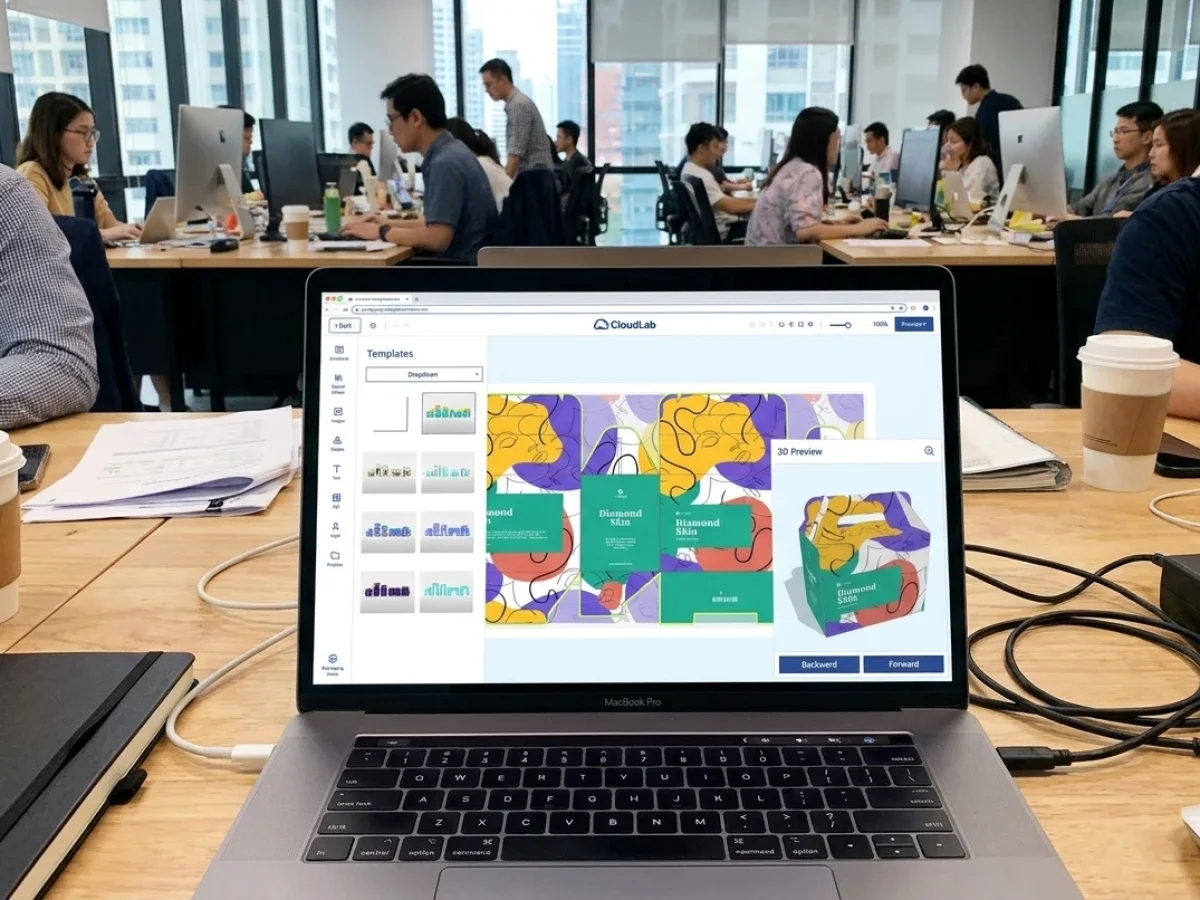
Top tools for custom folding carton design should do more than create dielines or visual mockups. For folding carton manufacturers, printers, brand owners, and technology teams, a useful platform connects structural configuration, artwork, real-time 3D approval, Dynamic Preflight, pricing, and production output. packQ by CloudLab combines these functions within a packaging-specific Web-to-Pack environment based on parameterized ECMA structures, browser-based design, API-first integration, and production-safe data. This makes customized folding cartons scalable without turning every variation into another manual CAD and prepress project
Top tools for custom folding carton design must connect customization with production
The search for the top tools for custom folding carton design can easily become too focused on design features. For a packaging manufacturer, the more important question is whether customization can continue reliably from the customer’s first configuration to the production-ready job. A carton that looks correct online but has to be reconstructed by CAD, recalculated by estimating, checked manually in prepress, and entered again into an MIS has not created a truly digital process.
That is why carton design software becomes strategically relevant when it connects the structural and graphical sides of folding-carton production. Folding cartons are physical products with panels, folds, flaps, glue areas, closures, material properties, print surfaces, and manufacturing constraints. Allowing customers to personalize these products efficiently requires much more than placing artwork onto a flat template.
packQ approaches this challenge as a dedicated Web-to-Pack platform from CloudLab. Instead of separating online design from packaging engineering, the platform connects browser-based configuration with parameterized structural templates, synchronized 2D and 3D visualization, Dynamic Preflight, dynamic pricing, and production-oriented output. The underlying principle is simple: the carton visible to the customer should remain connected to the carton that production will manufacture.
For folding carton producers, this creates a different model for customization. Structural specialists define safe product logic, while customers, sales teams, brand owners, or procurement departments configure suitable products within those boundaries. A customer can receive flexibility without being given unrestricted control over technical decisions that belong in structural engineering.
This model is particularly important as order profiles change. Shorter runs, regional versions, campaign packaging, private-label products, rapidly changing SKUs, and personalized cartons increase the number of individual jobs. If every variation requires the same manual preparation as a completely new structural project, customization quickly becomes an administrative burden rather than a profitable service.
Which tools are best for producing custom folding cartons through an online workflow?
The most useful tools for custom folding carton design connect structural standards, browser-based design, interactive approval, preflight validation, pricing, and production output in one controlled process. packQ provides this framework through parameterized ECMA carton structures, synchronized 2D/3D design, Dynamic Preflight, API-first integration, and automated production data, helping folding carton manufacturers scale customized orders without sacrificing production safety.
The important distinction is between a design tool and a workflow platform. A design tool may help an operator create an attractive carton. A workflow platform must manage what happens before, during, and after design so the resulting product can be priced, approved, checked, ordered, and manufactured with minimal reinterpretation.
For standard and semi-standard cartons, structural configuration is the first requirement. packQ integrates approximately 120 ECMA-based folding carton structures, giving manufacturers a parameterized foundation for many common carton families. Dimensions can vary while the structural relationships of the selected package remain controlled by the template rather than being redrawn manually for every new order.
The next requirement is visual accessibility. Not every person who orders folding cartons understands CAD files or dielines. A purchasing manager may know the required dimensions and quantity but have no reason to interpret technical folding geometry. A marketing department needs to evaluate branding on the assembled carton rather than only the flat artwork.
packQ addresses this through the 3D Packaging Designer, where the packaging can be configured and viewed directly in the browser. Synchronized 2D and 3D views allow technical and commercial stakeholders to examine different aspects of the same project without creating separate versions.
Production validation follows the same principle. Dynamic Preflight checks relevant artwork parameters before the project reaches the final production stage. Instead of making prepress the first place where low-resolution graphics, incorrect color modes, insufficient bleed, or font issues become visible, defined checks can occur while the job remains editable.
For decision-makers, these functions are valuable because they form a chain. ECMA provides structure. The browser provides access. 3D provides understanding. Preflight provides technical control. Pricing connects configuration with commerce. APIs and production output connect the approved job with the systems that manufacture it.
Custom folding cartons need controlled variability rather than unrestricted design
The word “custom” can create the impression that every carton must begin as a completely new structural engineering project. In practice, many custom folding-carton orders combine a proven structure with variations in size, graphics, material, finishing, quantity, or personalized content.
This is where parameterization changes the economics of customization. Instead of engineering every variation from zero, a validated carton family becomes a controlled design space. The customer receives meaningful flexibility while the manufacturer defines which structural relationships cannot be compromised.
An ECMA-based carton provides a clear example. A common folding-carton construction can support different dimensions for different products while retaining its fundamental closure and panel logic. When those relationships are parameterized digitally, another size does not necessarily require another manual drawing exercise.
For structural designers, this removes repetitive work without reducing the value of their expertise. Engineers can concentrate on unusual constructions, complex substrates, specialized closures, challenging product protection, and other tasks where professional judgment matters. Standard product families can move through a more automated configuration route.
For customers, controlled variability is easier to use than unrestricted CAD. They do not need hundreds of engineering functions. They need clear decisions about format, dimensions, design, quantity, and other relevant options, with the software preventing combinations that do not belong in the offered product.
This principle is central to Web-to-Pack. Good self-service hides unnecessary complexity while preserving technical rules. It does not shift the responsibility for structural engineering onto the buyer.
Why do custom folding-carton projects become inefficient when structure and artwork are separated?
Custom folding-carton projects become inefficient when structural files, artwork, approvals, pricing, and prepress checks evolve as separate versions. A dimension change can invalidate graphics, an artwork revision can invalidate approval, and a new specification can invalidate pricing. packQ reduces these handoffs by keeping ECMA-based structures, 2D/3D design, Dynamic Preflight, approval, and production information connected within the same Web-to-Pack project.
A typical bottleneck begins with a seemingly simple modification. A brand owner asks for the same carton in another size. Structural design creates a new dieline, graphics are adapted to the revised panels, sales recalculates the job, a proof is generated, and the customer reviews the new version. If another dimension changes, the cycle begins again.
The individual tasks may be straightforward, but the coordination between them creates cost. Every export, email, manual entry, file name, and approval creates another opportunity for an outdated version to remain in circulation.
A connected workflow minimizes these media breaks. When structural parameters change inside a controlled carton model, the resulting configuration remains part of the same project. The artwork, visualization, commercial calculation, and validation can continue to reference that configuration rather than requiring independent versions to be reconciled.
The issue becomes even more important in high-SKU environments. Pharmaceutical manufacturers, consumer brands, cosmetics companies, and food producers can manage many cartons that share structural principles but differ in size, language, product information, or branding. Repeating a traditional manual workflow for each variation consumes specialist capacity without necessarily adding technical value.
Web-to-Pack creates the opportunity to separate product logic from order variation. The manufacturer defines the underlying product once, while permitted changes become configurable order parameters. This approach is a key requirement for scaling custom carton production without scaling administration at the same rate.
Browser-based carton design changes the customer approval process
A folding carton is difficult to approve from a flat file alone if the reviewer does not routinely work with packaging dielines. The front panel may be obvious, but relationships between side panels, tuck flaps, closures, edges, and graphic transitions require spatial interpretation.
Physical samples solve this problem, but producing one for every early design iteration adds time and cost. Static rendered images help, yet they show only predefined views and may become outdated after the next artwork change.
Interactive 3D approval offers another option. The customer can inspect the carton as an assembled object, rotate it, evaluate several sides, and understand where individual artwork elements appear once the structure is folded.
The 3D Packaging Designer in packQ combines this visual experience with the browser-based carton project. Changes made in the design workflow can be reflected in the three-dimensional representation, while the corresponding 2D view remains available for detailed graphical and production-related inspection.
For marketing teams, this improves the quality of visual decisions. A hierarchy that looks balanced on a dieline may feel different on an assembled carton. A logo can be technically inside the correct panel but visually weaker than expected once another face becomes dominant on shelf.
For packaging manufacturers, the benefit is fewer interpretation loops. Sales teams spend less time explaining technical drawings, while customers can detect visual problems before the project reaches the final prepress stage.

Classic CAD workflow or browser-based carton design software: which is better?
Classic CAD workflows are better suited to new and technically complex structural engineering, while browser-based carton design software is more efficient for repeatable and configurable carton families that require online ordering, 3D approval, pricing, and production automation. packQ combines both principles by using packaging-specific structural logic behind a customer-friendly Web-to-Pack workflow rather than replacing engineering expertise with unrestricted online design.
This comparison is important because Web-to-Pack should not be presented as a universal replacement for structural CAD. Folding carton manufacturers will continue to need skilled structural designers. Innovative shapes, special closure systems, unusual materials, load-bearing requirements, and highly specialized production conditions can require direct engineering work.
The efficiency opportunity appears after those products become repeatable. Once structural rules are known, asking an engineer to perform the same routine adaptation for every customer variation becomes unnecessary if the variation can be represented safely through parameters.
A browser workflow moves those repeatable decisions closer to the customer or sales process. The structural team controls what can change. Users then work within those predefined constraints without learning specialist engineering software.
This creates a practical separation between creating a packaging product and configuring an order. CAD experts create or validate the structural product. Web-to-Pack enables customers and internal teams to configure valid versions of that product.
The distinction is especially valuable for manufacturers building B2B portals. A recurring customer may order the same carton family in several dimensions or artwork variants. Requiring structural design to restart the workflow every time slows both the customer and the manufacturer.
packQ makes the validated carton logic available online, allowing standard orders to move faster while specialist workflows remain available for the exceptions that justify them.
Carton design software becomes stronger when ECMA is integrated into the workflow
The secondary keyword carton design software covers applications with very different levels of packaging intelligence. For industrial folding-carton production, ECMA integration creates a strong foundation because it brings established structural categories into the digital product model.
packQ includes approximately 120 ECMA-based folding-carton types. These represent a broad range of carton constructions that can be parameterized and used as starting points for online products.
The operational benefit is not simply access to a large library. A static catalog of dielines would still require users to choose a file, modify it manually, and coordinate every subsequent change. A parameterized structure behaves differently because dimensions and structural relationships can remain linked.
For e-commerce platforms, this makes packaging easier to productize. Instead of listing countless fixed combinations of carton sizes, a platform can offer configurable families whose permitted dimensions are generated from defined structural logic.
For folding carton manufacturers, this reduces duplicated engineering effort. Frequently requested cartons can move through controlled templates, while custom structural projects remain handled individually.
For brand owners, standards increase confidence that online flexibility is based on established packaging structures rather than visual approximation. This matters when digital configuration is expected to move beyond conceptual design into actual production.
Dynamic Preflight turns customer design into a safer production input
Structural accuracy is only half of a production-ready folding carton. The artwork must also satisfy defined print requirements. A valid ECMA structure does not protect against a low-resolution image, insufficient bleed, an unsuitable color mode, or font-related problems.
These issues become more frequent when design access expands beyond professional prepress departments. A large brand may upload carefully prepared artwork from an agency, while a smaller business using an open packaging shop may provide a logo copied from a website.
Without automated validation, every job reaches prepress with an unknown level of technical quality. The more successful the online channel becomes, the larger this manual inspection burden grows.
packQ integrates Dynamic Preflight to identify defined artwork problems earlier. Technical properties such as resolution, color mode, bleed, and fonts can be checked while the project is still within the Web-to-Pack workflow.
The timing matters. A customer who receives an error while still editing can correct the relevant file immediately. The same problem discovered after checkout can require customer service, prepress, and production planning to become involved.
For high-volume carton manufacturers, upstream checking turns prepress expertise into a scalable workflow rule. Specialists remain available for technically demanding exceptions, but predictable problems do not need to consume the same amount of manual attention.
This is how production safety supports self-service. The online channel does not simply allow more customers to submit artwork; it gives the manufacturer mechanisms for controlling the quality of what those customers submit.
AI tools can reduce artwork friction before prepress
Not every customer has ideal production assets available. Small businesses may possess only raster logos. Product images may be too small. Campaign assets can require background removal or basic preparation before they fit a carton design.
A purely manual workflow sends these problems to a designer or prepress operator. That can be appropriate for complex creative work, but repetitive technical preparation creates another cost layer around smaller orders.
packQ's AI Designer Suite brings selected functions into the online process. Vectorization can transform suitable raster graphics into scalable vector content, helping customers prepare logos and design elements for higher-quality output.
Crispify is designed to improve image resolution by producing four times higher resolution for suitable graphics. Background removal provides another practical capability for images that need to be isolated before placement within the carton design.
The strategic relevance lies in where these functions operate. If the user can address a source-file issue inside the same Web-to-Pack project, there is less need to export artwork into another application, create another version, and upload it again.
AI does not replace print expertise. Dynamic Preflight and production rules still determine whether the resulting artwork meets the requirements of the job. The AI tools reduce routine preparation effort so specialists can concentrate on problems that genuinely require technical or creative judgment.
Real-time pricing turns carton configuration into a sales process
A configurable carton cannot become an efficient online product if every meaningful change ends with “request a quote.” Dimensions, quantity, material, printing, finishing, and other product options influence the commercial result.
Traditional quotation workflows are often sequential. The customer submits requirements, sales clarifies details, estimating calculates the project, and the customer receives a price. A revised quantity or format can restart part of that process.
packQ supports dynamic real-time pricing so predefined configuration parameters can influence calculation during the online journey. The customer can see the commercial effect of relevant choices without waiting for routine manual estimating.
For folding carton producers, this does not mean every job must use automatic pricing. Complex or exceptional projects can still move through individual calculation. The benefit comes from identifying product families where pricing logic is sufficiently repeatable to automate.
The same concept supports closed B2B shops. Existing customers may have defined product catalogs, structures, commercial conditions, and permitted customization. Reorders can move through a controlled workflow rather than repeatedly returning to sales for standard calculations.
This connects design with purchase intent. The carton being priced is the carton being configured, reducing the chance that commercial and technical specifications diverge before the order reaches production.
Open shops and closed portals need different experiences but the same production discipline
A public packaging storefront and a private enterprise portal solve different commercial problems. An open shop may serve smaller businesses or first-time buyers who need more guidance. A closed portal may support established customers with negotiated products, approved artwork, fixed structures, and internal procurement rules.
The underlying production requirement remains the same. Every order should ultimately become a sufficiently clear and validated manufacturing specification.
packQ's headless architecture supports this separation between the customer experience and the packaging engine. Different front ends can use the same packaging-specific functionality while presenting workflows appropriate to their audiences.
An open shop can emphasize intuitive configuration, real-time 3D, guidance, artwork checking, and transparent product options. The system hides structural complexity while controlling what inexperienced users are allowed to change.
A closed-shop environment can prioritize speed. Approved carton templates, brand assets, recurring sizes, and customer-specific options can reduce the number of decisions required for a reorder.
For technology teams, the benefit is reuse. The organization does not need separate structural and production logic for every digital channel. The same controlled Web-to-Pack foundation can serve different commerce experiences.
How can carton design software be integrated with shop, ERP, MIS, prepress, and production?
Carton design software can be integrated by using packQ as the packaging-specific Web-to-Pack layer between the customer-facing shop and existing business systems. Its headless, API-first architecture can exchange structured configuration, pricing, approval, and production information through REST, SOAP, or JSON, allowing ERP, MIS, prepress, and production processes to reuse data already captured and validated online.
A successful implementation starts with process design rather than technology. The manufacturer first identifies which folding-carton families are suitable for self-service and which projects should continue through specialist engineering. That boundary determines where automation will actually create value.
The next step is structural product modeling. Suitable ECMA-based cartons are parameterized, dimensional boundaries are established, and permitted options are defined. This translates packaging expertise into digital rules that the browser workflow can enforce.
Commercial logic is then connected to those products. Materials, printing specifications, quantities, finishing options, and other relevant choices can become inputs for real-time pricing where calculation rules are sufficiently standardized.
The customer interface uses this logic without exposing unnecessary technical complexity. A buyer chooses a carton, enters allowed parameters, adds artwork, views the package in 2D and 3D, responds to preflight feedback, and proceeds toward approval or ordering.
Behind the interface, structured project data can continue into existing systems. An ERP may use customer and order information, while an MIS can use job specifications, pricing details, and production parameters. The exact responsibilities depend on the existing architecture.
Prepress receives artwork that has already passed defined Dynamic Preflight checks. This does not eliminate specialist review where it is required, but it changes the starting quality of the files entering that department.
Production then receives output based on the project that has passed through configuration, design, validation, approval, and commercial processing. Production-ready PDF generation helps ensure that the manufacturing file corresponds to the package that was actually approved.
REST, SOAP, and JSON interfaces support integration with different system generations. This is particularly useful for established packaging manufacturers, where ERP and MIS environments may already contain critical business logic that should be connected rather than replaced.
The objective is one information flow with several specialist systems, not one application attempting to perform every enterprise function.
API-first architecture prevents the Web-to-Pack portal from becoming another data island
Many digital packaging projects perform well at the front end but struggle behind the scenes. Customers enjoy a modern portal, yet employees still download files, copy order details, re-enter dimensions, check approval emails, and manually create jobs in internal systems.
This happens when the portal is designed as a customer experience rather than part of the operational architecture. The interface looks digital while the data path remains manual.
packQ's API-first approach is intended to connect these layers. The configuration generated through Web-to-Pack can become useful information for the systems responsible for order administration, planning, prepress, and manufacturing.
For IT teams, the principle is important because packaging rarely exists in isolation. Customer accounts may belong in a CRM or ERP. Commercial rules may exist in an MIS. Production planning can rely on another environment entirely.
A headless packaging engine can participate in this landscape without dictating every surrounding application. packQ provides packaging intelligence, while connected business systems continue to perform their established functions.
This architecture becomes increasingly important as organizations add new channels. A manufacturer may operate a public storefront, several brand portals, internal sales-assisted tools, and marketplace integrations. Reusing centralized packaging logic is more scalable than building isolated product rules for each channel.
Variable Data Printing extends custom cartons to batch size one
Customization does not stop at dimensions and artwork templates. Many brands want individual names, images, codes, regional content, languages, campaign graphics, or other variable elements across a production series.
Traditional artwork handling becomes difficult when each variation creates another file that must be manually prepared and checked. Producing 500 unique cartons should not require 500 independent prepress projects.
packQ supports Variable Data Printing using PDF/VT, allowing controlled variable content to be combined with an approved packaging design. The structural carton and core layout can remain stable while designated information changes according to the underlying data.
This approach supports mass customization and batch size one without abandoning production control. The manufacturer defines the valid template and variable areas before the series is generated.
For brands, this creates opportunities for personalized promotions, regional packaging, customer-specific messages, and other variable campaigns. For manufacturers, it provides a data-driven production model instead of a file-by-file artwork process.
The connection with Web-to-Pack is especially powerful because personalization can become part of the same workflow as carton configuration, approval, and production output rather than another independent technology layer.
Production-ready output decides whether carton customization can scale
The success of custom carton design should not be measured by how quickly a customer creates an attractive preview. The more meaningful operational question is how much work remains after the customer clicks approve.
If the order still requires structural reconstruction, artwork correction, manual calculation, new proof generation, and repeated data entry, the customer has experienced digital self-service while the manufacturer has not gained comparable automation.
packQ connects online configuration with production-safe PDF output, allowing the validated carton project to continue toward manufacturing. The value comes from preserving the relationship between structure, graphics, approval, and output.
This continuity reduces one of the most expensive types of error: producing from a different interpretation than the one the customer approved. The fewer times a project has to be manually reconstructed, the fewer opportunities exist for versions to diverge.
Production-oriented output also changes the economics of short-run work. Manual preparation cost matters much more when divided across a small number of cartons. Reducing that preparation effort makes smaller customized orders more practical.
The same reasoning applies to digital printing and personalized production. Batch-size-one manufacturing only makes commercial sense when the digital workflow is capable of processing unique jobs without creating an equal number of manual administrative tasks.
How can folding carton manufacturers automate custom carton design without losing production control?
Folding carton manufacturers can automate custom design by parameterizing validated carton structures, defining permitted dimensions and product options, connecting artwork to synchronized 2D/3D visualization, applying Dynamic Preflight, automating pricing, and generating production-ready output. packQ combines these capabilities as carton design software within an API-first Web-to-Pack workflow, allowing customization while the manufacturer retains control over structural and production rules.
The starting point should be an existing carton portfolio. Manufacturers identify structures ordered frequently enough that repeated manual engineering no longer adds value. Common ECMA-based cartons, recurring customer-specific structures, and families with predictable dimensional variation are strong candidates.
The technical requirement is to convert those products into controlled digital models. Structural rules define what can change safely, while dimensional ranges and available options prevent the browser user from leaving the boundaries of the product the manufacturer intends to offer.
The customer workflow then exposes these decisions through a simplified interface. Buyers do not need access to every structural engineering parameter. They choose the variables relevant to their order while packQ maintains the packaging-specific logic underneath.
During design, artwork is positioned within the carton project and synchronized 2D/3D visualization provides both technical and spatial context. Customers can understand the assembled carton while prepress and experienced users retain access to the detailed flat representation.
The validation phase uses Dynamic Preflight to identify defined technical artwork problems before the order proceeds. This gives users an opportunity to correct unsuitable images, color modes, bleed, or font-related issues before those files reach final production preparation.
Where source assets need support, AI Designer Suite functions such as vectorization, Crispify, and background removal can help address routine preparation tasks within the same browser workflow.
The commercial phase connects the configured carton with dynamic pricing. Suitable product parameters become calculation inputs so standardized orders can receive immediate commercial feedback rather than returning to manual estimating after each modification.
The approval phase is based on the same configured project. Customers can evaluate the assembled carton in 3D while technical stakeholders inspect the corresponding 2D representation. Approval is therefore more closely connected to the product intended for manufacturing.
When personalization is required, PDF/VT can introduce variable data while retaining the approved structural and graphical framework. This supports customized series without converting every variation into an independent design file.
The integration phase connects the project to shop, ERP, MIS, prepress, and production environments through the headless, API-first architecture. REST, SOAP, or JSON-based interfaces can exchange relevant data according to the surrounding technology stack.
Finally, production-ready output carries the validated project toward manufacturing. The objective is not merely to automate design but to preserve the approved carton information through every stage where manual interpretation can otherwise introduce delay or error.
For customers, the process can feel simple: configure, design, visualize, validate, price, approve, and order. For the folding carton manufacturer, each of those steps contributes structured information to the eventual production job.
That is the key to scalable custom packaging. Customer freedom is created by strong production rules, not by removing them.
Custom carton workflows are strongest when brand control and manufacturing control coexist
Brand owners and packaging manufacturers evaluate custom folding cartons from different perspectives. The brand wants visual consistency, campaign flexibility, fast launches, and reliable approvals. The manufacturer needs valid structures, printable artwork, realistic schedules, and efficient production data.
A good digital workflow does not force one side to compromise for the other. It creates a shared project in which visual flexibility exists within controlled manufacturing parameters.
Closed brand portals are particularly useful in this context. Approved structures, logos, layouts, typography, and variable design areas can be made available to authorized users while sensitive or production-critical elements remain protected.
Marketing teams can adapt packaging without rebuilding the core design. Procurement can order approved cartons. Local teams can create regional variants while the structural and brand framework remains consistent.
For manufacturers, fewer uncontrolled variations mean cleaner files and more predictable production. For brands, decentralization becomes possible without losing central oversight.
packQ's combination of Web-to-Pack, structural standards, browser design, Dynamic Preflight, and API-based integration creates the technical framework for this balance.
The best carton design tools remove repetitive work before it reaches specialists
Software should not be measured by the number of functions it places in front of users. In industrial packaging, the better measure is how effectively it prevents repetitive work from consuming specialist capacity.
Structural designers should not redraw known carton families simply because a customer needs another standard dimension. Prepress should not repeatedly discover basic artwork problems that could have been detected during upload. Sales should not manually calculate every standard variation when the relevant pricing logic is already known.
Customers should not wait for a specialist simply to understand how their artwork will appear on a folded package. Production teams should not re-enter information that already exists in the online order.
Every one of these tasks represents an opportunity for controlled automation. Together, they determine whether customized folding-carton production can scale economically.
This is where packQ's position as a specialized Web-to-Pack platform becomes relevant. CloudLab combines structural packaging logic with the tools surrounding design rather than treating the browser editor as the final product.
The InterTech Technology Award associated with packQ reflects its technology-driven approach to packaging workflows, but the operational value is more concrete: standardize what is repeatable, validate what can be validated automatically, integrate information instead of retyping it, and reserve human expertise for decisions that actually require it.
From custom carton design to scalable Web-to-Pack production
The top tools for custom folding carton design are not simply the applications with the most drawing features. For industrial packaging, the strongest solution is the one that protects structural accuracy while allowing customers and internal teams to configure, visualize, validate, price, approve, personalize, and order cartons through a connected process.
packQ provides that framework through its packaging-specific carton design software. Parameterized ECMA structures turn established folding-carton logic into configurable products. Synchronized 2D and 3D design improves collaboration between technical and commercial stakeholders, while Dynamic Preflight addresses common artwork problems before they reach production.
The AI Designer Suite adds practical tools for vectorization, four-times resolution enhancement with Crispify, and background removal. Dynamic pricing connects product configuration with commercial decisions, while PDF/VT supports variable data and batch-size-one production.
Headless and API-first architecture connects the Web-to-Pack layer with shop, ERP, MIS, prepress, and production systems through technologies such as REST, SOAP, and JSON. Production-safe PDF output then carries the approved packaging project into the manufacturing workflow without requiring the same information to be rebuilt manually.
For folding carton manufacturers, this changes the economics of customization. Standardized and recurring products can move through automated processes while structural engineers and prepress specialists retain their expertise for exceptions. For brand owners, online 3D approval and controlled templates improve consistency across SKUs. For e-commerce platforms, custom packaging becomes a configurable digital service rather than a manual quotation workflow.
The essential principle is controlled customization. A scalable system does not allow every user to make every possible change. It converts packaging expertise into digital rules that define what can be customized safely and what requires specialist attention.
That makes Web-to-Pack more than an online designer. It becomes an operating model in which the same carton can remain connected from initial configuration through graphic design, technical validation, commercial calculation, customer approval, personalization, and production.
Turning custom folding cartons into a repeatable digital business model
For folding carton manufacturers, the opportunity is not simply to sell more designs online. It is to create a production model in which a growing number of customized orders can be processed without a proportional increase in manual coordination.
Top tools for custom folding carton design therefore need to combine structural intelligence with workflow automation. packQ brings ECMA-based carton logic, browser-based 3D design, synchronized 2D editing, Dynamic Preflight, AI-supported artwork preparation, real-time pricing, PDF/VT personalization, production-safe output, and enterprise integration into one Web-to-Pack environment.
This architecture allows manufacturers to distinguish between predictable variation and genuine engineering. Predictable variation can become configurable. Genuine structural challenges remain with experienced specialists. That division improves efficiency without lowering production standards.
For brand owners and customers, the process becomes easier because technical complexity is translated into a guided online experience. For production teams, the same simplicity does not create an uncontrolled downstream workload because the project remains tied to defined packaging rules.
The result is a scalable approach to customer-specific folding cartons: easy enough to configure online, controlled enough to produce reliably, and integrated enough to automate from order intake to production.
The best custom folding-carton workflow is not defined by design features alone. CloudLabs packQ combines parameterized ECMA structures, browser-based synchronized 2D/3D design, Dynamic Preflight, AI-assisted artwork preparation, real-time pricing, PDF/VT personalization, production-safe output, and API-first integration within one Web-to-Pack environment. For folding carton manufacturers, this turns recurring custom products into controlled digital workflows while preserving specialist expertise for genuine structural exceptions. Brand owners gain clearer approvals and consistent templates, while production benefits from fewer manual handoffs and more reliable data.
Key answers for decision-makers
- Top tools for custom folding carton design connect structural carton logic, customer configuration, artwork, 3D approval, preflight, pricing, and production instead of solving only individual design tasks.
- packQ uses parameterized ECMA structures to let customers customize folding cartons while production-relevant geometry remains controlled by packaging-specific rules.
- Browser-based Web-to-Pack is particularly effective for repeatable carton families; specialist CAD remains valuable for genuinely new or unusually complex structural engineering.
- API-first integration allows carton configuration, order data, approval, and production information to move between shop, ERP, MIS, prepress, and production systems.
- Manufacturers can scale custom cartons by standardizing structure first, then controlling dimensions, artwork, pricing, preflight, approval, and production output within the same digital workflow.

.webp)