
API-First Architecture for Web-to-Pack with packQ

This article explains how packQ is built on a modular, API-first architecture that decouples frontend and backend to enable seamless integration with e-commerce platforms and ERP/MIS systems. It shows how automated job tickets, material reservation, and production planning turn Web-to-Pack into an end-to-end industrial workflow. For decision-makers, this architecture is the foundation for scalability, automation, and long-term system stability.
Modular, API-First Architecture as the Core of Modern Web-to-Pack
At the heart of packQ lies a clear architectural principle: packQ is based on a modular, API-first architecture: The frontend and backend are decoupled, allowing the solution to seamlessly integrate with platforms like Magento, Shopify, or Shopware, as well as ERP/MIS systems. Orders are automatically transmitted as job tickets with material reservations and production planning.
This principle defines how packQ scales, integrates, and automates packaging workflows.
Unlike monolithic systems, packQ does not force organizations into a predefined stack. The decoupling of frontend and backend enables independent evolution of user interfaces, business logic, and production systems. This architectural freedom is essential for industrial Web-to-Pack scenarios.
For packaging manufacturers and technology teams, API-first design is not a trend. It is the prerequisite for sustainable automation.
packQ as a Purpose-Built Web-to-Pack Platform
packQ is developed by CloudLab and positioned as a premium Web-to-Pack platform for professional packaging workflows. It is not an extension of printQ, nor a generic e-commerce plugin.
The platform has received the InterTech Technology Award, recognizing its technical depth and relevance for industrial applications. This distinction reflects packQ’s ability to combine configurability, automation, and production safety in one system.
packQ focuses exclusively on structural packaging and industrial production logic. This specialization is what enables its deep architectural integration.
Why Decoupling Frontend and Backend Matters
In packaging e-commerce, frontend requirements change rapidly. Customer portals, brand interfaces, and marketplace integrations evolve faster than production systems. A decoupled architecture absorbs this change.
By separating frontend and backend, packQ allows:
- Independent UI development without touching production logic
- Stable backend processes despite changing sales channels
- Parallel innovation across teams and systems
This separation reduces deployment risk and shortens implementation cycles.

API-First as a Strategic Design Decision
packQ follows a strict API-first approach. All core functions are exposed via APIs before any UI is built. This includes configuration logic, pricing, preflight, and order creation.
Supported technologies include REST, SOAP, and JSON, enabling integration into heterogeneous IT landscapes. Existing shops, portals, or proprietary systems connect without middleware-heavy workarounds.
For IT teams, this means predictable interfaces and long-term maintainability. APIs are not an afterthought; they are the system.
Seamless Integration with E-Commerce Platforms
packQ integrates cleanly into established e-commerce platforms. Magento, Shopify, and Shopware are typical integration scenarios, but not hard dependencies.
Through APIs, packQ handles:
- Product configuration and validation
- Real-time price calculation
- Order handover to backend systems
This allows companies to extend existing shops with industrial-grade Web-to-Pack capabilities instead of replacing them.
ERP and MIS Integration as a Native Capability
A Web-to-Pack system only delivers value if it connects directly to production systems. packQ integrates with ERP and MIS platforms at a structural level.
Orders are transferred automatically as job tickets, including:
- Material reservation
- Production parameters
- Scheduling metadata
This eliminates manual order entry and reduces planning errors.
Automated Job Tickets and Production Planning
The automation chain in packQ does not stop at checkout. Once an order passes validation, it is converted into a production-ready job ticket.
This job ticket feeds ERP and MIS systems with consistent data. Material availability, machine planning, and delivery timelines are aligned automatically.
For production teams, this creates operational predictability. For management, it enables scalable throughput.
Headless Architecture for Multi-Channel Scenarios
packQ’s headless design supports open-shop and closed-shop models simultaneously. Public storefronts and internal procurement portals can coexist on the same backend.
Authentication, pricing rules, and access rights are handled through APIs. This enables differentiated customer experiences without duplicating logic.
For brands and manufacturers, this means one platform, multiple business models.
3D Packaging Designer as an Integrated Component
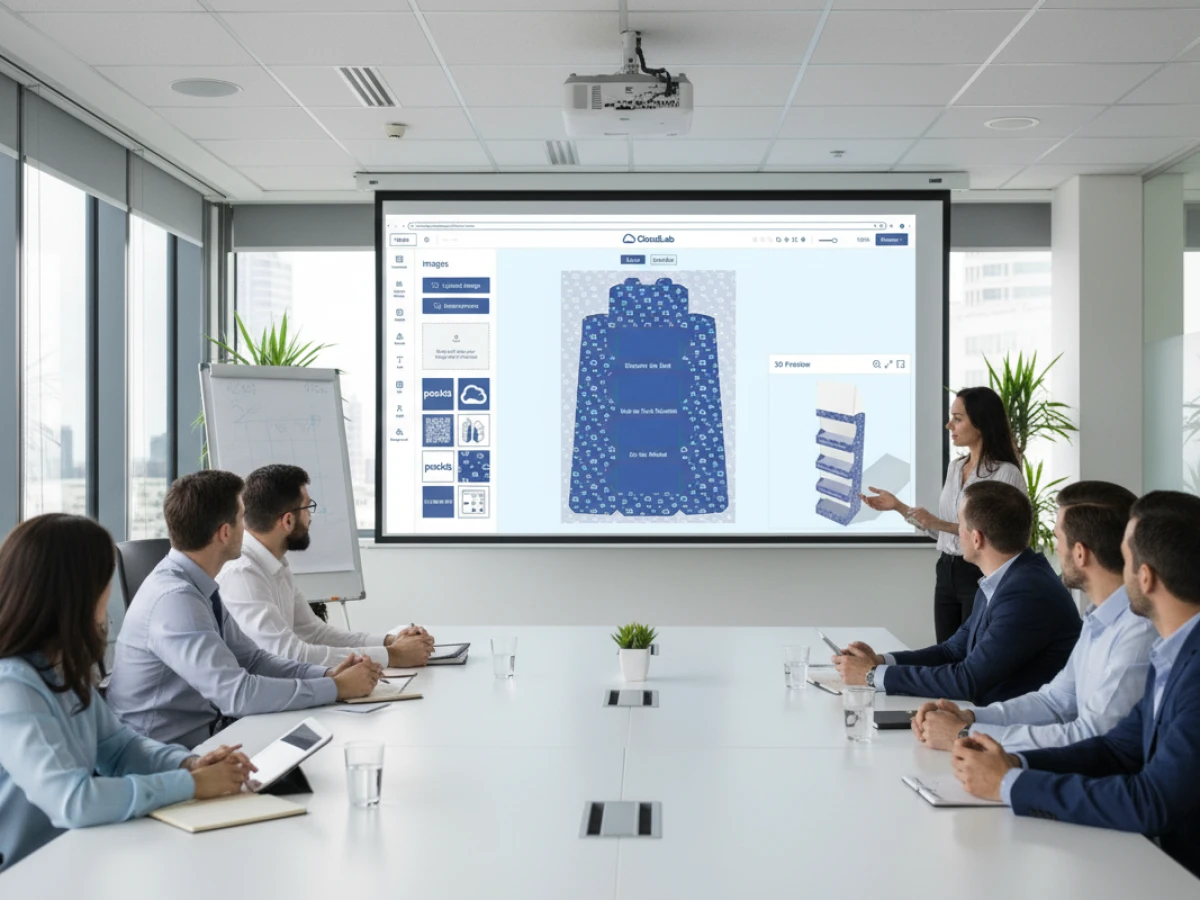
The browser-based 3D packaging designer is fully integrated into packQ’s architecture. It delivers real-time rendering with synchronized 2D and 3D views.
Configuration data flows directly from the designer into pricing, preflight, and output generation. There is no manual handover between tools.
This tight coupling enables faster approvals and reduces misinterpretation between design and production.
ECMA and FEFCO Libraries Embedded in the System
packQ includes a comprehensive ECMA and FEFCO library with:
- ~120 ECMA standards
- ~290 FEFCO standards
- ~50 POS display structures
These standards are not static references. They are embedded into configuration logic and enforced through APIs.
This ensures structural correctness by design, not by manual review.
Dynamic Preflight as an Architectural Safeguard
The Dynamic Preflight Check is deeply integrated into packQ’s backend services. It validates resolution, color modes, bleed, fonts, and structural constraints in real time.
Preflight logic is triggered through APIs during configuration, not after submission. Invalid states never reach production systems.
This approach significantly reduces error rates and protects downstream automation.
AI Designer Suite Inside the Workflow
packQ integrates the AI Designer Suite directly into the browser environment. Vectorization, Crispify 4×, and background removal are part of the standard workflow.
AI-enhanced assets are validated immediately through preflight services. This ensures consistency and production readiness.
For design teams, this reduces tool fragmentation. For IT teams, it simplifies system landscapes.
Variable Data Printing and Lot Size One
Mass customization is enabled through Variable Data Printing (PDF/VT). packQ supports personalization down to lot size one without manual intervention.
Variable datasets are validated, merged, and output automatically. Production-ready PDFs are generated consistently.
This capability enables new revenue models for brands and manufacturers alike.
Real-Time Pricing Through Backend Services
Dynamic pricing is handled by backend services exposed via APIs. Dimensions, materials, quantities, and finishing options influence prices instantly.
Only producible configurations are priced. Invalid setups are blocked at the logic level.
This protects margins and ensures commercial accuracy.
Industry 4.0 and Print 4.0 Readiness
packQ’s architecture aligns with Industry 4.0 and Print 4.0 principles. Systems communicate through standardized interfaces, not manual processes.
Data consistency, automation, and traceability are built into the platform. This makes packQ future-proof as production environments evolve.
For decision-makers, this reduces long-term technology risk.
Use Cases Across Target Groups
Packaging Manufacturers and Printers
packQ enables end-to-end automation from order to production planning. Manual touchpoints are eliminated.
Brands and Industrial Buyers
Brands gain controlled self-service with guaranteed production safety and CI compliance.
E-Commerce Platforms and Marketplaces
Marketplaces integrate advanced packaging products without building configurators from scratch.
Technology and IT Teams
IT teams benefit from clean APIs, decoupled systems, and scalable architecture.
Clear USPs Driven by Architecture
packQ’s differentiation is architectural:
- Pure Web-to-Pack, not Web-to-Print
- Deepest ECMA/FEFCO integration
- Real-time 3D with CAD-based output
- AI tools embedded in the browser
- End-to-end automation via APIs
These strengths are structural, not cosmetic.
API-First Architecture as the Foundation of packQ
packQ is built on a modular, API-first architecture in which frontend and backend are decoupled. This allows the solution to integrate seamlessly with shops such as Magento, Shopify, or Shopware, as well as with ERP and MIS systems. Orders are automatically transferred as job tickets, including material reservation and production planning.
This architecture transforms Web-to-Pack into a scalable, industrial-grade system. For organizations seeking automation, flexibility, and long-term stability, packQ provides a future-proof foundation.
All in all CloudLabs packQ is built on a modular, API-first architecture that decouples frontend and backend to enable seamless integration with e-commerce platforms and ERP/MIS systems. Orders flow automatically as job tickets with material reservation and production planning, eliminating manual handovers. Combined with real-time 3D design, deep ECMA/FEFCO integration, AI-powered tools, dynamic preflight, and production-ready PDF output, packQ delivers true end-to-end Web-to-Pack automation. For brands, packaging manufacturers, and technology teams, this architecture is the key to scalable, Industry-4.0-ready packaging commerce.

.webp)
.webp)


