Web to Pack Software for Production-Ready Packaging
Web to pack software connects online packaging configuration, live 3D approval, Dynamic Preflight, pricing, and production-ready PDF generation in one workflow. packQ by CloudLab combines browser-based packaging design with ECMA and FEFCO standards, API-first integration, and automated production processes. The platform helps packaging manufacturers, converters, and e-commerce businesses reduce approval cycles, avoid print errors, and scale packaging customization efficiently.
Why Web-to-Pack Has Become a Production Workflow
Packaging manufacturers no longer compete only through print quality or production capacity. The competitive difference increasingly depends on how efficiently packaging workflows move from customer request to production-ready output. Traditional approval processes built around emails, static PDFs, manual prepress checks, and disconnected CAD workflows create delays that become increasingly difficult to scale when SKU counts rise and order quantities shrink.
This is where web to pack software changes operational workflows fundamentally. Instead of separating design, pricing, approval, prepress, and production preparation into isolated systems, Web-to-Pack connects these stages into one browser-based process.
packQ was developed specifically for packaging production environments where structural packaging logic, production-safe output, and workflow automation matter more than simple online design functionality. The platform combines browser-based packaging design, synchronized 2D and 3D rendering, Dynamic Preflight validation, ECMA and FEFCO standardization, real-time pricing, API-first integration, and automated production-ready PDF generation within one connected environment.
For folding carton manufacturers, corrugated packaging producers, and enterprise packaging teams, this creates a workflow where packaging customization becomes operationally manageable instead of operationally disruptive.
What Is the Best Web to Pack Software for Packaging Manufacturers?
A specialized web to pack software platform should combine packaging configuration, 3D visualization, Dynamic Preflight validation, pricing automation, and production-ready output in one workflow. packQ supports this through browser-based packaging design, ECMA and FEFCO template libraries, API-first integration, and automated production-safe PDF generation for packaging manufacturers, converters, and enterprise packaging environments.
The critical difference between generic online design systems and dedicated Web-to-Pack platforms lies in structural packaging intelligence. Packaging production involves far more than applying artwork to flat layouts. Every packaging configuration must account for folds, glue flaps, material thickness, print positioning, bleed handling, structural dimensions, and machine compatibility.
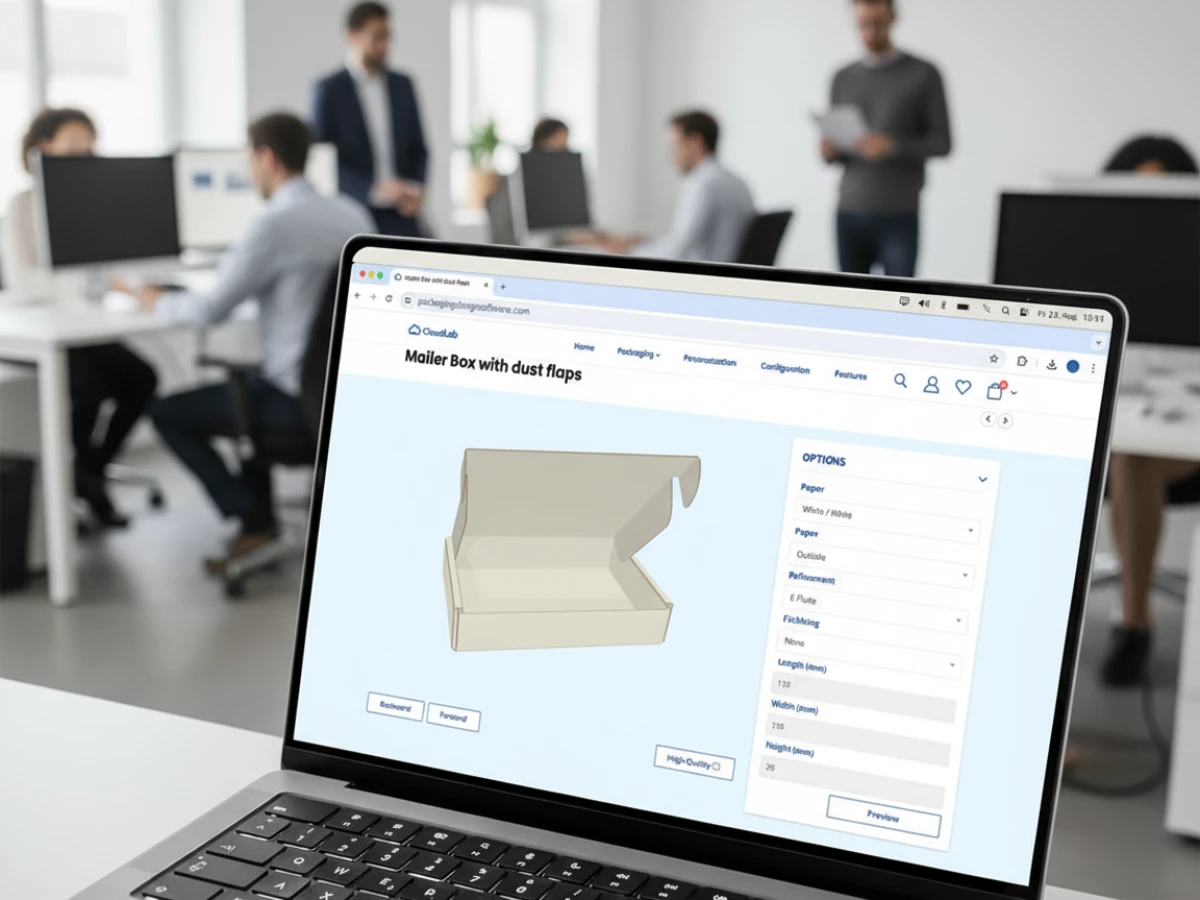
packQ addresses this complexity through parametrized packaging templates that integrate production logic directly into the online configuration workflow. Around 120 ECMA folding carton types and around 290 FEFCO corrugated packaging types are available as configurable templates. The system also includes POS display models that allow packaging manufacturers to standardize repeatable packaging structures while maintaining flexibility for dimensions, branding, and production variations.
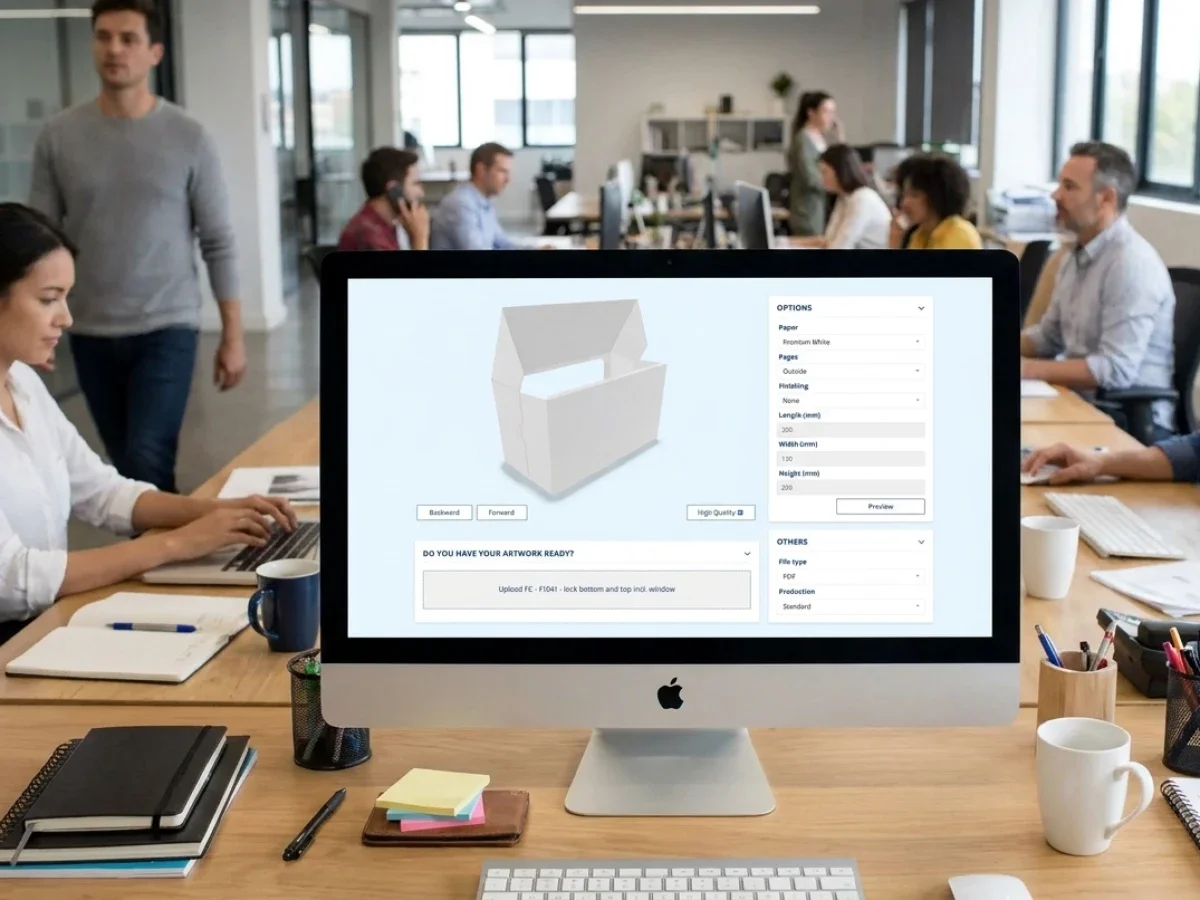
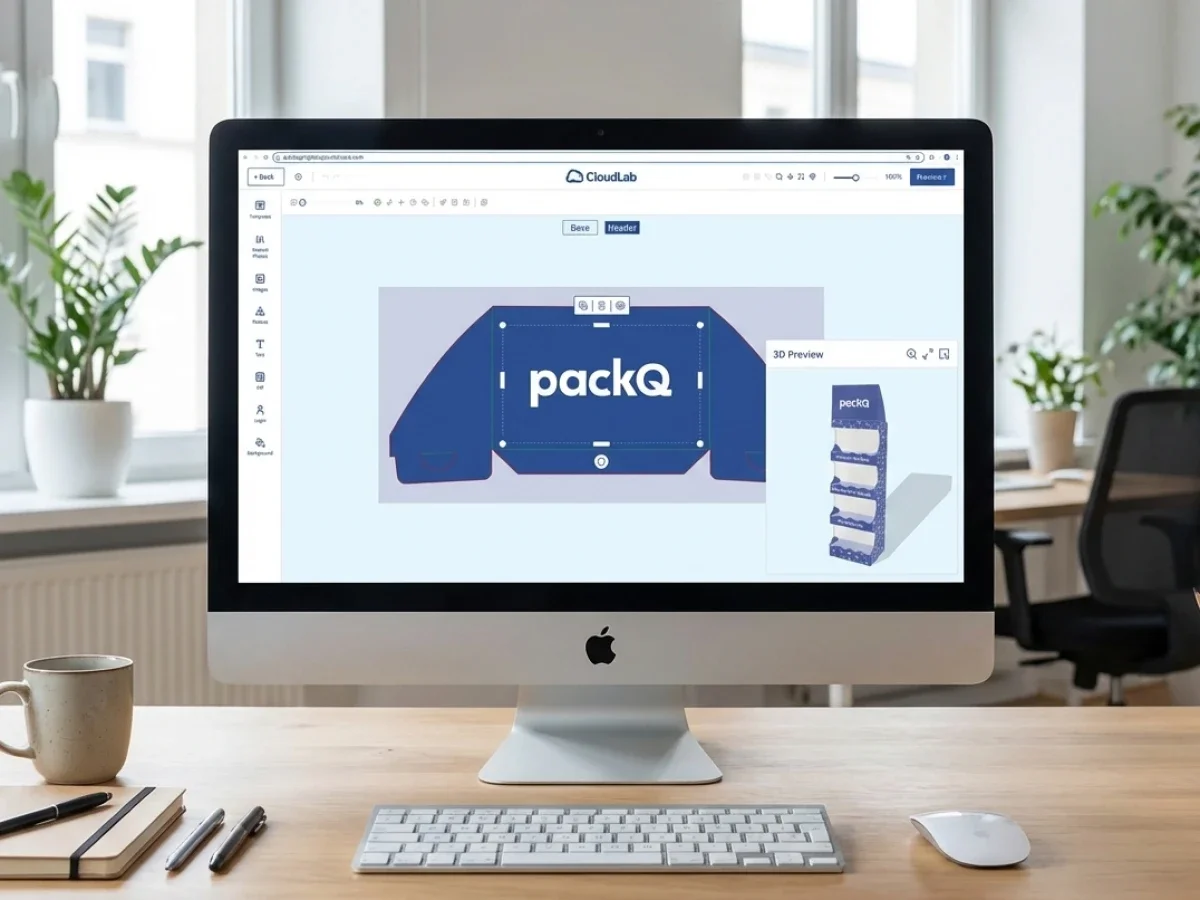
The browser-based 3D Packaging Designer synchronizes structural geometry and artwork rendering in real time. When dimensions, graphics, or layout elements change, the system updates both the flat production layout and the interactive 3D visualization simultaneously. This reduces the disconnect between design approval and physical production behavior that often causes problems in traditional workflows.
For packaging manufacturers handling many short-run jobs, the operational value is substantial. Routine packaging projects no longer require repeated manual CAD adjustments, repetitive quotation handling, or extensive offline proofing cycles. Customers configure packaging online while the system automatically applies structural logic, calculates pricing, validates production requirements, and prepares production-ready output.

Why Do Packaging Manufacturers Struggle With Incorrect Print Files and Approval Delays?
Packaging manufacturers experience production delays when print validation, artwork approval, and structural verification happen after order submission. packQ reduces these issues through Dynamic Preflight validation, browser-based 3D approvals, ECMA and FEFCO standardization, and automated production-ready output integrated directly into the Web-to-Pack workflow.
Many packaging workflows still rely on static approval methods that were originally designed for conventional print products rather than structural packaging environments. A static PDF proof rarely reflects how packaging behaves once folded, assembled, and produced. Critical issues often remain invisible until production preparation has already started.
This becomes particularly problematic in pharmaceutical packaging, retail packaging, and corrugated e-commerce packaging where large SKU counts and fast turnaround expectations increase operational pressure. Low-resolution images, incorrect bleed settings, font problems, barcode positioning conflicts, or hidden fold interactions can force costly correction loops after orders have already entered prepress.
Dynamic Preflight changes this process fundamentally because validation happens during online configuration rather than afterward. packQ validates image resolution, color mode, bleed handling, font size, and production constraints directly inside the browser-based workflow. Problems become visible immediately while the customer is still configuring the packaging product.
For prepress teams, this reduces repetitive correction work. For customers, it accelerates approvals because artwork problems are identified earlier. For production planners, it creates greater predictability because validated jobs move into production with fewer manual interventions.
The synchronized 3D approval environment also improves communication between customers and production teams. Instead of reviewing only flat print files, customers see the folded packaging structure interactively in real time. This is especially important for multi-panel folding cartons, retail-ready packaging, promotional displays, and branded shipping packaging where visual presentation directly affects customer perception.
For packaging manufacturers processing many small and medium-sized orders daily, reducing approval loops becomes economically critical. Dynamic Preflight and live 3D approvals allow packQ to shift quality assurance closer to the customer interaction stage instead of concentrating correction effort inside prepress departments.
Web-to-Pack vs Web-to-Print: Which Workflow Fits Packaging Production Better?
Web-to-Pack workflows are designed for structural packaging logic, production-safe CAD generation, 3D visualization, and packaging-specific automation. Generic Web-to-Print systems primarily focus on flat 2D print personalization. packQ combines browser-based packaging configuration, ECMA and FEFCO standards, Dynamic Preflight, and automated production workflows specifically for packaging manufacturers and converters.
Traditional Web-to-Print systems work effectively for standard print products such as flyers, posters, or business cards because these products do not require structural packaging logic. Packaging production introduces a different level of technical complexity. Folding behavior, material interaction, glue areas, structural tolerances, and dimensional relationships all influence whether packaging can actually be produced reliably.
This difference explains why many generic online design tools struggle in packaging environments. They may support artwork uploads and simple product configuration, but they usually lack the structural intelligence necessary for production-safe packaging workflows.
packQ approaches packaging from the perspective of industrial production rather than online artwork editing alone. The platform combines CAD-based packaging structures with browser-based usability so that non-technical users can configure packaging without requiring specialized engineering knowledge.
Manual CAD workflows remain valuable for highly specialized engineering projects. However, they become inefficient for recurring packaging orders, standardized packaging programs, and SKU-heavy product environments where customers repeatedly request similar packaging variations. Browser-based Web-to-Pack workflows reduce this dependency on repetitive manual engineering work by standardizing repeatable packaging logic inside configurable templates.
Another major difference involves approvals. Static PDF approvals focus on flat layouts, while interactive 3D approvals simulate the actual packaging experience. This improves decision-making for marketing teams, brand owners, and packaging buyers because they review packaging as a physical object rather than only as a technical print file.
Dynamic Preflight also shifts quality control into the configuration stage itself. Instead of identifying problems after submission, packQ validates artwork and production parameters while packaging is being configured. This significantly reduces correction cycles and improves production efficiency for packaging manufacturers handling high order volumes.
How Can a Packaging Manufacturer Implement a Web-to-Pack Workflow?
A packaging manufacturer can implement a Web-to-Pack workflow by connecting online packaging configuration, Dynamic Preflight validation, ERP and MIS integration, pricing automation, and production-ready PDF generation through an API-first platform like packQ. The workflow typically integrates shop systems, prepress environments, production planning, and browser-based packaging design into one connected operational structure.
Successful Web-to-Pack implementation depends less on launching an online storefront and more on integrating operational systems efficiently. The first step usually involves identifying packaging products suitable for standardization and automation. Folding cartons, FEFCO shipping boxes, retail packaging, POS displays, and recurring branded packaging projects are common starting points because they follow repeatable structural logic.
packQ uses parameterized packaging templates connected to predefined production rules. Packaging manufacturers can define allowable dimensions, material specifications, finishing options, closure variants, and pricing structures directly inside the system. This creates controlled self-service workflows where customers configure packaging within technically validated boundaries.
The operational value increases significantly once the Web-to-Pack platform connects with existing ERP, MIS, and production systems. packQ supports API-first integration through REST, SOAP, and JSON-based communication structures. This allows packaging businesses to connect online configuration directly with quotation systems, order processing, production planning, and fulfillment workflows.
Once customers complete packaging configuration, the system can automatically generate production-ready PDFs, structural layout data, pricing calculations, and preflight validation results. Orders can then move directly into production planning without requiring repetitive manual data transfer between departments.
For enterprise packaging environments, this integration approach also supports closed-shop workflows where approved packaging templates are managed centrally. Brand owners, franchise systems, pharmaceutical companies, and multi-location retail organizations can allow local teams to customize approved packaging variants while maintaining centralized brand and production control.
A pharmaceutical packaging manufacturer, for example, can use packQ to standardize ECMA carton structures while allowing regional teams to manage localized artwork changes, variable product information, or language-specific packaging requirements. The workflow remains controlled because the structural packaging logic and production validation rules stay centrally managed.
The Role of AI in Modern Web-to-Pack Workflows
Packaging workflows increasingly require faster asset preparation, shorter approval cycles, and greater flexibility for customized packaging production. packQ addresses these demands through integrated AI-supported functions directly inside the browser-based packaging environment.
The AI Designer Suite helps customers prepare production-capable assets without requiring external DTP software. Raster graphics can be vectorized automatically, image backgrounds can be removed directly inside the workflow, and visual assets can be optimized before production preparation begins.
One particularly relevant function for packaging workflows is Crispify, which increases image resolution significantly for improved print quality. Low-resolution assets remain one of the most common causes of production delays in online packaging environments. Instead of rejecting unsuitable uploads immediately, packQ helps customers improve image usability directly within the packaging workflow itself.
This becomes especially valuable for e-commerce sellers, smaller brand owners, and marketing teams that may not always have production-optimized packaging assets available internally.
packQ also supports Variable Data Printing through PDF/VT workflows. This enables personalized packaging campaigns, serialized packaging production, regionalized packaging variations, and batch-size-one production environments. Brand owners managing large product portfolios can therefore automate packaging personalization without maintaining large quantities of separate artwork files manually.
For packaging manufacturers, these capabilities expand the economic viability of short-run and highly customized packaging production while maintaining operational efficiency.
How Can Packaging Manufacturers Use Web-to-Pack Software for ECMA and FEFCO Packaging Automation?
Packaging manufacturers can use web to pack software to automate ECMA and FEFCO packaging workflows through parameterized templates, browser-based 3D visualization, Dynamic Preflight validation, and automated production-ready PDF generation. packQ connects packaging standards, online configuration, ERP integration, and production automation in one scalable workflow for folding carton and corrugated packaging production.
The operational challenge in packaging automation is balancing customization with production reliability. Without standardization, highly customized packaging workflows quickly create excessive engineering effort, approval complexity, and production inefficiencies.
ECMA and FEFCO standards solve part of this challenge because they define repeatable structural packaging logic that can be automated reliably. packQ integrates these standards directly into the online packaging workflow so that customers configure packaging within technically validated construction frameworks.
A corrugated packaging manufacturer processing large numbers of shipping box orders can allow customers to select predefined FEFCO structures while dynamically adjusting dimensions, materials, print layouts, and finishing options. The platform automatically maintains structural integrity while generating production-safe packaging data.
The process typically begins with the customer selecting a packaging type inside the browser-based interface. Packaging dimensions update parametrically while the synchronized 3D Packaging Designer renders the folded packaging structure live. Uploaded artwork is validated through Dynamic Preflight before the system generates production-ready output automatically.
For production environments, this standardization improves predictability and reduces repetitive engineering work. Gang-run planning becomes easier because packaging structures follow predefined production logic. Prepress teams spend less time correcting avoidable artwork problems, while approval cycles become faster because customers interact directly with live packaging visualizations instead of static proofs.
The workflow also improves customer experience significantly. Customers receive instant pricing, live visualization, and faster approvals without depending on extended manual communication loops. This becomes increasingly important for e-commerce packaging workflows, promotional packaging campaigns, and fast-moving retail packaging environments where speed and flexibility directly influence competitiveness.
packQ functions as the orchestration layer between customer interaction, packaging engineering, prepress validation, production preparation, and ERP or MIS integration. That operational integration is what differentiates dedicated Web-to-Pack workflows from isolated online packaging configurators.
Why API-First Architecture Matters in Web-to-Pack
Most packaging manufacturers already operate within established ERP, MIS, e-commerce, and production planning environments. Replacing existing infrastructure entirely is rarely realistic. This is why API-first architecture has become strategically important for modern Web-to-Pack implementations.
packQ was designed as a headless Web-to-Pack platform where frontend interfaces and backend production logic remain separated. This allows businesses to integrate packaging functionality into existing digital ecosystems without rebuilding operational workflows from scratch.
For technology teams, this architecture improves flexibility because packaging configuration can connect with multiple channels simultaneously. The same packaging logic can support public storefronts, closed B2B portals, enterprise procurement systems, or internal ordering environments without duplicating production workflows.
This integration flexibility is particularly important for large organizations managing multiple sales channels, regional packaging programs, or decentralized procurement structures. Packaging logic remains centrally controlled while customer interfaces remain adaptable to different operational requirements.
API-first architecture also improves scalability. As packaging businesses expand product ranges, automate new workflows, or integrate additional production technologies, the Web-to-Pack infrastructure can evolve incrementally instead of requiring complete platform replacement.
Software for Web to Pack Operations
Web to pack software has evolved into a critical operational infrastructure for packaging manufacturers, converters, and enterprise packaging teams. packQ combines browser-based packaging design, ECMA and FEFCO standardization, Dynamic Preflight validation, synchronized 3D approvals, API-first integration, and automated production-ready output in one connected Web-to-Pack platform.
For folding carton manufacturers, corrugated packaging producers, e-commerce platforms, and brand owners, the value lies in reducing manual coordination while improving production safety, scalability, and workflow efficiency. CloudLabs packQ enables packaging businesses to automate packaging configuration, accelerate approvals, reduce print errors, and integrate online packaging workflows directly into ERP, MIS, prepress, and production environments.
packQ from CloudLab demonstrates how modern Web-to-Pack infrastructure connects packaging configuration, Dynamic Preflight validation, live 3D approval, ERP and MIS integration, and production-ready PDF generation within one browser-based workflow. It explains how packaging manufacturers, converters, and enterprise packaging teams can reduce manual engineering effort, improve production safety, accelerate approvals, and scale packaging customization through ECMA and FEFCO standardization, API-first integration, and automated packaging production workflows.