Web to Print for Printers: From MIS Integration to Web-to-Pack
Web to print for printers only delivers value when tightly integrated into MIS and production workflows. Traditional easy-to-use print shop software focuses on ordering, not manufacturability. packQ extends the concept toward Web-to-Pack, combining 3D packaging logic, ECMA/FEFCO standards, automation, and API-first integration.
Web to Print for Printers at a Strategic Crossroads
Web to print for printers has moved from innovation to expectation. Online ordering, automated pricing, and self-service storefronts are now standard capabilities rather than competitive differentiators. For many print businesses, web to print became the foundation for scaling volume without scaling personnel.
Yet the environment in which printers operate has changed significantly.
Order sizes are shrinking, product variants are increasing, and customer expectations around speed and transparency continue to rise. At the same time, internal system landscapes have grown more complex, often centered around MIS, ERP, and production planning tools that predate modern web platforms.
This creates a fundamental tension. Web to print for printers must integrate seamlessly into existing systems while remaining easy to use for customers. When this balance is not achieved, efficiency gains quickly evaporate.
The challenge becomes even more pronounced when packaging enters the picture.
Why Web to Print for Printers Depends on System Integration
The value of web to print for printers is not defined by the storefront alone. It is defined by how effectively the storefront connects to internal systems.
Printers operate within tightly coupled workflows. Estimation, scheduling, production, finishing, invoicing, and logistics are rarely isolated steps. They are coordinated through MIS and ERP systems that act as the operational backbone of the business.
When web to print platforms operate in isolation, they create friction. Orders must be re-entered, data must be reconciled, and errors multiply. Easy-to-use print shop software may simplify the front end, but without deep integration it simply shifts complexity downstream.
For decision-makers, this leads to a critical insight: ease of use without integration is not efficiency.
The Limits of Easy-to-Use Print Shop Software Solutions
Easy-to-use print shop software solutions promise quick setup and intuitive interfaces. For simple products and low volumes, this promise can hold. However, printers rarely operate in such controlled environments for long.
As soon as product portfolios expand, pricing logic becomes more complex, or production constraints must be enforced, limitations emerge. Many easy-to-use print shop software solutions focus on visual configuration and checkout while leaving production logic to manual processes.
This gap is manageable in flat print scenarios. In packaging, it becomes a structural problem.
Packaging introduces geometry, construction rules, material dependencies, and finishing constraints that cannot be validated visually alone. When these elements are not embedded into the configuration process, printers are forced to rely on manual checks.
This is where traditional web to print for printers reaches its ceiling.
From Web to Print for Printers to Web-to-Pack
Web-to-Pack represents a natural evolution of web to print for printers, not a replacement. It extends the concept from print-centric ordering to product-centric manufacturing logic.
Where web to print platforms focus on pages and layouts, Web-to-Pack platforms focus on physical products. They embed construction intelligence, production rules, and standards directly into the ordering process.
This shift aligns digital ordering with how packaging is actually produced.
packQ was built specifically to support this transition.

packQ as a Premium Web-to-Pack Platform
packQ is a specialized Web-to-Pack platform developed by CloudLab Solutions and recognized with the InterTech Technology Award. Unlike generic web to print solutions, packQ was designed from the ground up for packaging workflows.
Its purpose is not to replace existing MIS or ERP systems, but to integrate with them seamlessly. packQ acts as a digital front end that translates customer input into production-ready data without manual interpretation.
This positioning is crucial for printers who want to extend their offerings beyond flat print while protecting existing system investments.
Real-Time 3D as a Decision Enabler for Printers
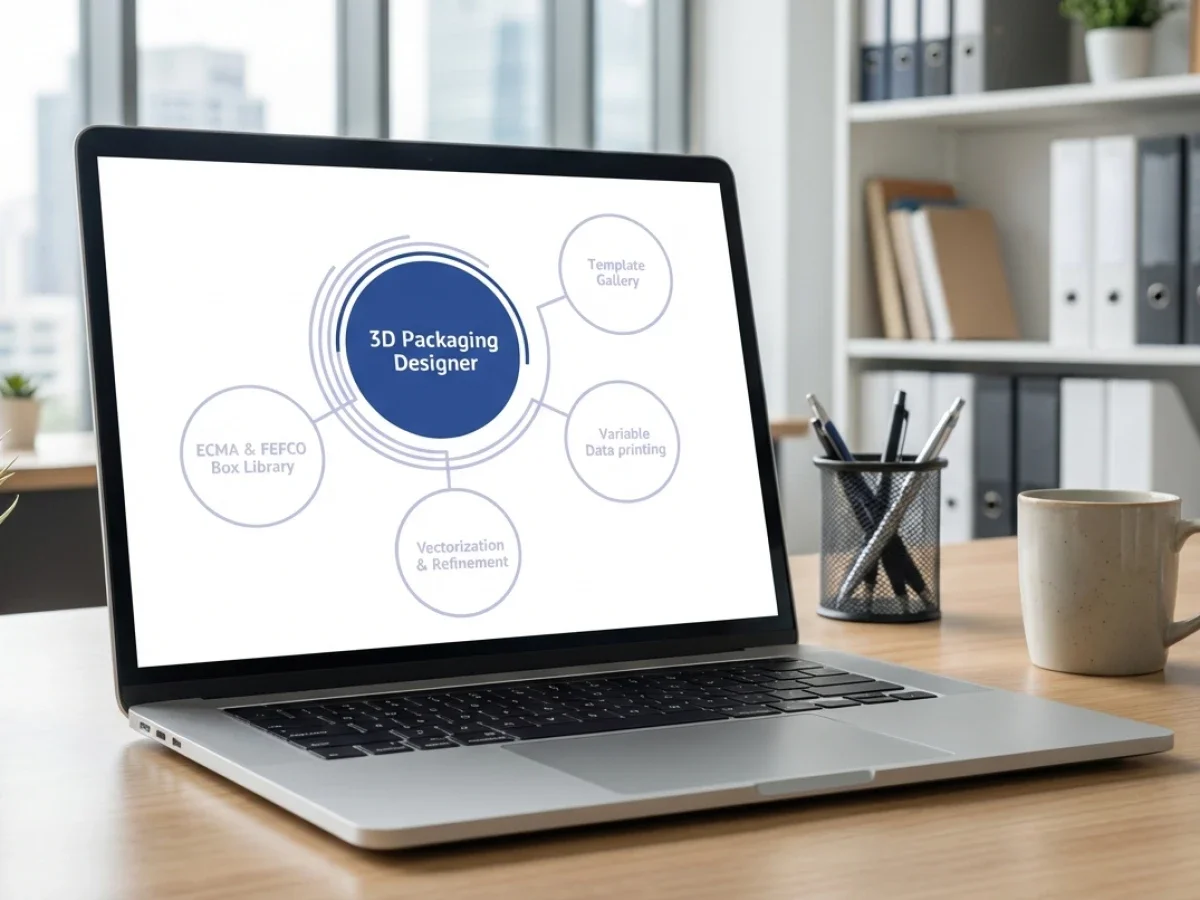
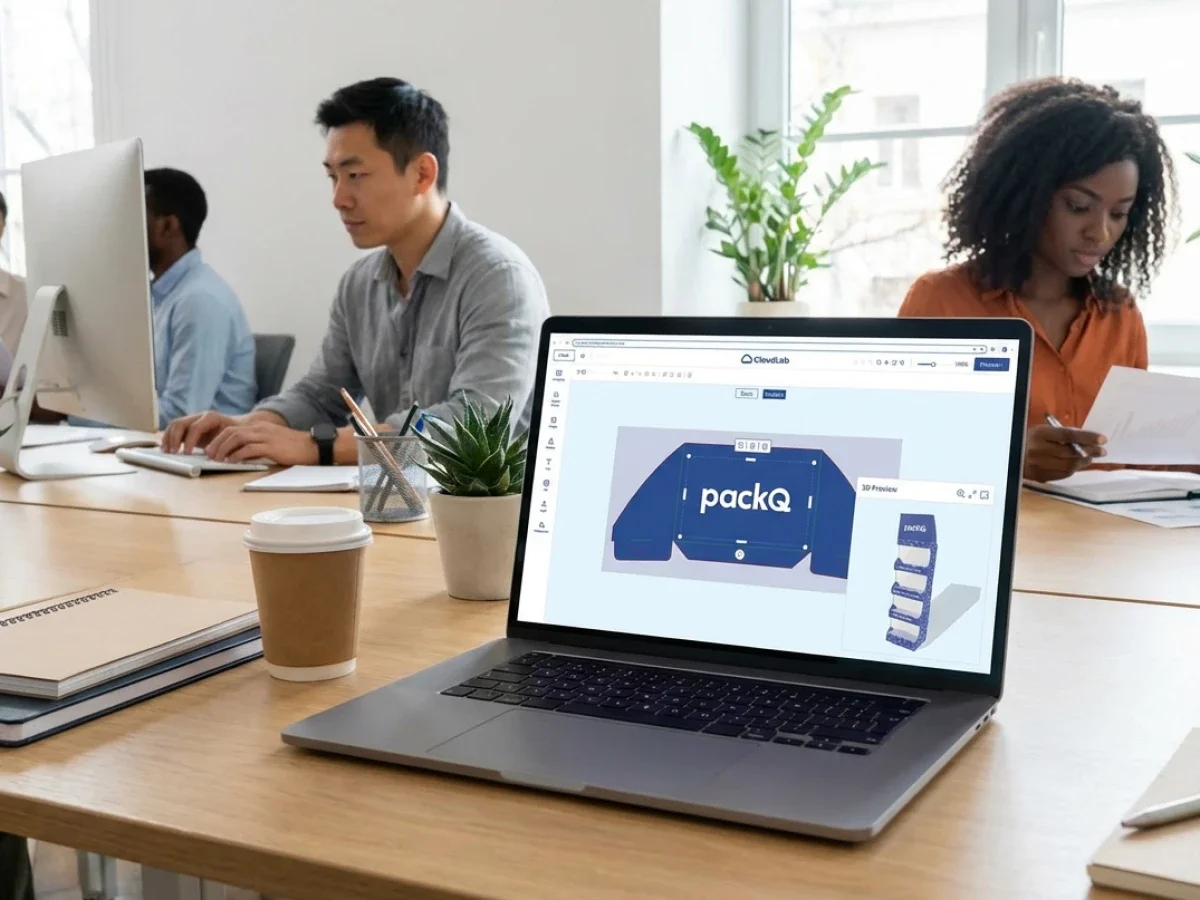
Packaging decisions require visual certainty. packQ provides this through a browser-based 3D packaging designer with real-time rendering and synchronized 2D and 3D views.
Every change to dimensions, materials, or artwork updates the structural model instantly. The preview reflects actual construction logic rather than an approximation. This eliminates ambiguity during approval and reduces back-and-forth between sales, customers, and production.
For printers, this means faster approvals and fewer costly corrections after order placement.
ECMA and FEFCO as Production Standards in Digital Form
Efficiency in packaging production depends on standardization. packQ integrates ECMA and FEFCO standards directly into the platform, covering approximately 120 ECMA folding cartons, 290 FEFCO corrugated designs, and 50 POS display types.
These standards are implemented as parametric models rather than static templates. Users can adjust dimensions and options while the system enforces construction rules automatically.
This approach allows printers to offer customization without losing control over manufacturability, a balance that easy-to-use print shop software solutions typically cannot achieve.
Embedding Packaging Intelligence into the Workflow
Many printers rely on a small group of specialists to validate packaging jobs. This knowledge dependency limits scalability and introduces operational risk.
packQ embeds packaging intelligence directly into the configuration process. Construction logic, tolerances, and validation rules are enforced automatically. This reduces reliance on individual expertise and enables consistent quality across higher volumes.
Packaging knowledge becomes part of the system rather than a bottleneck.
AI Designer Suite and Prepress Efficiency
Artwork quality remains a major source of inefficiency in print and packaging workflows. packQ addresses this with an integrated AI Designer Suite.
Raster images can be vectorized, resolution can be enhanced using Crispify with four-times higher output resolution, and backgrounds can be removed directly in the browser. These capabilities reduce manual prepress effort and accelerate job preparation.
For printers, this translates into higher throughput without increasing prepress headcount.
Variable Data Printing and Mass Customization
Variable Data Printing is increasingly relevant for both print and packaging. packQ supports PDF/VT-based Variable Data Printing, enabling mass customization down to lot size one.
Each variant is generated within the same structural and validation framework. This ensures that personalization does not compromise production stability.
For printers serving marketing campaigns, regulated industries, or personalized packaging use cases, this capability opens new revenue streams.
Dynamic Pricing as a Core Capability
Pricing complexity increases as products become more configurable. packQ integrates dynamic pricing in real timedirectly into the configuration process.
Dimensions, materials, print options, and quantities are calculated instantly. This transparency accelerates decision-making and reduces the need for manual quoting.
For printers, automated pricing improves scalability and protects margins.
Dynamic Preflight Check for Error Prevention
Quality issues in print and packaging often originate early but are detected late. packQ shifts quality control upstream with a Dynamic Preflight Check.
Resolution, color mode, bleed, and font usage are validated during configuration. Errors are addressed before an order is placed, not after production planning has begun.
This proactive approach reduces waste and increases operational predictability.
Headless, API-First Architecture for MIS Integration
Web to print for printers only works at scale when tightly integrated into MIS and ERP systems. packQ was designed as a headless, API-first platform, supporting REST, SOAP, and JSON interfaces.
This architecture allows packQ to connect seamlessly with existing system landscapes. Order data, production parameters, and pricing information flow automatically between systems.
Printers can extend their digital capabilities without disrupting established workflows.
Production-Safe Output Without Manual Interpretation
Every configuration in packQ generates production-safe PDF output and CAD-accurate die-lines. There is no interpretative layer between customer approval and production.
What is approved in 3D is exactly what reaches the production floor. This consistency is essential for automation and a key differentiator compared to traditional web to print software.
Web-to-Pack Use Cases for Printers
packQ supports a wide range of scenarios relevant to modern printers.
The platform enables:
- B2B portals with customer-specific pricing and assortments
- B2C storefronts for standardized packaging products
- Hybrid open-shop and closed-shop models
All scenarios operate on the same automation backbone and integrate into the same MIS environment.
Impact on Printing and Packaging Operations
For printers expanding into packaging, Web-to-Pack changes operational economics. Small orders become profitable. Engineering effort per job decreases. Throughput increases without proportional growth in staff.
packQ allows printers to scale complexity without scaling cost.
Benefits for Brands and Industrial Customers
Brand owners like Colordruck Baiersbronn benefit from faster approvals, consistent quality, and decentralized ordering within controlled frameworks. Packaging becomes a strategic asset rather than a bottleneck.
Industrial customers gain transparency, repeatability, and reliable lead times. Procurement processes align with modern digital expectations.
Technology Teams and Print 4.0 Readiness
From a technology perspective, CloudLabs packQ aligns with Industry 4.0 and Print 4.0 principles. Standardized data, automation, and API-based integration support long-term scalability.
IT teams gain flexibility. Production teams gain stability. The organization gains resilience.
Web to Print for Printers vs. Web-to-Pack Platforms
The distinction between web to print for printers and Web-to-Pack platforms lies in scope. Web to print focuses on ordering and layout. Web-to-Pack focuses on production intelligence.
packQ bridges this gap, enabling printers to evolve their offerings without replacing their core systems.
Integration of Web to Print for Printers
Web to print for printers remains a critical capability, but its value depends on deep integration and production awareness. Easy-to-use print shop software solutions simplify ordering but fall short when complexity increases. packQ extends web to print for printers into Web-to-Pack by combining real-time 3D, ECMA/FEFCO standards, automation, and API-first MIS integration. For printers preparing for Print 4.0, this evolution is not optional. It is strategi.
Web to print for printers delivers value only when seamlessly integrated into MIS and production workflows. Easy-to-use print shop software solutions reach their limits as complexity grows and how Web-to-Pack platforms extend digital print commerce. By combining real-time 3D packaging design, deep ECMA and FEFCO integration, AI-supported artwork optimization, dynamic pricing, preflight validation, and API-first architecture, packQ positions itself as a premium Web-to-Pack solution for printers, packaging manufacturers, brands, and technology teams.

.webp)