
Web to Print Solutions Comparison for Industrial Print

A web to print solutions comparison only delivers value when production complexity, integration depth, and scalability are considered. Generic platforms perform well in flat print but fail in packaging and industrial scenarios. packQ positions itself as a premium Web-to-Pack platform that redefines what the best web to print solution means for complex manufacturing environments.
Web to Print Solutions Comparison at an Industry Turning Point
A web to print solutions comparison is no longer a purely commercial exercise. What once focused on storefront usability, template editing, and checkout convenience has become a strategic decision with long-term operational consequences. As print businesses diversify into packaging, textiles, and large-format applications, the limitations of traditional web to print platforms become increasingly visible.
Digital ordering alone no longer creates differentiation. The decisive factor is how deeply a solution integrates into production logic, system landscapes, and industrial workflows. This shift fundamentally changes how the best web to print solution should be evaluated.
For decision-makers, the question is no longer which platform looks best in a demo. The real question is which solution can scale complexity without scaling risk.
Why Web to Print Solutions Must Be Compared by Industry Context
A meaningful web to print solutions comparison must start with industry context. Flat commercial print, textile printing, large-format signage, and packaging each follow different production rules. A solution optimized for one domain often fails in another.
Generic web to print platforms typically assume that products are page-based, dimensions are static, and production variability is limited. This assumption holds for business cards or flyers. It breaks down as soon as products become physical objects with structure, material behavior, and finishing dependencies.
The best web to print solution is therefore never universal. It is context-specific, and nowhere is this more evident than in packaging.
The Hidden Gap in Most Web to Print Solutions
Most web to print solutions excel at ordering efficiency but struggle with manufacturing intelligence. They simplify configuration and checkout while delegating production validation to downstream processes. This creates a structural gap between customer input and production reality.
In low-complexity environments, this gap is manageable. In industrial printing, it becomes a liability.
Packaging, textile, and large-format printing introduce constraints that cannot be validated visually alone. Geometry, material thickness, folding behavior, and finishing compatibility must be correct before production begins. When software fails to enforce these constraints, organizations compensate with manual effort.
A web to print solutions comparison that ignores this gap inevitably leads to suboptimal decisions.
Packaging as the Stress Test for Web to Print Platforms
Packaging represents the most demanding use case in any web to print solutions comparison. Unlike flat print, packaging is a constructed product. Structure comes before design, and production constraints govern every decision.
Traditional web to print platforms treat packaging as a printable surface. They rely on uploaded die-lines, static previews, and manual checks. This approach does not scale.
In packaging, errors propagate quickly. A single incorrect configuration can disrupt entire production runs, affect logistics, and create waste. The cost of late-stage correction is exponentially higher than in flat print.
This is why packaging exposes the true limitations of generic web to print solutions.
From Web to Print Solutions Comparison to Web-to-Pack Evaluation
As packaging enters the digital ordering space, the focus shifts from web to print solutions comparison to Web-to-Pack evaluation. Web-to-Pack platforms embed packaging intelligence directly into the ordering process.
They enforce construction rules, validate manufacturability in real time, and generate production-safe output automatically. This fundamentally changes how risk is managed.
Instead of correcting errors after order placement, Web-to-Pack platforms prevent them by design.
packQ was created precisely to address this shift.
packQ as a Premium Web-to-Pack Platform
packQ is a specialized Web-to-Pack platform developed by CloudLab Solutions and awarded the InterTech Technology Award. It is not a traditional web to print solution, but a purpose-built platform for packaging-centric workflows.
packQ extends the concept of digital ordering into the domain of industrial manufacturing. It connects customer configuration directly with production logic, eliminating manual interpretation.
In any serious web to print solutions comparison that includes packaging, packQ represents a distinct category rather than a feature variant.
Real-Time 3D as a Differentiation Criterion
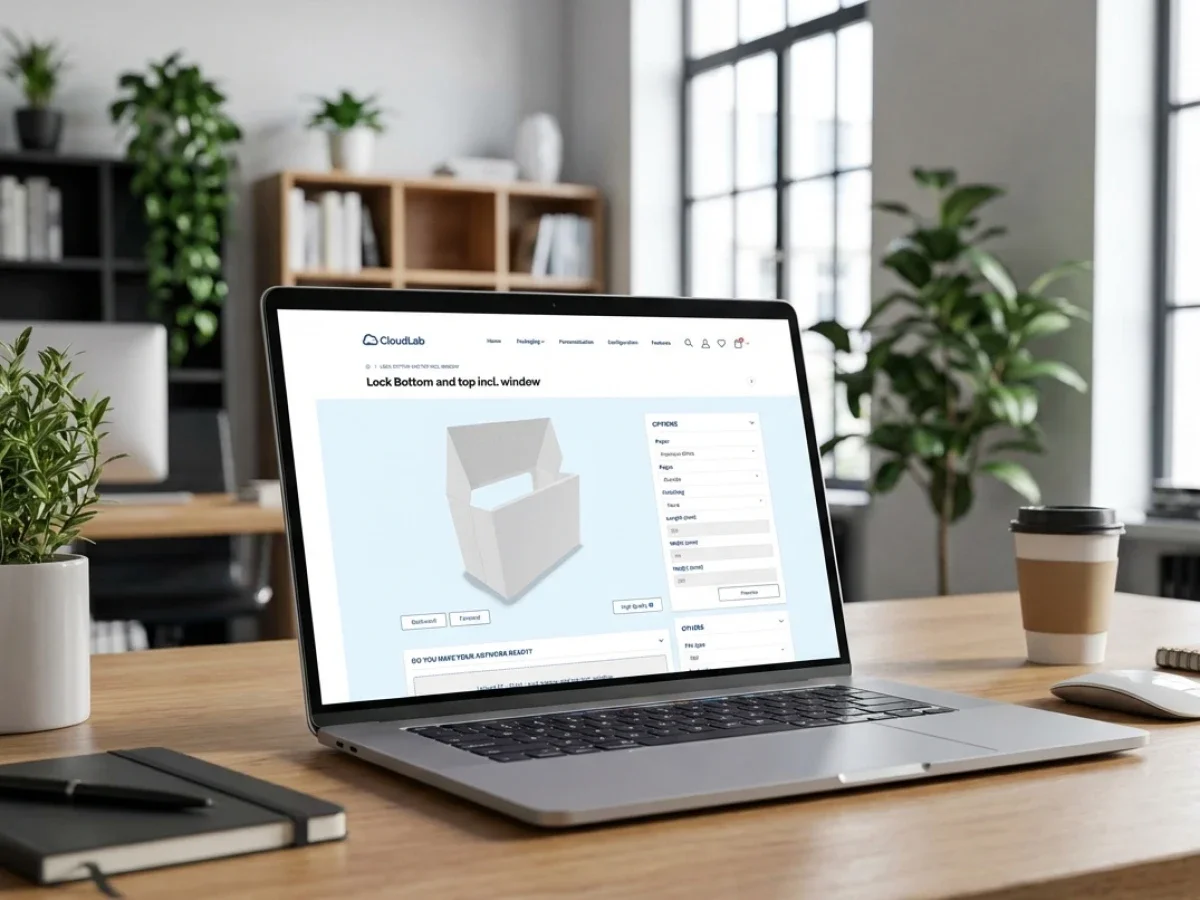
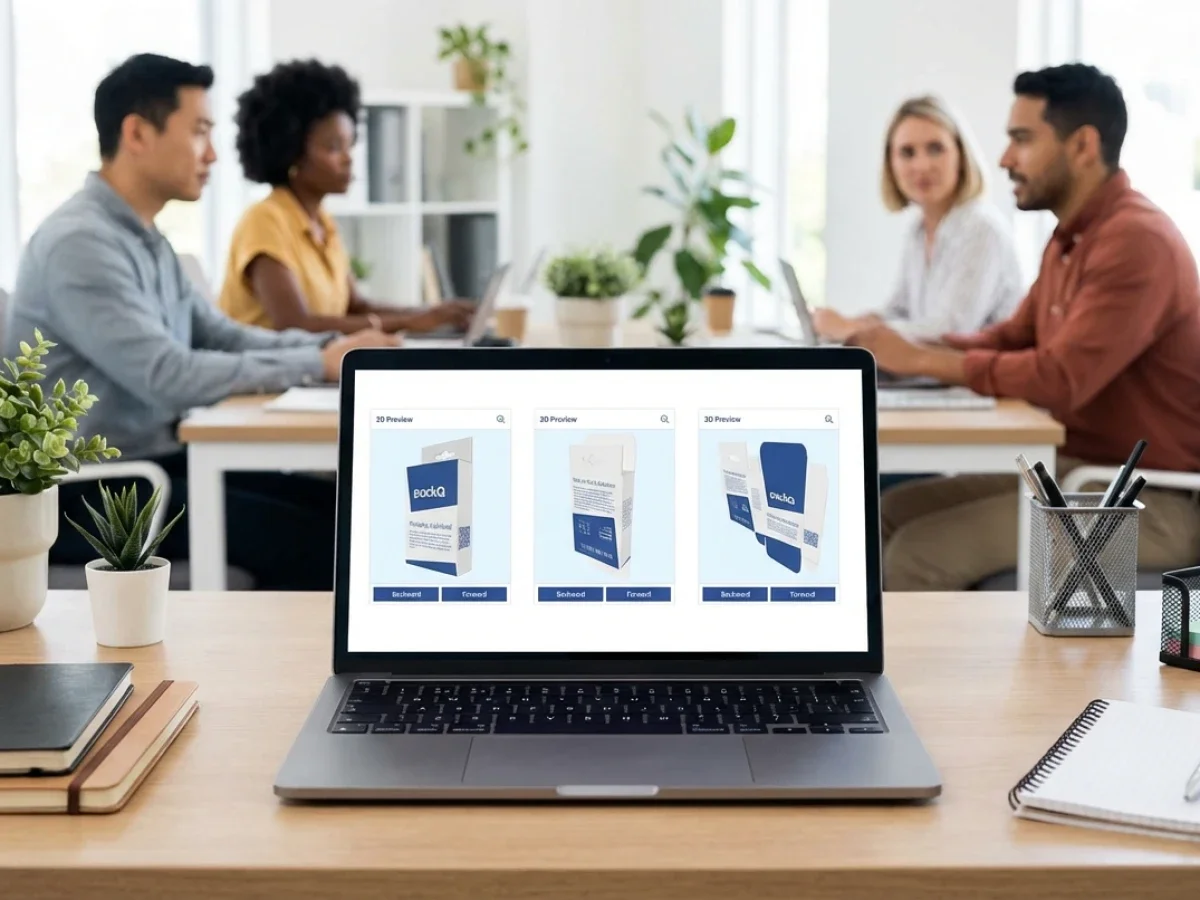
One of the clearest differentiators in a web to print solutions comparison is how a platform handles visualization. Most solutions rely on static previews or simplified mockups. packQ uses a browser-based 3D packaging designer with real-time rendering and synchronized 2D and 3D views.
Every change to dimensions, materials, or layout updates the structural model instantly. The visualization reflects actual CAD-based construction logic, not an approximation.
This capability transforms approval workflows. Stakeholders approve what will be produced, not a visual guess. Faster approvals and fewer corrections become a structural advantage.
ECMA and FEFCO as Built-In Production Standards
Another decisive factor in a web to print solutions comparison is how standards are handled. packQ integrates ECMA and FEFCO standards directly into the platform, covering approximately 120 ECMA folding cartons, 290 FEFCO corrugated designs, and 50 POS displays.
These standards are implemented as parametric models. Users can adapt dimensions while the system enforces construction rules automatically.
This approach enables customization without sacrificing manufacturability. It is a level of control that generic web to print platforms do not offer.
AI-Supported Design in Industrial Contexts
Design assistance is often highlighted in web to print solutions comparison, but the context matters. packQ’s AI Designer Suite is not a marketing add-on. It is a production accelerator.
Raster images can be vectorized, resolution enhanced using Crispify with four-times higher output resolution, and backgrounds removed directly in the browser. These capabilities reduce manual prepress effort and stabilize data quality.
In industrial environments, this translates directly into throughput gains.
Variable Data Printing Beyond Marketing
Variable Data Printing is often evaluated as a personalization feature. In packaging and industrial print, it serves broader purposes such as traceability, compliance, and batch differentiation.
packQ supports PDF/VT-based Variable Data Printing, enabling lot size one without compromising production stability. Each variant is generated within the same validation framework.
This ensures that variability does not introduce operational risk, a critical criterion in any best web to print solution assessment.
Dynamic Pricing as an Operational Requirement
Pricing complexity increases with configurability. packQ integrates dynamic pricing in real time, calculating dimensions, materials, print options, and quantities instantly.
This capability eliminates manual quoting and accelerates decision-making. For B2B environments, it enables scalable self-service without margin erosion.
In a web to print solutions comparison, pricing automation is no longer optional. It is a prerequisite for scale.
Dynamic Preflight Check and Error Prevention
Quality assurance is a decisive but often overlooked factor in web to print solutions comparison. packQ integrates a Dynamic Preflight Check that validates resolution, color mode, bleed, and font usage during configuration.
Errors are detected before an order is placed, not after production planning has begun. This upstream validation reduces waste and increases predictability.
In complex production environments, this capability directly impacts profitability.
API-First Architecture and System Integration
The best web to print solution must integrate seamlessly into existing system landscapes. packQ is built as a headless, API-first platform, supporting REST, SOAP, and JSON interfaces.
This architecture enables deep integration with ERP, MIS, and production systems. packQ acts as a digital front end without disrupting established workflows.
In enterprise environments, this flexibility is a decisive advantage.
Production-Safe Output as a Non-Negotiable Standard
Every configuration in packQ generates production-safe PDF output and CAD-accurate die-lines. There is no interpretative layer between approval and production.
What is approved in 3D is exactly what reaches the production floor. This consistency is essential for automation and sets packQ apart in any web to print solutions comparison involving packaging.
Comparing Web to Print Solutions Across Industries
A realistic web to print solutions comparison must acknowledge that different industries impose different requirements.
Flat print prioritizes speed and simplicity. Textile printing introduces material behavior and color management complexity. Large-format printing adds logistics and finishing constraints. Packaging combines all of these challenges and adds structural logic.
packQ addresses the most complex end of this spectrum. By solving packaging, it inherently supports less complex scenarios.
Open-Shop and Closed-Shop Scenarios
packQ supports both B2B and B2C models through open-shop and closed-shop scenarios.
The platform enables:
- Open-shop environments for standardized products
- Closed portals for brand-controlled assortments
- Hybrid models combining both approaches
All scenarios operate on the same automation backbone and system integration layer.
Impact on Printers and Packaging Manufacturers
For printers and packaging manufacturers, packQ changes operational economics. Small orders become profitable. Engineering effort per job decreases. Throughput increases without proportional staffing growth.
This ability to scale complexity without scaling cost is a defining characteristic of the best web to print solution in industrial contexts.
Value for Brands and Industrial Buyers
Brand owners benefit from faster approvals, consistent quality, and decentralized ordering within controlled frameworks. Packaging becomes a strategic asset rather than an operational bottleneck.
Industrial buyers gain transparency, repeatability, and reliable lead times. Procurement processes align with modern digital expectations.
Technology Teams and Print 4.0 Alignment
From an IT perspective, packQ aligns with Industry 4.0 and Print 4.0 principles. Standardized data, automation, and API-based integration enable long-term scalability.
Technology teams gain flexibility. Production teams gain stability. Organizations gain resilience.
Web to Print Solutions Comparison Revisited
A meaningful web to print solutions comparison must go beyond feature checklists. It must evaluate how deeply a platform understands production, integrates into systems, and manages risk.
In packaging and industrial print, the best web to print solution is no longer a traditional web to print platform. It is a Web-to-Pack platform.
packQ embodies this shift.
Comparisons of Industrial Print Solutions
A web to print solutions comparison that includes packaging, textiles, and large-format printing reveals a clear conclusion. Generic platforms excel at ordering but fail at manufacturing intelligence. packQ redefines what the best web to print solution means by extending digital ordering into production logic. With real-time 3D, ECMA/FEFCO standards, AI-supported design, dynamic pricing, preflight validation, and API-first integration, packQ positions itself as the leading Web-to-Pack platform for complex industrial printing environments.
A web to print solutions comparison must consider production complexity, not just storefront usability. Traditional platforms fall short in packaging, textile, and large-format printing, and how Web-to-Pack platforms redefine the category. By combining real-time 3D packaging design, deep ECMA and FEFCO integration, AI-powered design tools, dynamic pricing, preflight validation, and API-first architecture, packQ positions itself as the best web to print solution for industrial-scale, production-safe workflows.


.webp)


