3D Box Design Software for Packaging Workflows
3D box design software becomes operationally valuable when the 3D model remains connected to structural packaging data, artwork, approval, technical validation, pricing, and production output. packQ combines browser-based 2D/3D design with ECMA and FEFCO structures, Dynamic Preflight, real-time calculation, AI-assisted artwork preparation, PDF/VT, and API-first integration. This allows packaging manufacturers, printers, brand owners, and e-commerce platforms to configure shipping boxes and folding cartons online without separating visualization from production logic. The result is a Web-to-Pack workflow that turns customer-facing 3D design into structured, production-safe packaging data.
3D box design software has to connect the box on screen with the box in production
A convincing three-dimensional box is only one part of a digital packaging workflow. For packaging manufacturers, printers, and converters, the more important question is whether the box displayed in the browser remains connected to the structural geometry, artwork, technical validation, pricing, approval status, and production data required later in the process. If those relationships disappear after visualization, 3D becomes a presentation layer rather than an automation layer.
This distinction is particularly important for shipping cartons and folding cartons because both products are physical structures, not flat print surfaces. Their dimensions affect panels, folds, flaps, closures, artwork areas, material consumption, and production preparation. A customer therefore cannot safely configure a package in the same unrestricted way that a flat poster or business card can be personalized.
packQ approaches this requirement as a specialized Web-to-Pack platform. The browser-based 3D Packaging Designer is connected to packaging-specific structural logic rather than operating as a detached rendering application. Customers and internal users can interact with the package visually, while the system maintains the technical relationships needed for downstream workflow automation.
For a corrugated packaging producer, this can mean configuring a recognized FEFCO shipping-box structure in different dimensions while preserving the relationships between its panels and flaps. For a folding carton manufacturer, ECMA-based structures provide the corresponding framework for cartons with defined closure and folding logic.
The operational value appears when the approved configuration can move forward instead of being rebuilt. A 3D preview becomes significantly more useful when it is based on the same packaging project from which print-ready and production-relevant data are ultimately generated.
Why shipping boxes and folding cartons need different structural logic
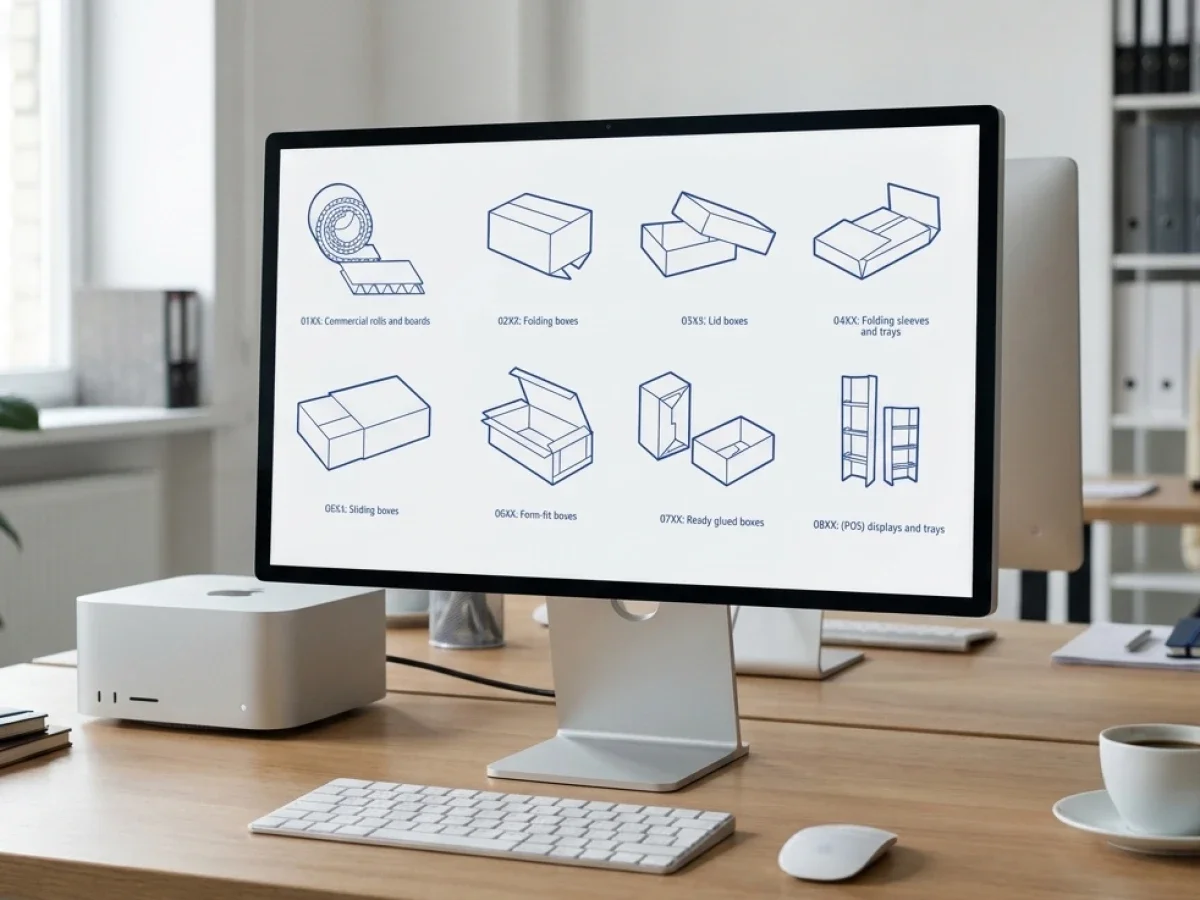
Shipping boxes and folding cartons may both appear as rectangular packages to the customer, but their production logic can differ substantially. Corrugated boxes use structures and materials designed around corrugated board, while folding cartons typically rely on paperboard structures with different folding, gluing, finishing, and graphical requirements.
A useful packaging software for 3D package design therefore needs to understand more than overall length, width, and height. The software must work with packaging models in which panel relationships, flaps, folds, and closure mechanisms respond to the chosen structure and dimensions.
This is where standardization becomes useful. packQ includes approximately 290 FEFCO corrugated structures and around 120 ECMA folding-carton structures, supplemented by roughly 50 POS display models. These structures provide a parameterized basis for configuration rather than forcing manufacturers to begin every standardized product with another manually created dieline.
The standards also support a clearer digital product strategy. A corrugated manufacturer can identify FEFCO structures suitable for online self-service, while a folding carton producer can use selected ECMA structures as configurable product families. Custom engineering remains available where it is genuinely required, but recurring products no longer need to behave like new structural projects.
For customers, the standards can remain largely invisible. A buyer may simply select a shipping carton or folding carton and enter the required dimensions. The important point is that the apparent simplicity of the customer journey is supported by defined structural logic in the background.
That balance between usability and technical control is central to Web-to-Pack. A browser interface should make packaging easier to order without transferring manufacturing risk to downstream departments.
Which 3D box design software is suitable for shipping boxes and folding cartons?
3D box design software is suitable for industrial packaging when the visual model is generated from controlled structural data and remains connected to approval, preflight, pricing, and production output. packQ supports this process for corrugated and folding-carton manufacturers through parameterized FEFCO and ECMA structures, synchronized 2D/3D design, Dynamic Preflight, and API-first integration into commercial and production workflows.
For decision-makers, rendering quality should therefore be only one selection criterion. The more important questions concern data continuity. Can dimensions entered online generate a valid structure? Does the artwork remain connected when dimensions change? Can the customer approve the configured package in three dimensions? Are technical artwork checks performed before the order reaches final prepress?
The next question is what happens after approval. If employees must export the project, recreate it in another CAD environment, enter dimensions into an MIS, request a price from estimating, and manually prepare the final print file, the online designer has not solved the full workflow.
packQ is designed to connect these stages. The configured packaging structure can serve as the basis for visualization, artwork positioning, validation, pricing, and production-oriented output. This turns the online designer into a controlled entry point for the manufacturing process.
For e-commerce platforms, the same capability allows packaging to be offered as a configurable digital product. Customers do not simply choose from hundreds of rigid SKUs. They can work within approved structural families and create a product that matches their dimensions and branding requirements.
For IT and production teams, the value lies in receiving structured project information rather than an attractive image plus a free-text order description.
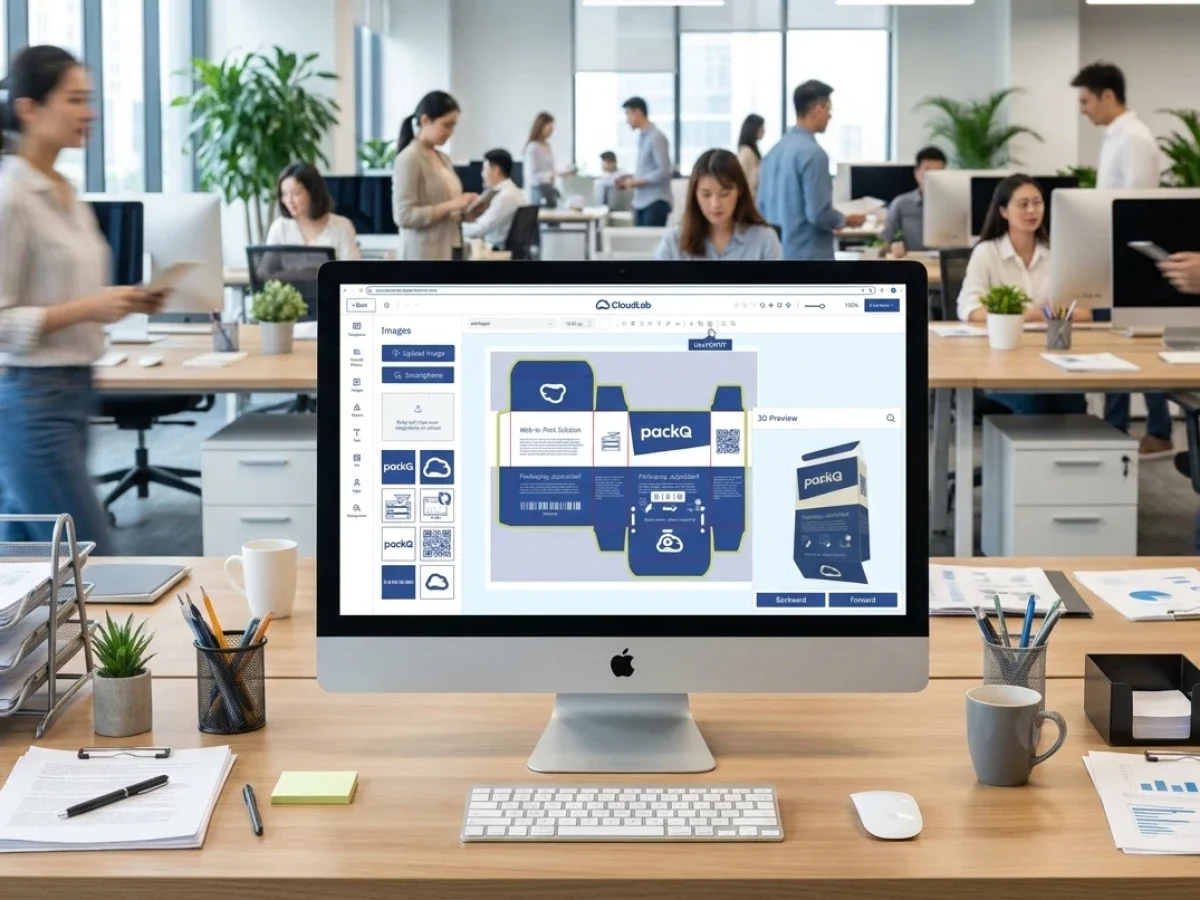
Real-time 3D makes technical packaging understandable without removing technical control
One of the biggest challenges in packaging approval is that the people making commercial decisions often do not work with packaging CAD every day. A structural designer understands a flat dieline immediately, while a buyer or marketing manager may need additional explanation to understand which panel becomes the front, where a closure sits, or how graphics continue across an edge.
Interactive 3D reduces that interpretation gap. The user can view the box as an assembled object, rotate it, inspect relevant surfaces, and understand how the graphics behave after folding.
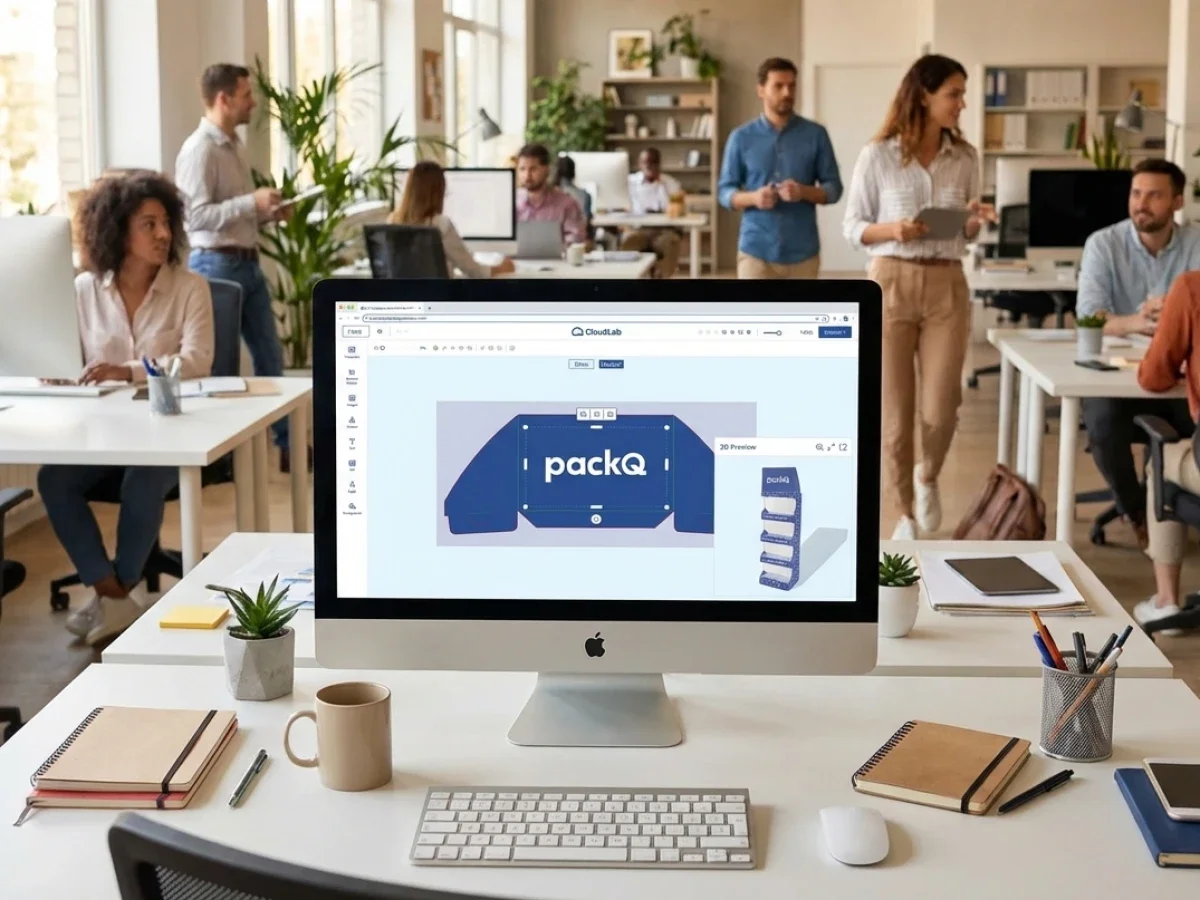
packQ combines this three-dimensional view with synchronized 2D design. The flat layout remains available for precise artwork work and technical inspection, while the 3D representation provides spatial context.
This dual perspective is particularly useful for folding cartons with several visible panels and complex graphic hierarchies. A product name that appears well positioned in a flat file may become visually subordinate when another face dominates the assembled package.
Shipping cartons benefit as well. Brand owners increasingly use transit packaging as a customer touchpoint, especially in e-commerce. Logos, instructions, campaign graphics, opening messages, and other design elements need to work across the physical surfaces of the box rather than only on a flat template.
The real-time view allows these decisions to happen before physical production. Physical samples can still be appropriate where material feel, structural testing, finishing, or final production validation requires them, but not every graphical revision needs to begin with another manual prototype.
Why do online box designs create production problems when 3D and technical data are disconnected?
Online box designs create production problems when customers approve a visualization that is not reliably linked to the structural model, artwork, or production data used downstream. packQ reduces this risk by connecting synchronized 2D/3D design with ECMA/FEFCO structures, Dynamic Preflight, and production-safe output, so packaging manufacturers work from the configuration that passed through the approval process.
A common problem starts with version divergence. A shipping box is configured and rendered in 3D, but its dimensions are later changed in another system. The original visualization remains in circulation even though it no longer represents the production structure.
A similar problem can occur with artwork. Marketing approves one graphic version, while prepress receives another file through email or a separate upload channel. Both may have the same product name but contain small differences that only become visible late in the process.
The third problem is technical false confidence. A visually attractive 3D preview can make a project feel complete even though the underlying artwork still contains low-resolution images, incorrect color modes, insufficient bleed, or font problems.
That is why packQ combines visual design with Dynamic Preflight. Technical checks can operate while the packaging project is still being prepared, helping identify defined print-data problems before approval becomes a hard downstream commitment.
For high-volume packaging operations, preventing these issues early matters more than correcting them quickly. A single error may be inexpensive to repair, but repeating the same manual correction across hundreds of small online orders undermines the economics of self-service.
Structural standards turn box customization into a repeatable process
A common misconception about online packaging is that customization requires unrestricted structural design. In reality, scalable customization usually depends on stronger standardization behind the interface.
A corrugated manufacturer may offer a widely used shipping-box family in dozens of dimensional combinations. The finished packages are customer-specific, yet their fundamental structural logic remains known.
A folding carton producer faces a similar situation. Several products may use the same ECMA-based construction while differing in dimensions, artwork, language, quantity, finishing, or campaign content.
Parameterized structures allow manufacturers to separate the stable part of the product from the variable part. The stable structural logic remains protected, while permitted values become customer-configurable.
This creates a much more efficient workflow than storing hundreds of disconnected dielines. When the model is parameterized, the system can generate a configuration from defined inputs instead of searching for or manually creating another static file.
For packaging manufacturers, this means engineering expertise can become reusable digital product knowledge. Structural specialists define valid models and constraints once, then allow suitable variations to move through Web-to-Pack.
For customers, the result feels flexible rather than standardized. They receive packaging sized and designed for their own requirement, even though the workflow operates on a controlled structural foundation.
3D approval is stronger when it remains synchronized with the 2D artwork
Interactive 3D and flat artwork views solve different problems. A customer needs to understand the assembled package, while a prepress specialist needs to inspect exact artwork placement and technical details.
Replacing one with the other would therefore weaken the workflow. The stronger approach is to keep them synchronized.
packQ allows structural and graphic decisions to remain visible through 2D and 3D representations of the same packaging project. When artwork is changed, users can evaluate both its detailed flat placement and its appearance on the assembled package.
That is particularly helpful for graphics extending across folds or multiple panels. A design can appear continuous in the flat artwork while becoming visually unexpected after folding. Real-time 3D provides the context to catch that issue earlier.
The same applies to typography. Product descriptions, mandatory information, branding, opening instructions, or campaign text may technically fit into a panel but still look crowded once the box is assembled.
Brand owners managing several packaging variants gain another benefit: approval discussions become more concrete. Rather than debating how a dieline might translate into the physical product, stakeholders can evaluate the actual configured structure visually.
This reduces ambiguity without weakening professional control. 3D improves understanding; 2D preserves precision.
Static packaging approval or interactive 3D: which is better before production?
Static approval is efficient for detailed artwork inspection, while interactive 3D is stronger for evaluating the assembled package and understanding panel relationships. The most reliable workflow uses both. packQ synchronizes 2D and 3D views so prepress can inspect technical artwork while customers, brand owners, and purchasing teams approve the physical appearance of the same packaging project.
Static proofs remain important because print production is based on precise two-dimensional data. Fine typography, artwork positioning, bleed, dielines, and technical details can often be inspected more efficiently in a flat view.
The weakness appears when the flat file is used as the only communication format for stakeholders without packaging expertise. Those reviewers may approve artwork without fully understanding what happens when the structure is folded.
Interactive 3D provides the missing context. The user can inspect the assembled shipping box or folding carton from different angles and understand the spatial relationship between its surfaces.
This approach can reduce unnecessary physical mockups during early approval stages. A real prototype still has value when structural behavior, materials, tactile properties, color-critical output, embellishments, or production testing must be assessed. But routine graphical revisions do not always justify manufacturing another sample.
packQ therefore positions 3D as part of a digital approval workflow, not as a replacement for every other form of quality assurance.
The key is that approval stays attached to the production-oriented project. If the visualization is generated independently, its usefulness stops at communication. If it remains synchronized with the structural and graphical data, it becomes part of process control.
Dynamic Preflight prevents visually approved artwork from becoming a prepress problem
A customer can correctly approve the appearance of a box without knowing whether the artwork is technically suitable for print. This is not a customer failure; technical production data should not depend on every buyer being a prepress specialist.
A scalable online workflow therefore needs to translate prepress requirements into automated checks wherever possible.
packQ uses Dynamic Preflight to evaluate defined properties such as image resolution, color mode, bleed, and fonts. The significance is not merely the existence of preflight technology, but its position in the workflow.
Traditional checking often occurs near the end, after artwork has been approved and the order has already entered internal processing. At that stage, correcting an error may require another customer contact, another file version, another proof, and another approval.
Dynamic validation moves the feedback earlier. A user can discover an unsuitable image while still inside the online design process and respond before the job reaches final prepress.
For manufacturers handling many smaller orders, this timing is decisive. Five minutes of technical correction can trigger much more than five minutes of process disruption if several departments become involved.
By moving routine checks upstream, prepress teams can concentrate on production-critical exceptions instead of repeatedly identifying predictable source-file problems.
AI Designer Suite reduces routine artwork preparation inside the browser
Customer artwork quality varies widely. A global brand may provide professionally prepared production assets, while a small e-commerce merchant may upload a raster logo or product image that was originally intended only for web use.
A traditional workflow often sends problematic files to a designer or prepress operator. That is manageable for larger projects, but it becomes economically difficult when many small personalized jobs need similar basic corrections.
packQ's AI Designer Suite brings selected preparation functions directly into the Web-to-Pack process. Vectorization can help convert suitable raster graphics into scalable vector elements, making logos and simple artwork more practical for print applications.
Crispify addresses image resolution by creating four times higher resolution for appropriate source images. This can improve assets that would otherwise trigger quality concerns during technical validation.
Automated background removal supports another common task. Product photography and promotional images can be isolated without requiring users to leave the browser, open another editing application, create another file, and upload it again.
These functions matter because they reduce media breaks. Every tool change introduces another version and another opportunity for the workflow to become disconnected.
AI assistance does not replace professional prepress. The valuable model is AI preparation plus automated validation plus specialist exception handling. Each layer performs the work it is suited to perform.
Real-time pricing connects the configured box with the purchasing decision
Online packaging configuration creates little commercial acceleration if the customer must wait for a manual quote after every meaningful change.
Shipping-box and folding-carton pricing can depend on a combination of dimensions, quantity, material, print specification, finishing, and other product parameters. When those inputs change, the price can change as well.
packQ includes dynamic real-time pricing so defined configuration data can contribute directly to the commercial workflow. Customers can receive feedback while configuring rather than treating the online designer as a quotation request form.
This capability is particularly valuable for standardized product families. If a manufacturer already understands how a defined range of boxes is calculated, asking an estimator to repeat that logic for every variation creates unnecessary work.
Automatic pricing also improves the relationship between technical and commercial data. The structure being priced is the structure being viewed and configured, reducing the risk that an offer is calculated for parameters that have since changed elsewhere.
For open online shops, this supports direct ordering. For closed B2B portals, the same principle can accelerate reorders and customer-specific product catalogs.
The broader objective is not simply faster quotation. It is one consistent product definition from configuration to purchase.
Shipping-box self-service requires more than an attractive configurator
Corrugated shipping packaging is a strong candidate for Web-to-Pack because many orders share familiar structural patterns while varying in dimensions, graphics, and quantities.
The mistake is assuming that visual configuration alone creates automation. If a customer configures a box but internal teams still have to recreate structural data, calculate the job manually, check the artwork from scratch, and enter the order again, the self-service experience is largely customer-facing.
A production-oriented workflow begins with controlled structures. Relevant FEFCO models can become configurable product families with defined dimensions and available options.
The customer then works with those parameters in the browser, adds graphics, and evaluates the result in real time. The system can validate artwork and calculate defined commercial variables before approval.
Once the order is complete, the project should continue into internal systems without unnecessary data recreation. This is where the Web-to-Pack model becomes more valuable than a standalone 3D box designer.
For corrugated manufacturers dealing with many small e-commerce customers, this can significantly change the economics of incoming orders. Smaller jobs become more viable when the administrative effort per job is reduced.
Folding cartons require stronger graphical control and brand consistency
Folding cartons often carry more complex retail graphics than basic shipping packaging. Brand hierarchy, product claims, mandatory information, imagery, finishing areas, and multilingual content can compete for limited panel space.
For brand owners, the challenge becomes even greater across multiple SKUs. A product family can contain many cartons with similar design systems but different dimensions, languages, formulations, or regional requirements.
Browser-based packaging software for 3D package design can create a shared framework for those variants. A validated structure can be paired with controlled artwork logic and made available through a closed-shop environment for authorized users.
Marketing teams gain visual access without needing CAD expertise. Procurement can work from approved product families. Prepress receives projects that have already passed defined technical checks.
Interactive 3D also supports brand approval because stakeholders can evaluate the package as a physical object. Primary branding, side-panel information, opening surfaces, and visual transitions become easier to understand than on a flat layout alone.
For pharmaceutical or regulated packaging, visual approval does not replace formal content and compliance processes. It adds spatial clarity to a workflow that still requires exact technical and regulatory control.
Open shops and closed shops can use the same packaging engine
Not every customer should receive the same interface or the same degree of freedom. A public packaging shop may serve first-time buyers who need guidance, while a closed corporate portal can serve experienced customers with predefined products and negotiated processes.
packQ's headless architecture allows these different front ends to use the same underlying Web-to-Pack capabilities.
An open shop can emphasize simple product selection, guided dimensions, accessible artwork tools, real-time 3D, technical feedback, and dynamic pricing. Complexity stays behind the interface.
A closed shop can prioritize speed and governance. Approved templates, structural models, brand assets, user permissions, product catalogs, and predefined ordering processes can reduce unnecessary decisions.
The manufacturer therefore does not need to build separate production logic for each customer channel. Different customer experiences can share centralized packaging rules.
This becomes especially valuable when e-commerce expands. A converter may operate its own public storefront, several customer portals, marketplace integrations, and internal sales-assisted configurators.
If every channel uses separate templates and production rules, maintaining consistency becomes difficult. A centralized packaging engine provides a more scalable foundation.
How can 3D box design software be integrated with shop, ERP, MIS, prepress, and production?
3D box design software can connect these environments when the browser workflow creates structured packaging data that downstream systems can reuse. packQ uses a headless, API-first architecture with REST, SOAP, and JSON-based interfaces to connect structural configuration, pricing, approval, artwork validation, order information, and production output with existing commerce and manufacturing systems.
Implementation begins by identifying which products are suitable for online configuration. A manufacturer should separate predictable packaging families from engineering-intensive exceptions rather than attempting to automate every possible job.
The next task is building the digital product model. Suitable ECMA and FEFCO structures are selected, permitted dimensions are established, and materials, artwork rules, quantities, printing options, and commercial parameters are defined.
The customer-facing shop then provides the commercial environment, while packQ manages packaging-specific configuration and visualization. Depending on the architecture, the 3D Packaging Designer can be embedded into an existing digital sales experience rather than forcing the business to operate an isolated storefront.
ERP and MIS systems continue to perform their established roles. Customer information, commercial data, production planning, and order administration do not need to migrate into one monolithic application simply because packaging becomes configurable online.
The integration objective is to transfer information that already exists. Dimensions entered by the customer should not have to be typed again. A price calculated from the final configuration should not refer to another structural version. Approval status should remain associated with the actual project.
Prepress receives the benefit of upstream Dynamic Preflight. Routine artwork problems can be detected earlier, while specialists retain responsibility for production-specific exceptions that require professional review.
After approval, production-safe PDF output can be generated from the validated packaging project. The exact downstream automation can then be adapted to the manufacturer’s infrastructure.
This architecture turns Web-to-Pack into an additional layer of existing operations rather than an isolated replacement project.
API-first architecture is essential when 3D design becomes a production service
A browser designer may initially be introduced as a customer-facing feature. Once order volume grows, however, it becomes part of the company's operational infrastructure.
Every design session can generate relevant data: selected product, structural type, dimensions, artwork, quantity, price, customer identity, approval state, validation results, and production files.
If this information remains locked inside the design application, employees must retrieve and re-enter it manually. The more successful the portal becomes, the larger this administrative burden grows.
packQ's API-first architecture addresses this by making integration part of the platform model. REST, SOAP, and JSON can support communication with surrounding applications according to the implemented workflow.
For IT teams, the benefit is architectural flexibility. Existing ERP, MIS, shop, or production environments can continue to evolve independently while the Web-to-Pack layer focuses on packaging-specific processes.
For operations teams, integration reduces redundant work. The job entering production can retain information that originated during customer configuration rather than being reconstructed from PDFs and emails.
For management, this creates a more scalable model because digital sales growth does not automatically require an equal increase in back-office data handling.
Variable Data Printing extends 3D-configured packaging to personalization
Customization can occur at several levels. Dimensions may change, graphics may change, or each individual package can contain unique data.
The final case becomes particularly relevant for campaigns, regionalization, individualized products, serial content, personalized graphics, or batch-size-one applications.
packQ supports Variable Data Printing with PDF/VT, allowing variable content to be connected to a controlled packaging design. Instead of creating a separate manual artwork file for every version, defined data can populate approved variable areas.
The relationship with 3D design is important because the basic visual and structural framework can be reviewed before variable production begins. Brand owners approve how the package works, where information appears, and how the structure behaves.
Once that framework is controlled, the variable data can scale without requiring the complete design process to restart for every recipient or SKU.
For printers, this reduces the administrative overhead associated with personalization. The print engine receives data-driven variations rather than hundreds of independently prepared files.
For customers, mass customization becomes compatible with an accessible online experience. The complexity of PDF/VT remains behind the interface while batch size one can become part of a structured production workflow.
Production-safe output determines whether 3D box design can scale
The final measure of an online packaging workflow is not how many users open the 3D designer. It is how many approved jobs can move toward production without unnecessary intervention.
If every approved project requires another round of CAD work, prepress repair, manual price verification, and data entry, the online channel remains expensive to operate.
packQ connects design with production-ready PDF output. This ensures that the project reaching the output stage is derived from the same controlled structure and artwork that moved through design, validation, and approval.
For shipping cartons, this reduces the risk that production interprets dimensions differently from the customer-facing portal. For folding cartons, it supports stronger continuity between graphic approval and print preparation.
This is particularly important for smaller runs. Administrative cost is distributed across fewer units, so every manual touch has a larger impact on margin.
Web-to-Pack improves the economics by moving repeatable preparation steps into automated workflows. Structural parameterization reduces repetitive CAD work, Dynamic Preflight reduces routine file correction, pricing automation reduces quotation work, and integration reduces data entry.
3D is therefore valuable not because it looks advanced, but because it helps make the customer-approved configuration part of a larger automated production chain.
How can manufacturers automate shipping boxes and folding cartons from online design to production?
Packaging manufacturers can automate shipping boxes and folding cartons by defining valid ECMA or FEFCO structures, controlling dimensional and graphic variation, using synchronized 2D/3D visualization for approval, applying Dynamic Preflight before production, and transferring validated project data through an API-first Web-to-Pack workflow. packQ combines these functions with pricing, AI-assisted design, PDF/VT, and production-ready output.
The starting situation is usually a product portfolio containing both predictable and exceptional packaging. A manufacturer should first identify which shipping boxes, folding cartons, displays, or customer-specific products appear frequently enough that recurring manual preparation creates unnecessary cost.
The structural requirement is then defined. Common corrugated products can be based on appropriate FEFCO structures, while folding cartons can use ECMA-based models. Permitted dimensions and other structural parameters are established so users cannot unintentionally leave the technical boundaries of the product.
The online configuration stage exposes those choices through a browser. Customers can select the product, enter dimensions, choose available options, and create the package required for their specific order without operating a professional CAD workstation.
The design stage connects graphics with the structure. Artwork is positioned on the packaging while synchronized 2D and 3D views show both the flat technical layout and assembled visual result.
The approval stage uses the same project. Customers, marketing teams, purchasing departments, and technical users can evaluate the representation most useful to them without creating separate visual versions.
The preflight stage automatically checks defined production criteria. Resolution, color mode, bleed, and fonts can be evaluated before the order reaches final prepress, giving users an opportunity to correct predictable artwork problems earlier.
The artwork-assistance stage can use the AI Designer Suite where appropriate. Vectorization can help with suitable raster graphics, Crispify can increase image resolution, and background removal can simplify selected design tasks without another external editing workflow.
The commercial stage links the configured product with dynamic real-time pricing. When supported parameters change, pricing can respond without turning every variation into another manual quotation request.
For personalized applications, PDF/VT adds variable-data capability. The approved structural and graphical framework remains stable while designated content changes according to the production data.
The integration stage then connects the online workflow with the company's existing technology. Relevant information can move between the shop, ERP, MIS, prepress, and production through the API-first architecture.
Finally, production output is generated from the validated project rather than from a manually recreated interpretation. This is the step that turns online 3D design into genuine manufacturing automation.
For the customer, the workflow remains understandable: select, configure, design, inspect, validate, price, approve, and order. For the manufacturer, every step creates structured information that can reduce work later in the process.
This is the key principle behind scalable 3D box design software: customer simplicity must be supported by production discipline behind the screen.
When physical prototypes still make sense
Digital 3D approval can eliminate many unnecessary prototype cycles, but it should not be presented as a universal replacement for physical samples.
A physical prototype can remain valuable when the project involves a new structural concept, unusual opening behavior, complex material interactions, highly tactile finishing, critical color requirements, or mechanical testing.
The role of Web-to-Pack is to remove the samples that exist mainly because stakeholders cannot understand a flat proof. If the only unanswered question is how artwork sits across several panels, an interactive 3D representation can often provide sufficient clarity much earlier.
This creates a more efficient use of physical prototyping. Instead of producing samples for every routine graphic revision, manufacturers can reserve them for decisions that genuinely require physical evaluation.
The distinction can shorten development cycles without compromising manufacturing quality. Digital approval solves visual and configuration questions; physical testing remains available for material and structural questions that cannot be reliably answered on screen.
For brand owners, this also improves decision timing. Visual issues can be resolved before a final physical sample is produced, increasing the likelihood that the physical prototype represents a near-final project rather than another early design iteration.
3D design creates stronger customer self-service when boundaries are clear
Self-service works poorly when the user is either given too little flexibility or too much. A rigid catalog cannot satisfy customers who need customized dimensions and graphics, while unrestricted design creates technical risk.
The strongest model is guided customization. Manufacturers decide which products are configurable, which parameters users can modify, and where manual review remains necessary.
packQ supports this logic through standardized structures and configurable product rules. Customers receive autonomy over the parts of the product that genuinely need to vary, while production-critical relationships remain protected.
This approach is particularly valuable for e-commerce platforms serving customers with different levels of packaging expertise. A professional print buyer and a small online retailer can use the same underlying packaging technology while receiving different levels of guidance through the front end.
For closed B2B shops, the controls can become even more specific. Approved cartons, brand templates, recurring dimensions, and customer-specific options reduce unnecessary choice and accelerate reorders.
The result is not simply more convenient ordering. It is a more predictable input stream for production, because customers are guided toward technically defined outcomes from the beginning.
From browser-based 3D boxes to production-safe Web-to-Pack
The value of 3D box design software should ultimately be measured by continuity. The shipping box or folding carton a customer sees in the browser should remain connected to its structure, artwork, technical validation, commercial parameters, approval, and production output throughout the process.
packQ provides that continuity through its packaging-specific Web-to-Pack architecture. Parameterized FEFCO and ECMA structures create a controlled foundation, while the 3D Packaging Designer makes those structures accessible to customers and internal teams without requiring specialist CAD knowledge.
Synchronized 2D/3D design improves communication between technical and commercial stakeholders. Dynamic Preflight moves routine file validation before final production preparation, while the AI Designer Suite supports vectorization, Crispify resolution enhancement, and background removal where source artwork needs assistance.
Dynamic pricing connects the configured packaging product with the purchasing process. PDF/VT supports personalization and batch size one, while production-safe output ensures that approved projects can continue toward manufacturing without an unnecessary reconstruction stage.
The headless, API-first architecture connects this Web-to-Pack workflow with shop, ERP, MIS, prepress, and production systems through technologies such as REST, SOAP, and JSON. Existing infrastructure can remain in place while the packaging configuration layer becomes more automated.
For corrugated packaging manufacturers, the result is a scalable way to offer configurable shipping cartons. For folding carton producers, it enables standardized structural families to support customer-specific graphics and dimensions. For brand owners, 3D approval creates clearer visual control. For e-commerce platforms, packaging becomes a configurable digital service.
The key is not simply putting a box in 3D. The key is ensuring that the digital box remains the same controlled product from first configuration to final production data.
A digital box should remain the same box all the way to production
Effective 3D box design software connects customer experience with manufacturing reality. A realistic browser preview creates confidence, but production value appears only when the visual package is supported by structural standards, technical validation, controlled customization, pricing logic, and reliable downstream data.
packQ brings these elements together through Web-to-Pack. FEFCO and ECMA structures provide packaging-specific geometry, synchronized 2D and 3D visualization supports clearer approval, Dynamic Preflight protects print-data quality, and AI-assisted functions reduce repetitive artwork preparation.
Real-time pricing turns configuration into a commercial workflow, while PDF/VT extends the same system toward personalized packaging and lot size one. Production-safe PDF output connects the approved project with manufacturing rather than forcing prepress to rebuild what the customer already configured.
API-first integration completes the process by connecting CloudLabs packQ with shop, ERP, MIS, prepress, and production environments. This creates an architecture in which online packaging is not an isolated design experience but the first stage of an automated production workflow.
For printers, corrugated manufacturers, folding carton producers, brand owners, marketplaces, and technology teams, that continuity is the decisive benefit. The package that is configured, visualized, validated, priced, and approved should remain the package that reaches production.
3D box design becomes operationally valuable when visualization is connected directly to structural packaging logic and production. packQ combines parameterized FEFCO and ECMA structures, browser-based synchronized 2D/3D design, Dynamic Preflight, AI-assisted artwork preparation, real-time pricing, PDF/VT personalization, and production-safe output within one Web-to-Pack workflow. Its headless, API-first architecture connects shop, ERP, MIS, prepress, and manufacturing environments, allowing shipping boxes and folding cartons to move from customer configuration to production with fewer manual handoffs, clearer approvals, and stronger data consistency.
Key answers for decision-makers
- 3D box design software should connect structural configuration, 3D visualization, artwork, approval, pricing, preflight, and production data rather than create isolated box renderings.
- packQ supports shipping boxes and folding cartons through parameterized FEFCO and ECMA structures that keep customer configuration within defined packaging logic.
- Interactive 3D approval improves spatial understanding, while synchronized 2D views remain essential for artwork positioning and technical review.
- API-first integration connects browser configuration with shop, ERP, MIS, prepress, and production systems without rebuilding the complete existing software landscape.
- A scalable online box workflow starts with standardized structures, adds controlled customization and validation, and generates production-ready output from the approved configuration.