Corrugated Manufacturing Software for Online Orders
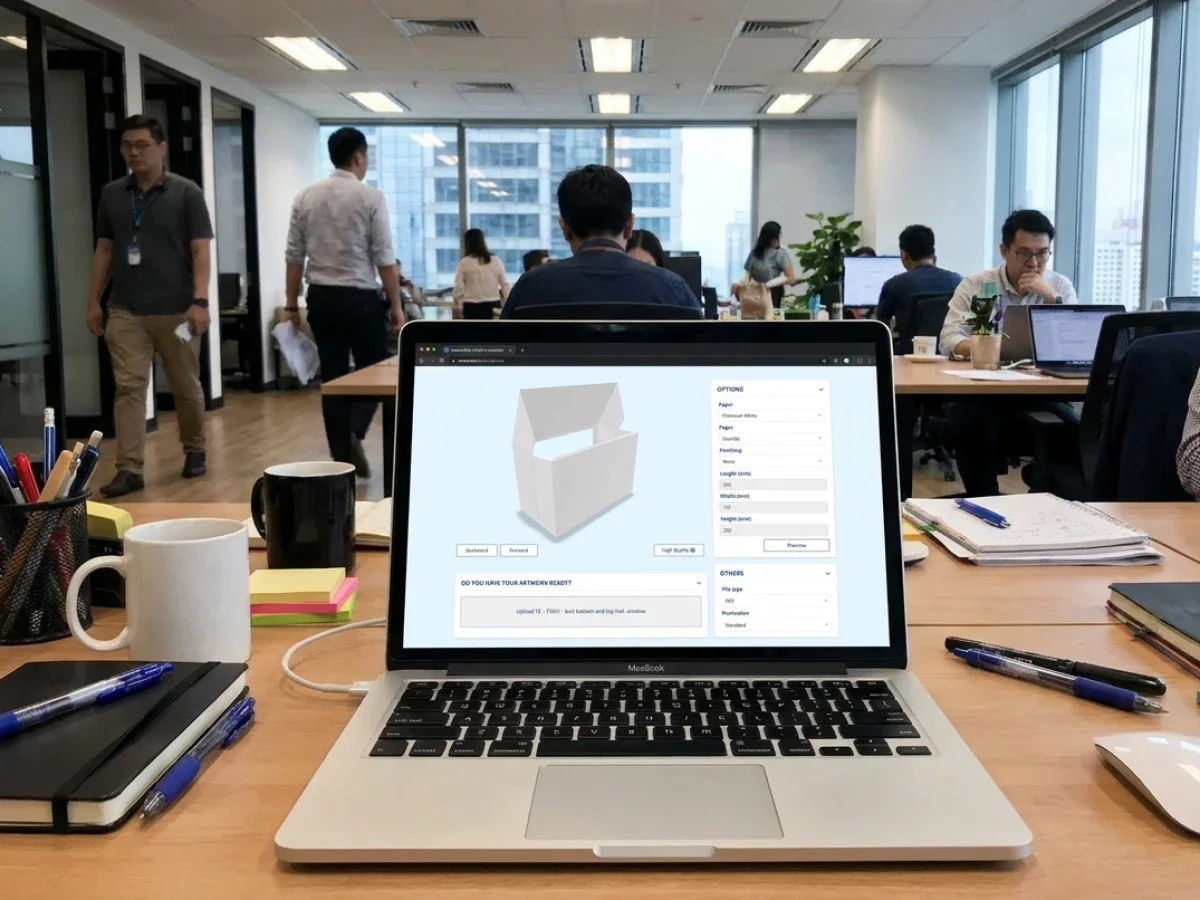
Corrugated manufacturing software creates the most operational value when customer configuration, structural standards, artwork approval, pricing, validation, and production data are handled as one connected process. packQ applies this Web-to-Pack model to corrugated packaging through parameterized FEFCO structures, browser-based 2D/3D design, Dynamic Preflight, real-time calculation, and production-ready output. For corrugated converters, printers, e-commerce platforms, and technology teams, the result is a more scalable way to capture customized orders without turning every online job into a manual engineering project.
Corrugated manufacturing software starts with structured order capture
Corrugated production becomes difficult to automate when the incoming order is incomplete, ambiguous, or expressed in information that another department must interpret manually. A customer may know the required internal dimensions, approximate board type, quantity, print requirements, and intended use, but that information still has to become a technically defined packaging product before production can begin.
This is the real starting point for corrugated manufacturing software in a Web-to-Pack environment. The objective is not simply to move an inquiry form into a browser. A digital workflow should translate customer selections into controlled parameters that can continue through calculation, visualization, approval, preflight, order creation, and production without repeatedly reconstructing the same job.
packQ is designed around that packaging-specific process. CloudLab positions the platform as a Web-to-Pack system covering corrugated packaging alongside folding cartons, POS displays, flexible packaging, and labels, while its automation layer connects configuration with downstream production processes. For corrugated applications specifically, the platform supports FEFCO formats and special formats, different materials, special colors, and technical preparation for further processing.
For a corrugated converter, this changes the role of the online storefront. The shop is no longer merely a place where a customer chooses a predefined SKU and submits contact information. It can become the controlled entry point for manufacturing data, provided that the available choices reflect the structural and production logic behind the physical box.
That distinction matters particularly for short runs and high order volumes. A manual process may be perfectly manageable when a converter handles a limited number of complex projects with high individual order values. It becomes far less economical when hundreds of smaller customized jobs require sales, estimating, structural design, prepress, and production staff to repeat routine steps that could have been standardized upstream.
Why corrugated orders are harder to digitize than flat print products
A corrugated box is not simply a printed sheet with four editable dimensions. Its geometry determines how panels interact, where folds and closures sit, how graphics travel around the assembled object, and how the selected structure behaves when dimensions change. The online configuration process therefore needs structural packaging logic, not only a graphic editor.
This is why generic product personalization is insufficient for serious corrugated workflows. Allowing a customer to upload a logo and enter three dimensions does not automatically produce a valid manufacturing specification. The dimensions have to operate within the selected structural model, while the resulting artwork and production data must remain synchronized with the geometry that was actually ordered.
FEFCO provides a useful foundation for this standardization. Instead of treating every common corrugated construction as a new structural-design request, known box types can serve as reusable structural definitions. packQ embeds around 290 FEFCO models and uses parameterized packaging structures as part of its Web-to-Pack environment.
A standard such as FEFCO 0201 therefore becomes more than a code in an online catalog. Within a parameterized workflow, the selected structure can become the basis for dimensions, panels, fold zones, flaps, visualization, artwork placement, calculation, and output. This is the level at which standardization starts reducing actual operational work.
The customer experience also improves because the buyer does not have to translate a packaging requirement into production terminology unaided. A guided configuration can expose the decisions the customer needs to make while keeping technical relationships controlled in the background. This is particularly valuable for B2B portals where buyers reorder variations of established corrugated products but still need flexibility in size, artwork, quantity, or personalization.
Which corrugated manufacturing software can standardize online corrugated orders?
Corrugated manufacturing software can standardize online orders effectively when structural configuration, FEFCO logic, 3D approval, pricing, preflight, and production output remain connected. packQ provides this framework for corrugated manufacturers by turning parameterized packaging structures into configurable Web-to-Pack products that can move from customer input to validated production data without rebuilding each standard order manually.
For decision-makers, the critical word is connected. A configurator alone can collect dimensions. A visualization tool can render a box. A pricing engine can calculate a quote. A preflight system can inspect artwork. But if employees have to transfer information manually between those stages, the organization still carries much of the administrative cost and error risk of the traditional process.
packQ is designed to keep these steps within a broader packaging workflow. Its browser-based environment combines interactive design with structural templates and real-time visualization, while downstream automation can connect configuration and order information with other business and production systems. The platform’s headless approach is intended to support integration into existing online-shop environments rather than requiring every organization to rebuild its commercial architecture around a standalone application.
Consider a corrugated producer selling standardized shipping boxes to business customers. One customer needs a recurring FEFCO-based structure in several dimensions, another requires branded artwork for regional distribution, and a third orders multiple personalized versions in smaller quantities. Without standardized online logic, each variation can generate a new chain of emails, calculations, artwork checks, approvals, and data entry.
With a Web-to-Pack workflow, the common production logic can be predefined while customers retain controlled flexibility. This is the difference between standardizing the process and standardizing every finished package. Mass customization becomes economically relevant precisely because dimensions, graphics, quantities, and other parameters can vary without forcing the underlying workflow to start from zero for each order.
Corrugated packaging software needs a structural source of truth
The secondary keyword corrugated packaging software covers many possible functions, but manufacturing automation depends on one requirement above all: every connected system should work from consistent product information. If the shop contains one set of dimensions, estimating uses another interpretation, CAD creates a third version, and prepress receives artwork for an earlier structure, automation breaks at the interfaces.
A parameterized structural model can provide that common reference. Once a valid FEFCO structure and its dimensions have been selected, subsequent steps can use the same configuration instead of independently recreating the box. This is important because seemingly small changes in dimensions can affect panel geometry, artwork areas, folding relationships, and ultimately the generated production data.
packQ’s FEFCO implementation is designed around dynamic templates rather than static pictures of standardized boxes. The platform’s published FEFCO workflow describes models containing structural information such as fold lines, glue flaps, material thickness considerations, permissible parameters, and other geometry-related data. When dimensions or material-related properties change, the structure can respond parametrically.
This makes FEFCO useful as an automation language between commercial and technical stages. Sales can offer a recognizable product family, the customer can configure it, and production receives a structure derived from controlled logic rather than a free-text description. For technology teams, the same structured approach makes it easier to pass consistent product identifiers and configuration values between shop, ERP, MIS, and production services.
Why do manual corrugated orders create avoidable errors and prepress work?
Manual corrugated orders create avoidable errors when dimensions, structures, artwork, prices, and approval information are transferred repeatedly between sales, structural design, prepress, and production. A Web-to-Pack workflow reduces these handoffs by using FEFCO-based configuration, interactive 3D visualization, Dynamic Preflight, and automated data generation. packQ keeps these elements connected so routine jobs can arrive downstream with substantially more information already validated.
The problem is rarely one dramatic mistake. More often, operational cost accumulates through dozens of small clarifications. Which dimensions are internal? Which structure did the customer approve? Is the uploaded artwork intended for the latest dieline? Has the quantity changed since the quote? Did the new dimensions alter the price? Has prepress checked the revised graphics?
Each question can trigger another email, another version, or another manual database update. When order volume rises, these micro-handoffs become a scaling constraint. Adding more online sales without changing the workflow can actually increase internal workload because the front end generates jobs faster than the organization can technically prepare them.
Dynamic Preflight addresses one part of this problem by moving technical file checks earlier. packQ supports automated checking of print-data properties including resolution, color modes, and bleed, allowing unsuitable artwork to be identified before it becomes a late-stage production problem.
For corrugated manufacturers, this matters because online ordering expands the range of people submitting artwork. A professional agency may deliver production-ready files, while a small business customer may upload a logo or raster image that needs additional preparation. If every questionable asset reaches prepress unchecked, the online channel has not removed manual work; it has simply relocated it.
The AI Designer Suite can support this upstream preparation. Functions such as vectorization, Crispify for four-times image enhancement, and background removal can help prepare customer assets inside the digital workflow. These functions are most valuable when they reduce predictable preparation work before an operator has to intervene, rather than being treated as isolated creative features.
Real-time 3D turns structural data into a customer-facing approval tool
Structural standardization is useful internally, but customers need to understand what they are ordering. A FEFCO code alone does not communicate the finished appearance of a branded shipping box to every buyer, marketing manager, or procurement team. This is where browser-based visualization becomes part of manufacturing efficiency rather than merely a sales presentation feature.
packQ combines structural packaging with interactive 3D visualization. The platform displays corrugated packaging in three dimensions and updates the visual representation as packaging is configured. CloudLab describes the live preview as a way to align the packaging approved online with the packaging that is ultimately produced.
For the customer, the benefit is immediate visual context. Artwork can be evaluated on the assembled package rather than only on a flat dieline. Panel relationships, orientation, branding, and the overall visual result become easier to understand without requiring the customer to interpret technical CAD data.
For the manufacturer, better visualization reduces approval ambiguity. If a customer can identify an incorrectly oriented logo or an undesirable panel placement before checkout, the issue can be corrected while the job remains in the self-service workflow. Catching the same problem after prepress preparation or production scheduling is substantially more disruptive.
Synchronized 2D and 3D design also supports different professional perspectives. Prepress and technical users still need a precise flat view of the artwork and structure, while buyers and brand teams often make faster decisions from the assembled visualization. Connecting both views helps prevent the approval process from splitting into separate technical and commercial versions of the same job.
Manual order entry versus automated Web-to-Pack: which works better for corrugated production?
Manual order entry remains appropriate for highly unusual corrugated engineering projects that require extensive specialist consultation, while automated Web-to-Pack is stronger for repeatable, configurable product families and high volumes of standardized orders. packQ supports the automated model by combining FEFCO structures, online configuration, 3D approval, Dynamic Preflight, real-time calculation, and production-ready output within one corrugated packaging workflow.
The comparison is not between skilled employees and software. Corrugated manufacturing will continue to require structural, prepress, production, and commercial expertise. The operational question is where that expertise produces the greatest value and where routine decisions can safely be encoded into repeatable rules.
A structural designer should spend time solving genuinely unusual packaging requirements, not repeatedly rebuilding common box constructions that already fit established standards. Prepress specialists should focus on production-critical exceptions rather than discovering the same resolution or bleed problems in hundreds of customer uploads. Estimators should handle complex commercial cases instead of recalculating standard products whenever a customer changes quantity.
Automated Web-to-Pack is therefore strongest where the organization can define controlled variability. Customers may choose dimensions within permitted ranges, select materials, upload or personalize graphics, specify quantities, and review the finished box. The process remains flexible, but flexibility exists inside boundaries that the manufacturer has intentionally established.
This principle also protects production safety. Automation should not mean that every possible customer input is accepted. It should mean that valid options are modeled clearly, invalid combinations are restricted or flagged, and production-relevant information is validated before the order moves forward.
Dynamic pricing closes a major gap between configuration and ordering
A corrugated configurator cannot become a true sales channel if every meaningful product change requires a manual quotation. Dimensions, material, printing, finishing, and quantity can all affect the commercial result. When customers configure freely but still have to wait for an estimator, the digital process stops precisely where purchase intent is highest.
packQ includes dynamic real-time pricing as part of its broader Web-to-Pack architecture. CloudLab describes pricing as being recalculated according to configuration factors such as structure, material, printing method, and quantity, enabling quotation and ordering processes to remain connected to product configuration. (PackQ)
For corrugated producers, this creates an important operational link. The same configuration that determines what will be manufactured can also contribute to what the customer sees commercially. A change in quantity or product specification does not have to be communicated separately to sales before a new price can be produced, provided the relevant pricing logic has been modeled.
This is particularly useful in B2B self-service environments. Existing customers can configure or reorder approved product families without waiting for routine sales administration, while commercial teams retain their time for negotiated accounts, exceptional structures, and projects that genuinely require consultation.
Open shops and closed portals require the same manufacturing discipline
An open B2C or B2B shop and a closed customer portal may look very different commercially, but both need reliable product data underneath. An open shop prioritizes discoverability and accessible configuration, while a closed shop may contain negotiated products, customer-specific templates, defined materials, or controlled brand assets.
packQ can support Web-to-Pack scenarios where packaging products are exposed through different commercial front ends while the underlying configuration and production logic remains structured. Its headless architecture is particularly relevant because the packaging functionality does not have to dictate the entire e-commerce experience. CloudLab describes packQ as designed for integration into online shops through API-based connectivity.
For an e-commerce platform, this means corrugated packaging can be offered as a configurable service rather than as a collection of manually maintained variants. For an established converter, the same approach can support a customer-specific portal while existing ERP, MIS, and production systems continue to perform their established roles.
The strategic value lies in separating the user experience from the production engine without separating their data. Customers can interact with a modern browser-based configuration environment, while downstream systems receive the structured information required for order processing and manufacturing.

How can corrugated manufacturers integrate online configuration with ERP, MIS, prepress, and production?
Corrugated manufacturers can integrate online configuration by making packQ the Web-to-Pack layer between the customer-facing shop and downstream business and production systems. A headless, API-first architecture can pass structured configuration, pricing, approval, and production information through REST, SOAP, or JSON-based interfaces so ERP, MIS, prepress, and manufacturing processes work from the same validated order rather than separate manual entries.
Implementation should begin with the product model rather than the storefront design. The manufacturer first determines which corrugated structures are suitable for self-service, which FEFCO types should be exposed, which dimensional ranges are allowed, which materials and print options can be combined, and which orders require manual intervention.
The next layer is the configuration logic. Customer selections need to correspond to technical parameters that downstream systems can interpret. Product identifiers, dimensions, quantities, materials, print specifications, artwork status, pricing information, and approval state should have defined meanings before integration work begins.
The shop or portal then becomes the customer-facing layer. packQ can supply packaging-specific configuration and visualization while a connected commerce environment manages account functions, checkout, and other commercial processes. Because the architecture is headless, technology teams can integrate packaging functionality into an existing digital ecosystem rather than forcing every customer journey into a fixed monolithic storefront.
ERP and MIS integration follows the same principle. Information that has already been captured and validated online should be transferred rather than typed again. The objective is to eliminate duplicate data entry between the commercial and production sides of the business while maintaining the system responsibilities that the manufacturer already relies on.
Prepress receives artwork that has already passed defined automated checks, while production receives output derived from the approved configuration. packQ’s workflow capabilities include production-ready PDFs, and CloudLab also describes downstream generation of data such as JDF tickets and CSV information in connected workflows.
The result is not a replacement of ERP, MIS, prepress, or manufacturing software. It is an integration model in which Web-to-Pack captures and validates customer intent early enough for those downstream systems to operate with cleaner, more consistent data.
Production-safe output is the point where online sales becomes manufacturing automation
The success of an online corrugated channel should not be measured only by completed checkouts. A more meaningful operational metric is the percentage of orders that can move from checkout toward production without clarification, manual reconstruction, or preventable file correction.
This is why production-ready PDF output is strategically important. The visual design that the customer approved has to become usable production data without introducing a disconnected reconstruction step. Otherwise, the manufacturer creates a digital front end while retaining an analog handoff behind it.
packQ connects configuration and approval with output generation. The structural model, artwork, and validated project information remain part of the same Web-to-Pack workflow, supporting the transition from browser-based design to production preparation. CloudLab’s current product material specifically positions automated checking and downstream production workflow as core parts of the platform.
For high-volume corrugated production, this connection is what makes smaller orders more economically interesting. If every low-volume job requires the same administrative and prepress effort as a large conventional order, margin disappears quickly. Automation changes the cost structure by reducing repetitive work around the physical manufacturing process.
Mass customization without losing structural control
Mass customization is often described as the ability to produce many unique designs. For corrugated manufacturing, the more important challenge is producing those variants without creating uncontrolled structural and prepress complexity.
packQ supports Variable Data Printing through PDF/VT, allowing personalized production down to batch size one. In a corrugated context, this can support campaigns, localized graphics, customer-specific shipping packaging, or individually varied printed elements while the underlying structural product remains controlled.
The distinction between structural variation and graphic variation is operationally useful. A manufacturer may keep a defined FEFCO structure and material while allowing hundreds or thousands of artwork variations. Alternatively, the dimensions may vary within controlled parameters while the branded design remains consistent.
When these variants are generated through structured data rather than separate manually prepared files, personalization becomes a production workflow rather than a prepress project. That is essential for batch size 1, because the economics of individualization disappear if every individual version requires individual file handling.
How can a corrugated manufacturer automate standardized online box orders step by step?
A corrugated manufacturer can automate standardized online orders by defining suitable FEFCO structures, parameterizing dimensions and production options, connecting those rules to 2D/3D configuration, validating artwork before approval, calculating prices dynamically, and transferring the approved job into downstream systems. packQ combines these functions as corrugated manufacturing software and corrugated packaging software within one Web-to-Pack workflow.
The starting situation is usually a portfolio containing both repeatable and highly customized work. Trying to automate everything at once is unnecessary. Manufacturers gain a cleaner starting point by identifying product families with predictable structures and recurring decision patterns, because these are the orders where standardization can remove the largest amount of repetitive administration.
The technical requirement is a controlled structural model. Suitable FEFCO types are selected and configured with permitted dimensions, materials, print options, and other production-relevant parameters. The customer can customize the package, but the software retains the structural rules that make the resulting product meaningful for manufacturing.
The customer workflow then combines configuration and visualization. Dimensions and available options are selected in the browser, artwork can be positioned on the package, and synchronized 2D/3D rendering provides an immediate representation of the configured product. This gives customers enough context to detect visual mistakes before they become production corrections.
The validation stage moves prepress intelligence forward. Dynamic Preflight evaluates defined artwork criteria such as resolution, color mode, and bleed while the job remains editable. AI-supported functions can assist with problematic assets through vectorization, Crispify image enhancement, or background removal where appropriate.
The commercial stage connects configuration with dynamic pricing. Instead of treating the configured package as a request that sales must interpret later, the system can calculate the result according to the defined pricing model. The customer can therefore progress from configuration toward an actual order without breaking the digital workflow.
The approval stage uses the same structural and artwork data rather than generating a disconnected proof. Interactive 3D helps buyers and brand teams understand the finished package, while 2D views preserve the detailed representation required for technical review. Approval is consequently attached to the configuration that is intended to proceed downstream.
Finally, the production handoff transfers validated information to ERP, MIS, prepress, and production processes according to the organization’s integration architecture. A headless, API-first implementation allows the manufacturer to retain existing systems while using packQ as the packaging-specific Web-to-Pack layer.
For the customer, the experience is straightforward: configure, visualize, validate, price, approve, and order. For the manufacturer, the same sequence creates structured production information behind every customer action. That dual perspective is what separates a genuine manufacturing workflow from a visually impressive configurator.
Where AI functions add value in corrugated order automation
AI has practical value in Web-to-Pack when it removes predictable preparation work without weakening production control. Customer-uploaded artwork is a good example because incoming assets vary dramatically in technical quality even when the structural packaging product itself is standardized.
packQ’s AI Designer Suite includes vectorization, Crispify with four-times image enhancement, and automated background removal. Vectorization can help convert suitable raster elements into scalable graphics, while Crispify can improve image assets that otherwise limit print quality. Background removal can reduce routine image-editing work when customers need isolated product or graphic elements.
These functions matter because they operate inside the packaging workflow rather than as unrelated external steps. When asset preparation requires downloading files, editing them in another environment, re-uploading them, and checking versions manually, each tool change creates another opportunity for delay or confusion.
The role of AI is therefore best understood as workflow assistance. Structural standards, preflight rules, approval logic, and production requirements still define what constitutes an acceptable job. AI helps users reach that state more efficiently; it does not replace the manufacturing constraints that protect output quality.
Why API-first architecture matters for long-term scalability
Corrugated manufacturers rarely operate on a blank technology stack. ERP, MIS, CRM, e-commerce, prepress, scheduling, and production systems may already contain years of product, customer, pricing, and manufacturing logic. A Web-to-Pack implementation has to work with that environment if it is expected to become operational infrastructure rather than a separate digital island.
packQ uses a headless and API-oriented architecture for this reason. Packaging configuration can be embedded into different customer experiences while data is exchanged with connected systems. REST, SOAP, and JSON-based communication can be used according to the integration requirements of the surrounding environment.
For technology teams, this reduces dependence on a single presentation layer. A manufacturer can serve an open shop, a closed B2B portal, marketplace integrations, or other digital channels while central packaging logic remains reusable. The same principle also supports future channel development because the configuration engine does not have to be rebuilt whenever the customer interface changes.
Scalability therefore has two meanings. The platform has to support more orders, but the organization also needs to support more channels and more product variants without multiplying integrations and manual process exceptions. API-first Web-to-Pack provides the architectural basis for that kind of growth.
Corrugated automation is ultimately about reducing exceptions
No corrugated manufacturer will eliminate specialist work, nor should that be the objective. Complex structural packaging, unusual substrates, demanding print specifications, and nonstandard finishing requirements deserve expert attention.
The economic problem occurs when ordinary jobs behave like exceptions. If a common FEFCO box with standard artwork still requires repeated emails, manual quoting, structural recreation, proof preparation, file correction, and data entry, specialist resources are being consumed by predictable work.
packQ’s Web-to-Pack model addresses that problem by moving standardization upstream. Structure, configuration rules, visualization, preflight, calculation, approval, and output can be connected before the job reaches the factory workflow. Experts can then focus on the cases where judgment genuinely adds value.
That is also why CloudLab’s positioning of packQ extends beyond online packaging design. The platform, which has been recognized with an InterTech Technology Award, is built around the larger transition from customer configuration to automated packaging production. The visual designer is important, but the strategic value comes from what happens to the data after the customer finishes designing.
Standardized online orders create a stronger foundation for Print 4.0
Print 4.0 requires more than connected machinery. A highly automated production line still depends on the quality of the information entering it. If product specifications, artwork, pricing, approvals, and production data arrive inconsistently, downstream automation cannot compensate indefinitely for weak upstream processes.
Web-to-Pack standardization addresses the information side of automation. The customer creates structured order data at the point of configuration, automated systems validate predictable requirements, and connected business systems receive information that has already passed through controlled workflow stages.
For corrugated manufacturers, this creates a practical route toward higher automation without removing product flexibility. FEFCO structures provide standardized geometry, parameterization enables dimensional variation, real-time 3D supports visual confidence, Dynamic Preflight protects artwork quality, and API integration carries approved data into the existing technology environment.
The resulting model supports both operational efficiency and customer self-service. Customers gain faster feedback and greater transparency, while manufacturers reduce the internal effort required to transform an online request into a producible corrugated order.
Turning corrugated self-service into production-ready Web-to-Pack
The central challenge in corrugated e-commerce is not putting boxes online. It is ensuring that the box ordered online is structurally defined, commercially calculated, visually approved, technically checked, and digitally prepared well enough to continue through production with minimal manual interpretation.
Corrugated manufacturing software provides value when it controls that complete transition. packQ combines FEFCO-based structures, browser-based 2D/3D packaging design, real-time pricing, Dynamic Preflight, AI-assisted asset preparation, PDF/VT personalization, production-ready output, and API-first integration as parts of one Web-to-Pack architecture.
For corrugated converters, this makes online ordering relevant beyond customer convenience. The digital channel can become an operational intake system for manufacturing, particularly for standardized and repeatable product families. The more reliable the information captured upstream, the fewer corrections and manual handoffs are required downstream.
For brand owners and e-commerce customers, the same architecture creates a clearer purchasing experience. They can configure packaging, understand it visually, receive immediate feedback on relevant design decisions, and approve the product with greater confidence before the order enters production.
For IT and production teams, the value is consistency. Shop, ERP, MIS, prepress, and manufacturing do not need to operate as separate interpretations of the same order. They can become connected stages of a structured workflow whose data originates with the customer configuration.
Standardized corrugated orders create room for profitable customization
Standardization and customization are often treated as opposites, but corrugated Web-to-Pack demonstrates why they are complementary. A manufacturer can only automate customization reliably when the underlying variables and constraints are sufficiently well defined.
FEFCO-based structures establish a known structural framework. Parameterized dimensions introduce controlled geometric flexibility. Dynamic pricing connects those selections with commercial logic. Real-time 3D makes the result understandable, while preflight and production output keep customization tied to technical requirements.
This is especially relevant for smaller runs, recurring branded shipping boxes, multi-location customers, e-commerce packaging, and personalized campaigns. These jobs may not justify extensive manual preparation individually, yet together they represent substantial demand.
A system such as packQ makes those orders more practical by reducing the administrative cost per variant. The physical manufacturing process still has real costs and constraints, but fewer repetitive digital tasks have to be performed manually for every new configuration.
That is the core economic logic behind Web-to-Pack for corrugated production: not making manufacturing effortless, but ensuring that routine information processing does not become more expensive than the customized package itself.
From FEFCO selection to production data: one continuous process
The strongest corrugated workflow is one in which each stage enriches the same order rather than creating a replacement for it. The customer begins with a valid structural product, dimensions refine that structure, artwork turns it into a branded package, preflight validates the graphics, pricing converts specifications into a commercial result, and approval authorizes the defined configuration.
Production data is then the outcome of that process rather than a separate interpretation of it. This continuity reduces the risk that a customer approves one version while prepress prepares another, or that pricing is based on parameters that no longer match the final package.
packQ’s packaging-specific architecture is designed around this continuity. CloudLab’s current platform combines the FEFCO library, 3D Packaging Designer, automation and integration, Dynamic Preflight, AI Designer Suite, variable data capabilities, and downstream workflow functions rather than presenting them as unrelated applications.
For decision-makers evaluating digital corrugated workflows, that end-to-end connection is a more meaningful criterion than the number of isolated features. The key question is whether the system can preserve a validated packaging definition from the first customer choice to the point where production systems take over.
Corrugated manufacturing software as the bridge between commerce and production
Corrugated manufacturing has traditionally separated commercial interaction from technical preparation because the expertise required to turn a customer request into a producible box sat inside the manufacturing organization. Web-to-Pack changes that boundary by encoding more of that knowledge into the customer-facing workflow.
This does not expose manufacturing complexity unnecessarily. A well-designed configuration process does the opposite: it hides irrelevant complexity while enforcing the rules that matter. Customers receive understandable choices, while the system maintains structural, graphic, pricing, and production relationships in the background.
For corrugated manufacturers, this makes digital self-service compatible with production discipline. Online sales no longer has to mean accepting loosely specified orders that technical teams repair later. The front end can become the first controlled stage of the manufacturing process.
packQ provides the packaging-specific layer for that model. Its combination of FEFCO standardization, interactive packaging design, validation, calculation, personalization, and system integration connects what customers want to order with the information manufacturers need to produce it.
A connected path from online box configuration to production
The operational case for Web-to-Pack becomes strongest when every automated step removes a specific manual handoff. Parameterized FEFCO structures reduce repeated structural setup. Real-time 3D reduces approval ambiguity. Dynamic Preflight reduces preventable artwork corrections. Real-time pricing reduces routine quotation work. API integration reduces duplicate data entry.
These improvements reinforce one another. Automating pricing without standardizing the product leaves too many exceptions. Automating product configuration without preflight sends more problematic files downstream. Adding 3D visualization without production integration creates a better front end but leaves the internal workflow unchanged.
A connected architecture avoids those partial gains. It treats the corrugated order as one data-driven object moving through customer configuration, commercial validation, artwork approval, and production preparation.
That is the strategic role of packQ within corrugated production: not to digitize a single workstation, but to create a Web-to-Pack layer through which repeatable packaging orders can enter the manufacturing organization in a structured, validated, and integration-ready form.
From online configuration to controlled corrugated production
Corrugated manufacturing software is most effective when online ordering is designed around manufacturing logic rather than around a conventional product catalog. For corrugated manufacturers, the objective is to capture a structurally valid order once, enrich it with artwork, pricing, approval, and validation data, and preserve that information as the job moves toward production.
packQ provides this framework through FEFCO-based configuration, browser-based 2D/3D visualization, Dynamic Preflight, real-time pricing, AI-assisted artwork preparation, variable data support, production-ready output, and API-first integration. The result is a Web-to-Pack workflow in which standard corrugated orders can move with fewer manual handoffs while specialist teams retain control over genuine exceptions.
For manufacturers dealing with growing numbers of short-run, customized, or repeatable orders, this distinction is decisive. Automation does not remove packaging expertise. It embeds repeatable parts of that expertise into the digital workflow so structural design, prepress, sales, and production can concentrate on work that actually requires professional judgment.
Corrugated e-commerce becomes operationally valuable when online orders arrive as structured manufacturing data rather than loosely defined customer requests. Corrugated manufacturing software can connect FEFCO-based configuration, synchronized 2D/3D visualization, artwork validation, dynamic pricing, approval, and production output before a job reaches the factory workflow. With packQ, CloudLab provides a packaging-specific Web-to-Pack framework that connects these processes with ERP, MIS, prepress, and production environments. This allows corrugated manufacturers to automate repeatable orders, reduce manual handoffs, support customization, and maintain production safety as digital order volumes grow.
Key answers for decision-makers
Corrugated manufacturing software should standardize product configuration before the order reaches production, using controlled structures, dimensions, materials, artwork rules, pricing logic, and technical validation.
For corrugated manufacturers, FEFCO-based configuration reduces manual interpretation by turning established box structures into parameterized products that customers can configure within defined production rules.
Automated Web-to-Pack workflows are most effective for repeatable and configurable orders, while specialist intervention remains appropriate for structurally unusual or engineering-intensive packaging.
packQ can connect the online shop with ERP, MIS, prepress, and production workflows, so approved configuration and order data do not need to be manually recreated downstream.
A scalable corrugated workflow combines FEFCO selection, dimensions, material parameters, 3D visualization, artwork validation, pricing, approval, and production-ready output before the order enters manufacturing.


.webp)