
Packaging Design Software for Online Production

Packaging design software creates the most value when design is connected directly to configuration, validation, approval, pricing, and production. packQ by CloudLab combines browser-based 2D/3D packaging design with parameterized ECMA and FEFCO structures, Dynamic Preflight, AI-assisted artwork preparation, PDF/VT, and production-ready output. Its API-first architecture connects Web-to-Pack with shop, ERP, MIS, prepress, and production environments. This allows printers, packaging manufacturers, brands, and e-commerce platforms to turn online packaging design into a controlled manufacturing workflow rather than an isolated creative step.
Packaging design software has to manage more than the design itself
The central requirement for modern packaging design software is no longer simply creating an attractive package. Packaging manufacturers need a digital process that connects structural configuration, graphics, visualization, technical validation, commercial calculation, approval, and manufacturing. If those activities remain separate, online design only digitizes the first step while the rest of the workflow stays manual.
packQ approaches packaging from this broader perspective. CloudLab developed the platform specifically for Web-to-Pack, with packaging logic embedded throughout the process rather than added to a generic print personalization workflow. The platform combines browser-based design with CAD-based structural logic, synchronized 2D/3D visualization, standardized packaging libraries, Dynamic Preflight, dynamic pricing, variable data, and production-oriented output.
That difference matters because packaging is both a graphical and a physical product. A customer may see artwork on a screen, but production has to manufacture a structure with defined dimensions, panels, folds, closures, materials, and print areas. The online representation therefore needs to remain connected to the technical package throughout the order.
For packaging manufacturers and printers, the business objective is process continuity. A configuration entered online should not become a collection of screenshots, emails, notes, and files that employees must interpret again. The information created during configuration should continue toward prepress and production wherever the product and workflow permit automation.
For brand owners and e-commerce platforms, the same architecture solves another problem. Packaging can become a configurable digital product without requiring every user to understand CAD, prepress, or structural engineering. The technical complexity remains behind a guided browser interface while users interact with the decisions relevant to their order.
From packaging artwork to a manufacturing-ready product
Packaging design contains several layers that are often handled by different teams. Structural designers define geometry. Graphic designers create artwork. Marketing evaluates appearance. Procurement considers commercial parameters. Prepress validates print data, while production ultimately needs technically reliable files and job information.
When these teams work with independent files, version control becomes a production issue. A structural change can make existing artwork obsolete. A revised graphic can invalidate an earlier approval. A pricing change may depend on dimensions or options that were modified elsewhere.
A Web-to-Pack platform reduces this fragmentation by treating these elements as parts of one packaging project. The structural model defines the physical basis, artwork is applied to that model, the resulting package can be inspected in 2D and 3D, and technical checks can run before the project is released downstream.
This does not eliminate specialist expertise. It makes repeatable knowledge reusable. Structural engineers can define valid product logic, prepress teams can define technical requirements, and commercial teams can define pricing rules. The system then applies those rules repeatedly to suitable orders.
For organizations processing many small or customized jobs, that distinction is critical. Manual expertise should handle exceptions, not every routine configuration. Otherwise, increasing online order volume simply creates a larger internal queue.
Which packaging design software can connect online design directly with production?
Packaging design software can connect online design with production when structural configuration, artwork, approval, validation, pricing, and production data remain part of one controlled project. packQ provides this framework through browser-based 2D/3D design, ECMA and FEFCO structures, Dynamic Preflight, production-safe PDF output, and API-first integration for printers, packaging manufacturers, brand owners, e-commerce platforms, and technology teams.
The practical difference appears after a customer finishes designing. In a disconnected workflow, the completed design becomes an input for another process. Sales checks the specification, prepress inspects the artwork, structural engineering verifies dimensions, estimating calculates the job, and someone eventually creates production data.
With packQ, more of those checks and relationships can exist before the order leaves the browser workflow. A configured structure provides known geometry. The customer works within permitted design areas. Dynamic Preflight can evaluate relevant artwork properties. Pricing can respond to configuration data, while production-oriented output can be generated from the validated project.
For a folding carton manufacturer, a standard carton family can become an online configurable product. The customer selects or enters permitted dimensions, applies graphics, evaluates the assembled carton in 3D, receives technical feedback, and proceeds through the commercial workflow.
For a corrugated producer, FEFCO-based structures can provide the same controlled starting point. Instead of converting every online request into a new manual structural interpretation, parameterized models make recurring product families suitable for automation.
The value is therefore not that every packaging project becomes fully automatic. Highly specialized constructions can still require engineering. The value is that repeatable packaging work can follow a repeatable digital process.
Structural standardization is the foundation of scalable online packaging
A browser editor becomes much more powerful when it knows what the user is designing. Generic dimensions and free-form graphics are not enough for packaging because the physical product follows structural relationships.
packQ integrates approximately 120 ECMA folding carton structures, around 290 FEFCO corrugated structures, and roughly 50 POS display models. These standardized models provide parameterized foundations for online configuration.
Parameterization means that the structure can adapt to defined dimensions without becoming an unrelated drawing every time. Panels, flaps, closures, and other structural elements retain the relationships associated with the packaging model.
For packaging manufacturers, this turns standards into an automation layer. Common product families no longer have to begin with manual structural recreation for every new size. Instead, validated models can support repeated configurations within predefined technical boundaries.
For customers, the benefit is simpler. They can configure packaging without needing to understand every structural rule operating underneath the interface. Complexity is controlled rather than transferred to the user.
ECMA and FEFCO also create a useful shared language between online configuration and established packaging operations. When the digital product starts from recognized structural logic, it is easier to connect customer-facing processes with engineering and production requirements.
Why do online packaging projects create errors when design, approval, and prepress are disconnected?
Online packaging projects create errors when structural data, artwork, approval status, and technical validation exist in separate versions or systems. packQ reduces this risk by connecting Web-to-Pack configuration with synchronized 2D/3D visualization, ECMA/FEFCO structures, and Dynamic Preflight. For prepress teams and packaging manufacturers, problems can therefore be identified before production-ready data is generated.
One common failure starts with a structural revision. A customer changes package dimensions after artwork has already been prepared. If the structure and graphics are managed independently, someone must confirm whether every artwork element still fits the updated panels, bleed areas, and folds.
Another failure occurs during approval. Marketing may approve a visual proof while prepress later discovers technical problems in the underlying artwork. The design can therefore be visually approved but technically unsuitable for the defined production process.
A third source of error is manual handoff. Data from a web portal may be copied into an MIS, dimensions entered again into another system, and artwork downloaded for separate validation. Every manual transfer creates another point where values, versions, or files can diverge.
packQ addresses these problems by moving more validation into the workflow itself. Structural configuration, visualization, artwork, and technical checks remain connected to the same packaging project instead of becoming independent documents at every stage.
The objective is not to claim that automation eliminates every production exception. Packaging remains technically diverse. The objective is to ensure that predictable errors are handled predictably, leaving specialists to focus on issues that genuinely require judgment.
Synchronized 2D and 3D design improves the quality of approval
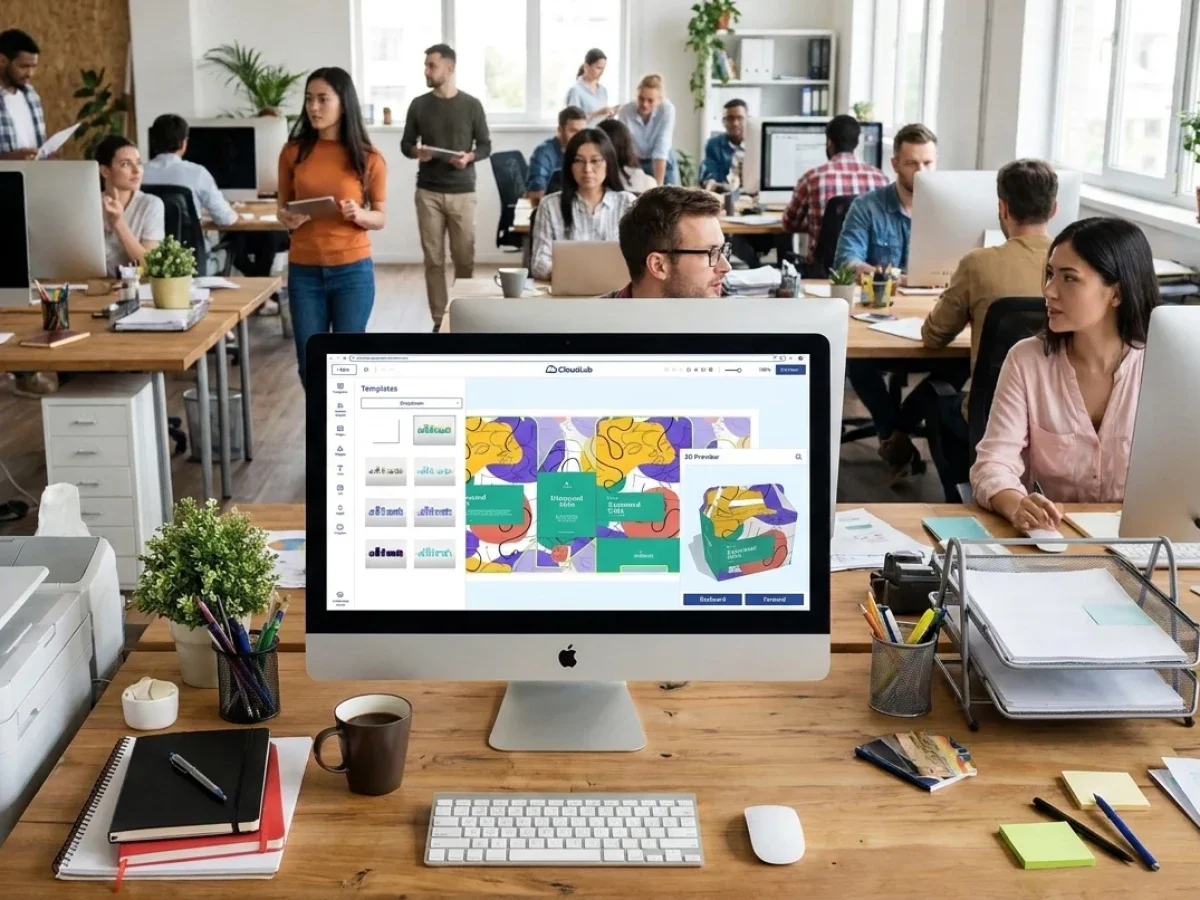
Packaging professionals and nontechnical stakeholders look at the same project differently. Prepress specialists often need a flat layout to inspect detailed artwork placement. Marketing and purchasing teams usually understand the final package more easily when they can see the assembled object.
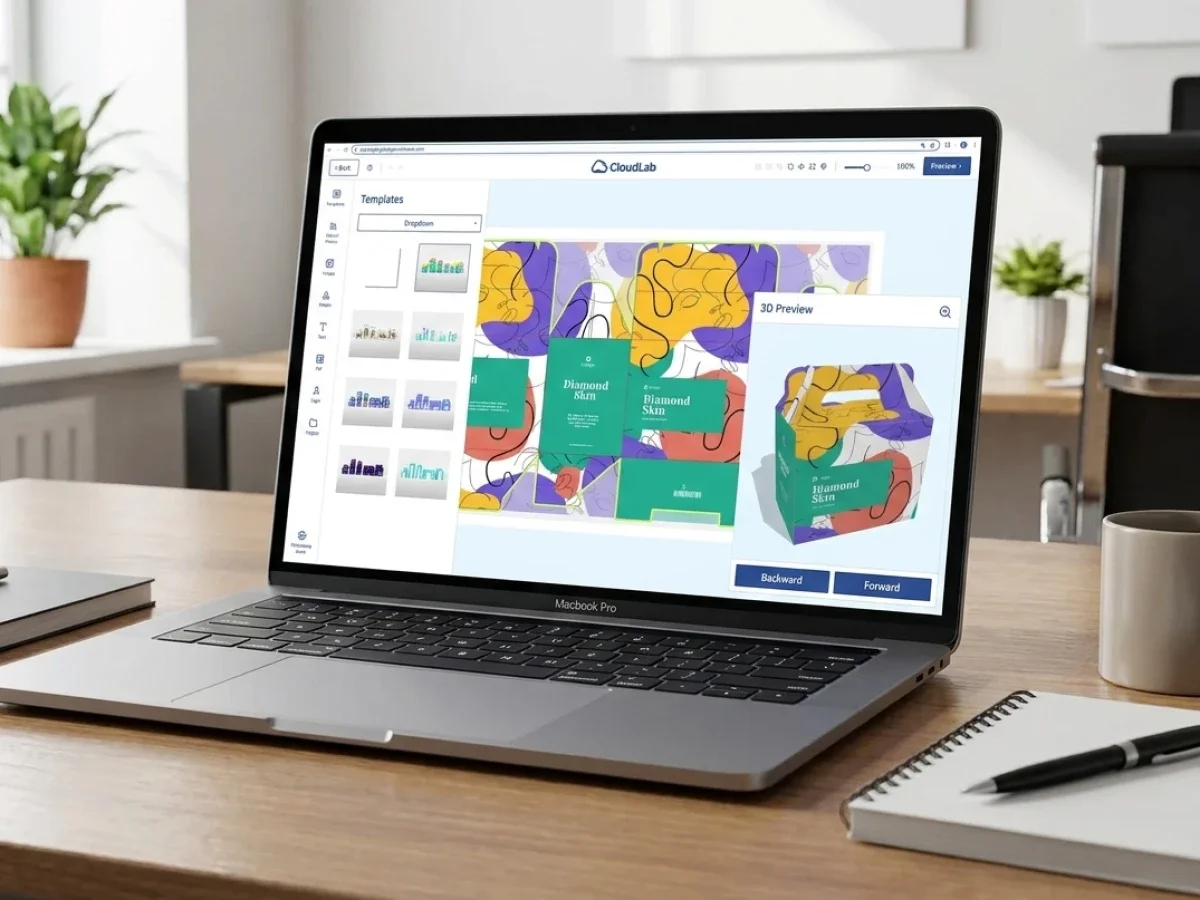
packQ uses synchronized 2D and 3D visualization to serve both requirements. Changes to the project can be represented across both views, giving users technical detail without losing spatial context.
This matters because a flat dieline can be technically precise while still being difficult for a non-specialist to interpret. A logo may sit correctly on one panel but appear visually secondary once the package is folded. Text crossing a structural transition may look different on the physical object than expected from the flat artwork.
Interactive 3D helps users inspect those relationships before approval. The package can be viewed from different perspectives while the underlying 2D representation remains available for detailed work.
For brand owners managing many SKUs, the approach can improve consistency across variants. Marketing can evaluate the assembled package, while prepress works from the same project rather than another independently generated proof.
The critical factor is synchronization. 2D and 3D should represent the same package, not two separate interpretations that have to be reconciled later.
Software for packaging design must protect print data as well as structure
The secondary keyword software for packaging design often focuses attention on creative tools. In industrial Web-to-Pack, however, artwork quality is only useful when it satisfies the technical requirements defined for production.
A package can have valid geometry and still contain unsuitable graphics. Images may have insufficient resolution. Color modes can conflict with production requirements. Bleed may be missing, fonts may cause issues, or artwork can extend beyond intended areas.
packQ integrates Dynamic Preflight to move technical validation closer to the design process. Instead of waiting until the completed order reaches prepress, defined checks can operate while users are still working with the project.
This changes the correction loop. When an issue is identified early, the customer or operator can address it while the relevant artwork and configuration remain immediately accessible. Prepress does not have to begin every job by discovering predictable problems after commercial approval.
For high-volume online operations, that timing has direct operational value. A handful of manual corrections may be manageable, but hundreds of small jobs with routine artwork defects can consume specialist capacity rapidly.
Dynamic Preflight therefore supports both production safety and scalability. It does not remove professional prepress; it filters preventable problems before those specialists need to intervene.
AI-assisted artwork preparation should solve production problems, not create another tool chain
Artwork submitted through online packaging portals varies significantly in quality. Professional brand teams may upload carefully prepared assets, while smaller customers can arrive with raster logos, low-resolution images, or graphics that require basic preparation before printing.
Sending every imperfect asset into a separate correction workflow weakens self-service. The customer uploads a file, receives an email requesting another version, searches for the original designer, and returns later with a replacement. The digital process becomes fragmented before the order has even been placed.
The AI Designer Suite in packQ brings selected artwork-preparation functions into the browser workflow. Vectorization can convert suitable raster graphics into scalable vector content, while background removal can isolate subjects without requiring a separate editing process.
Crispify addresses another frequent issue by generating four times more pixels for suitable images, providing a practical way to improve source resolution inside the workflow. These capabilities are useful because they operate where the problem appears rather than after the file has already moved downstream.
The production principle remains important: AI assistance should not bypass quality control. It should reduce routine preparation work while Dynamic Preflight and defined production rules continue to determine whether the resulting artwork satisfies the workflow requirements.
For prepress teams, that creates a healthier division of labor. Automation handles repeatable corrections, while specialists retain responsibility for cases that require technical judgment.
Manual packaging workflows or integrated Web-to-Pack: which approach is more suitable?
Manual workflows remain appropriate for exceptional packaging projects that require extensive structural engineering or specialist intervention, while integrated Web-to-Pack is stronger for standardized, configurable, repeatable, and personalized products. packQ combines packaging-specific design, 3D approval, Dynamic Preflight, pricing, and production output so manufacturers can automate suitable orders without removing expert control from complex projects.
A manual process provides flexibility because specialists can respond individually to almost any requirement. That flexibility is valuable for unusual constructions, complex finishing, prototypes, or projects whose technical parameters cannot be represented reliably through predefined rules.
The weakness appears when the same manual process is applied to routine products. If every standard folding carton requires sales to collect dimensions, structural design to prepare a familiar model, estimating to calculate the price, and prepress to check predictable artwork properties, the organization repeatedly pays for work it already understands.
Web-to-Pack turns that established knowledge into digital product logic. Valid structures become templates, configuration limits become rules, pricing parameters become calculations, and technical artwork requirements become automated checks.
The result is not a choice between people and software. It is a choice about where human expertise creates the most value. Routine configuration can move toward automation while specialists focus on engineering, quality, and exceptional requirements.
packQ is designed for this division. Its packaging-specific architecture connects customer self-service with production controls instead of simplifying the front end at the expense of downstream manual work.
Dynamic pricing connects design decisions with commercial decisions
Packaging configuration has immediate commercial consequences. Dimensions influence material use. Quantity changes production economics. Printing and finishing options affect the job specification. A customer can therefore make a technically valid design choice that changes the commercial result.
If pricing operates separately, every meaningful modification can trigger another quotation cycle. The customer changes the package, sales sends the specification to estimating, a revised price is prepared, and the customer may then request another change.
packQ incorporates dynamic real-time pricing so defined configuration parameters can influence pricing during the online process. This gives customers and sales teams commercial feedback while the package is still being configured.
For open-shop scenarios, immediate pricing supports a transactional customer journey. A buyer can explore permitted options and understand their commercial implications without waiting for routine manual calculations.
Closed B2B portals can use the same principle for recurring customer-specific products. Approved packaging structures, options, and commercial rules can support faster reorders while maintaining controlled product logic.
The strongest benefit is again data continuity. The configuration being priced is the configuration being designed.When the customer proceeds, the commercial decision is based on the same product information that continues through the workflow.
From Web-to-Print to packaging-specific Web-to-Pack
Web-to-Print and Web-to-Pack share several concepts: browser access, personalization, templates, online ordering, automated file creation, and integration. The difference appears in the product being controlled.
Flat print products can often be described through dimensions, pages, media, graphics, and finishing parameters. Packaging introduces another layer because the printed object must become a three-dimensional structure with folds, panels, closures, and manufacturing relationships.
A packaging-specific system therefore needs structural intelligence alongside graphic personalization. It must understand the relationship between a dieline and the assembled object, not simply provide another editable canvas.
packQ was built around this packaging requirement. Its ECMA and FEFCO libraries, CAD-based structural logic, real-time 3D visualization, Dynamic Preflight, and production workflow distinguish its role from a generic personalization environment.
CloudLab's experience with printQ provides a broader digital print background, while packQ focuses specifically on packaging processes. brandQ addresses brand management use cases within CloudLab's product environment. The individual products serve different workflow requirements rather than treating every graphical process as the same problem.
For packaging decision-makers, this distinction matters when evaluating scope. A Web-to-Pack project should begin with the packaging process, then determine how storefront, design, pricing, prepress, and production need to connect around it.
How can packaging design software be integrated with shop, ERP, MIS, prepress, and production?
Packaging design software can be integrated by treating the Web-to-Pack layer as a packaging engine between the customer interface and existing business systems. packQ uses a headless, API-first architecture with REST, SOAP, and JSON-based interfaces so technology teams can connect configuration, pricing, approval, order information, prepress, and production workflows without rebuilding the complete IT landscape.
The implementation should start with product logic rather than APIs. A packaging manufacturer first determines which products are suitable for online configuration, which parameters customers may control, and which exceptions still require specialist review.
Next, structural models and configuration rules are established. ECMA and FEFCO templates can provide foundations for standard products, while individual parameterization defines the valid dimensions and options offered through the digital channel.
The customer-facing shop or portal then handles discovery, accounts, product selection, checkout, and the broader commerce experience. packQ supplies the packaging-specific configuration and design functions behind that experience.
The ERP or MIS can remain responsible for established business processes such as customer information, job management, costing logic, planning, or order administration. Integration prevents information captured online from having to be typed into these systems again.
The prepress workflow receives projects whose artwork has already been subjected to defined Dynamic Preflight checks. Complex cases can still be reviewed manually, but routine technical validation begins earlier.
The production layer receives the output and job information required by the configured workflow. packQ can generate production-relevant data, including production-safe PDF output, while integrations and automated routing can move information into downstream environments.
REST, SOAP, and JSON support different integration requirements within established IT landscapes. The exact interface strategy depends on the surrounding systems, but the architectural principle remains consistent: packQ adds packaging intelligence without requiring every connected system to be replaced.
That approach is especially valuable for mature packaging manufacturers. Their ERP, MIS, prepress, and production systems often contain years of business logic. Web-to-Pack should extend that environment with a digital customer and automation layer rather than forcing an unnecessary infrastructure reset.
Headless architecture supports multiple packaging sales models
A packaging manufacturer may not have one digital channel. The organization can operate a public storefront, private customer portals, marketplace connections, sales-assisted configuration, and internal ordering environments simultaneously.
A tightly coupled application can make this difficult because design functionality is bound to one front end. Headless architecture separates the packaging engine from the presentation layer, allowing different customer experiences to use the same underlying capabilities.
For an open B2C or SME-oriented shop, the interface can emphasize ease of use, guided configuration, 3D visualization, and immediate pricing. Customers may have limited packaging expertise, so the workflow exposes only the choices they need.
A closed B2B portal can work differently. Existing customers may have approved structures, materials, brand assets, templates, prices, and ordering permissions. Their workflow can prioritize fast reordering and controlled customization.
A marketplace can integrate packaging configuration as a service without reproducing the complete packQ interface. Technology teams can use APIs to connect relevant functionality with the surrounding platform.
The common advantage is centralized packaging logic. Structural rules, preflight requirements, production parameters, and automation do not have to be reinvented for every sales channel.
Variable Data Printing turns one approved design into many production variants
Personalization changes the economics of packaging because the number of unique designs can increase dramatically without a corresponding increase in order volume. A campaign may require individual names, images, codes, regional information, or customer-specific content.
If every variation becomes a separate manual artwork file, the workflow stops scaling quickly. The design itself may be simple, but file preparation and verification multiply with every variant.
packQ supports Variable Data Printing through PDF/VT, allowing variable content to be generated within a controlled packaging framework. This enables personalized series and workflows extending toward batch size one.
The structural package and approved graphical framework remain stable while designated data fields vary according to the project. This allows brands to create personalized campaigns without manually rebuilding the complete package for every recipient or SKU.
For packaging manufacturers, PDF/VT connects personalization with production automation. The value is not simply producing more visual variants. It is producing those variants without multiplying prepress work at the same rate.
This is particularly relevant for digital print environments where short runs and personalization are commercially viable only if administrative and file-preparation costs remain controlled.
Production-ready output is the real endpoint of online packaging design
An online designer can create an excellent customer experience while still creating operational problems behind the scenes. The critical test comes after checkout: what does production receive?
If employees receive only customer artwork and configuration notes, the manufacturer still needs to reconstruct the actual production job. That limits the economic benefit of online ordering because manual preparation remains proportional to order volume.
packQ is designed to generate production-oriented output from the validated packaging project. The structure, artwork, and configuration that passed through the online process remain connected to the output stage.
Production-safe PDF generation helps establish a reliable bridge between online approval and manufacturing. Depending on the workflow, additional production information can also move through connected systems and automated routing.
This continuity is especially important for small orders. A large packaging run can economically absorb more manual administration. A batch of highly customized short runs cannot if every order requires the same amount of human preparation.
For Web-to-Pack, automation per order is therefore a strategic metric. Increasing online revenue without reducing manual touches can simply move the bottleneck from sales to prepress or production planning.
How can packaging manufacturers automate online design from configuration to production?
Packaging manufacturers can automate online design by defining standardized structures, configuration rules, artwork requirements, pricing logic, approval controls, preflight criteria, and production output before opening the workflow to customers. packQ combines these elements as packaging design software and software for packaging design, using Web-to-Pack, ECMA/FEFCO structures, 3D visualization, Dynamic Preflight, and API-first integration to connect customer configuration with manufacturing.
The starting point is a repeatable packaging portfolio. A manufacturer identifies folding cartons, corrugated boxes, displays, labels, flexible packaging, or other products whose options can be represented through controlled digital rules. Products requiring extensive engineering can remain outside full self-service.
The structural requirement comes next. Existing packaging expertise is translated into parameterized models. ECMA and FEFCO standards can accelerate this process for common constructions, while the organization defines acceptable dimensions, materials, closures, and other relevant options.
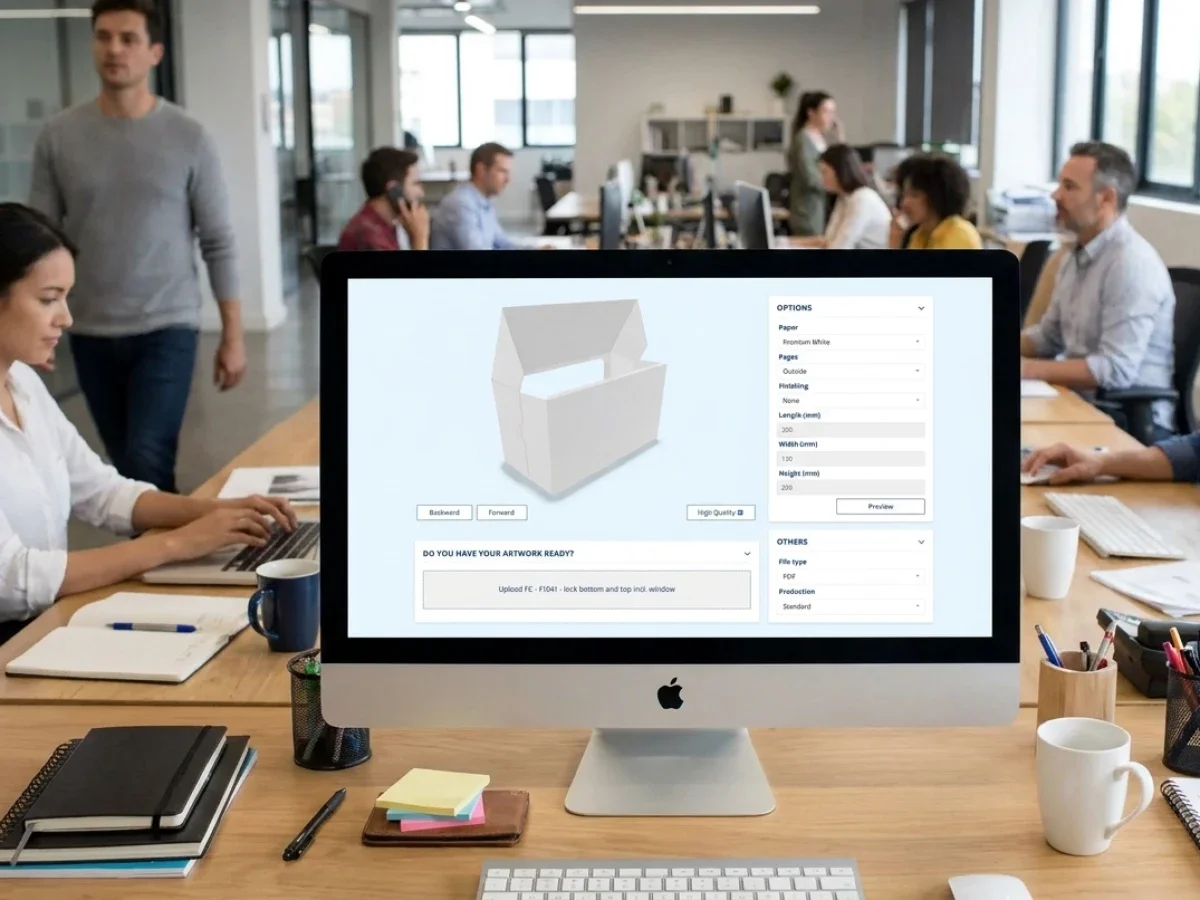
The customer workflow then exposes only valid decisions. A user selects a product, enters permitted dimensions, chooses options, uploads artwork, and works within defined design areas. The system guides the configuration rather than presenting unrestricted CAD functionality.
During visualization, synchronized 2D and 3D views connect technical layout with the assembled package. Customers can evaluate the physical result while prepress and experienced users retain access to the flat representation required for detailed inspection.
During artwork preparation, AI-assisted functions can reduce common barriers. Vectorization helps with suitable raster graphics, background removal prepares images for layout, and Crispify can enhance source resolution by generating four times more pixels.
The validation stage uses Dynamic Preflight to evaluate defined technical criteria such as resolution, color mode, bleed, and fonts. Problems are identified before the job reaches final production preparation, reducing avoidable correction cycles.
The commercial stage applies dynamic pricing to the configured product. Dimensions, quantities, printing options, materials, or other defined parameters can influence calculation logic, allowing customers to understand commercial consequences during configuration.
The approval stage keeps visual and technical information connected. Stakeholders evaluate the same packaging project that has passed through structural configuration and technical validation rather than approving an unrelated rendering or exported proof.
For personalized products, PDF/VT introduces variable data without requiring a separate manual design process for every version. Controlled templates can support campaigns, individualized packaging, and batch-size-one applications.
The integration stage transfers relevant project and order information to existing systems. Shop, ERP, MIS, prepress, and production environments can exchange data through packQ's API-first architecture using appropriate REST, SOAP, or JSON interfaces.
Finally, production output is generated from the validated project. The objective is that manufacturing receives information derived from what the customer actually configured and approved rather than a manually reconstructed interpretation.
For the customer, this can feel like a straightforward digital journey: configure, design, visualize, validate, price, approve, and order. Behind that simple interface is a much more rigorous technical process.
For the manufacturer, that hidden rigor is precisely what makes self-service scalable. Web-to-Pack succeeds when simplicity for the customer does not create complexity for production.
Packaging design software becomes infrastructure when every stage shares the same data
The most important shift in online packaging is not moving a designer into the browser. It is changing the way packaging information travels through the organization.
When structural design, artwork, pricing, approval, preflight, and production are independent steps, every department creates another interpretation of the same job. Employees spend time synchronizing those interpretations instead of improving the product or solving genuine exceptions.
A connected platform treats them as different stages of one digital packaging project. Structural parameters influence visualization. Artwork belongs to the selected structure. Validation evaluates that artwork. Pricing responds to configuration. Approval applies to the resulting project, and downstream systems receive the information generated throughout the process.
This is the deeper value of packQ's packaging-specific architecture. The 3D Packaging Designer attracts attention because it makes the customer experience visible, but the operational value comes from everything connected behind it.
Dynamic Preflight reduces technical uncertainty. ECMA and FEFCO reduce structural ambiguity. API-first integration reduces media breaks. Production-oriented output reduces reconstruction. Variable data capabilities reduce manual work in personalized campaigns.
Together, these functions support the Print 4.0 and Industry 4.0 principle that information should move digitally through the process with as little unnecessary manual reinterpretation as possible.
CloudLab's recognition through the InterTech Technology Award reflects the technological relevance of this approach. More importantly for a packaging decision-maker, the platform addresses a practical challenge: turning packaging expertise into a scalable digital workflow.
Choosing the right scope for Web-to-Pack automation
Not every packaging job should follow the same degree of automation. A successful implementation distinguishes between products that can be fully parameterized, products that can be partially automated, and projects that require specialist engineering from the beginning.
Standard folding cartons and corrugated structures are strong candidates when dimensions and options can be represented reliably. Reorders and branded variants are also attractive because much of the technical logic has already been approved.
Highly unusual structures may follow a hybrid workflow. A specialist can first establish the design and production logic, after which recurring variants may become configurable if the relevant parameters can be controlled.
This staged approach prevents a common implementation mistake: trying to automate complexity before the organization has defined its rules. Automation works best on understood processes. Web-to-Pack then makes that knowledge available consistently across customers, sales channels, and production systems.
For technology teams, the same principle applies to integration. The goal does not have to be connecting every system on day one. A well-defined product workflow can be established first, followed by deeper ERP, MIS, prepress, and production integration as operational requirements are validated.
The result is a Web-to-Pack architecture that can scale with the business instead of becoming a large one-time IT project whose scope is difficult to control.
Packaging design software should connect creativity with production
The strongest packaging design software does not stop when a package looks correct on screen. It carries structural, graphical, technical, commercial, and approval information forward until the project becomes reliable production input.
packQ provides that framework through packaging-specific Web-to-Pack technology. Parameterized ECMA and FEFCO structures establish controlled geometry, while synchronized 2D/3D design makes packaging understandable to both technical and nontechnical stakeholders. Dynamic Preflight moves quality checks upstream, and AI-assisted artwork preparation helps resolve common source-file problems earlier.
Dynamic pricing connects configuration with commercial decisions. PDF/VT supports personalized packaging and batch size one. Production-safe output connects approved projects with manufacturing, while the headless, API-first architecture enables integration with shop, ERP, MIS, prepress, and production systems.
For printers and packaging manufacturers, this creates a path toward processing more standardized and customized orders without increasing manual work at the same rate. For brand owners, it improves visual control and approval. For e-commerce platforms, packaging becomes a configurable digital service. For IT and production teams, the workflow produces structured information that can continue through existing systems.
The central value of packaging design software is therefore continuity. packQ connects online packaging design with Web-to-Pack automation and production safety so the package configured by the customer can remain the same controlled digital project through visualization, validation, approval, pricing, and manufacturing.
Packaging design creates greater operational value when it remains connected to the complete production workflow. CloudLabs packQ combines browser-based 2D/3D design, parameterized ECMA and FEFCO structures, Dynamic Preflight, AI-assisted artwork preparation, real-time pricing, PDF/VT personalization, and production-safe output within one Web-to-Pack environment. Its headless, API-first architecture connects customer-facing configuration with shop, ERP, MIS, prepress, and production systems, helping packaging manufacturers, printers, brands, and e-commerce platforms reduce manual handoffs while scaling customized and production-ready packaging.
Key answers for decision-makers
- Packaging design software should connect structural configuration, artwork, 3D approval, technical validation, pricing, and production output instead of treating design as an isolated process.
- packQ reduces production risk by combining standardized ECMA/FEFCO structures with synchronized 2D/3D visualization and Dynamic Preflight before approved jobs reach manufacturing.
- Web-to-Pack is more suitable than isolated design workflows when packaging products require customer self-service, real-time pricing, automated validation, and direct integration with production systems.
- API-first integration allows packQ to exchange packaging and order data with shop, ERP, MIS, prepress, and production environments without requiring a completely separate digital infrastructure.
- Packaging manufacturers can automate online packaging by defining valid structures, configuration rules, artwork requirements, pricing logic, approval steps, preflight conditions, and production output inside one connected workflow.

.webp)


