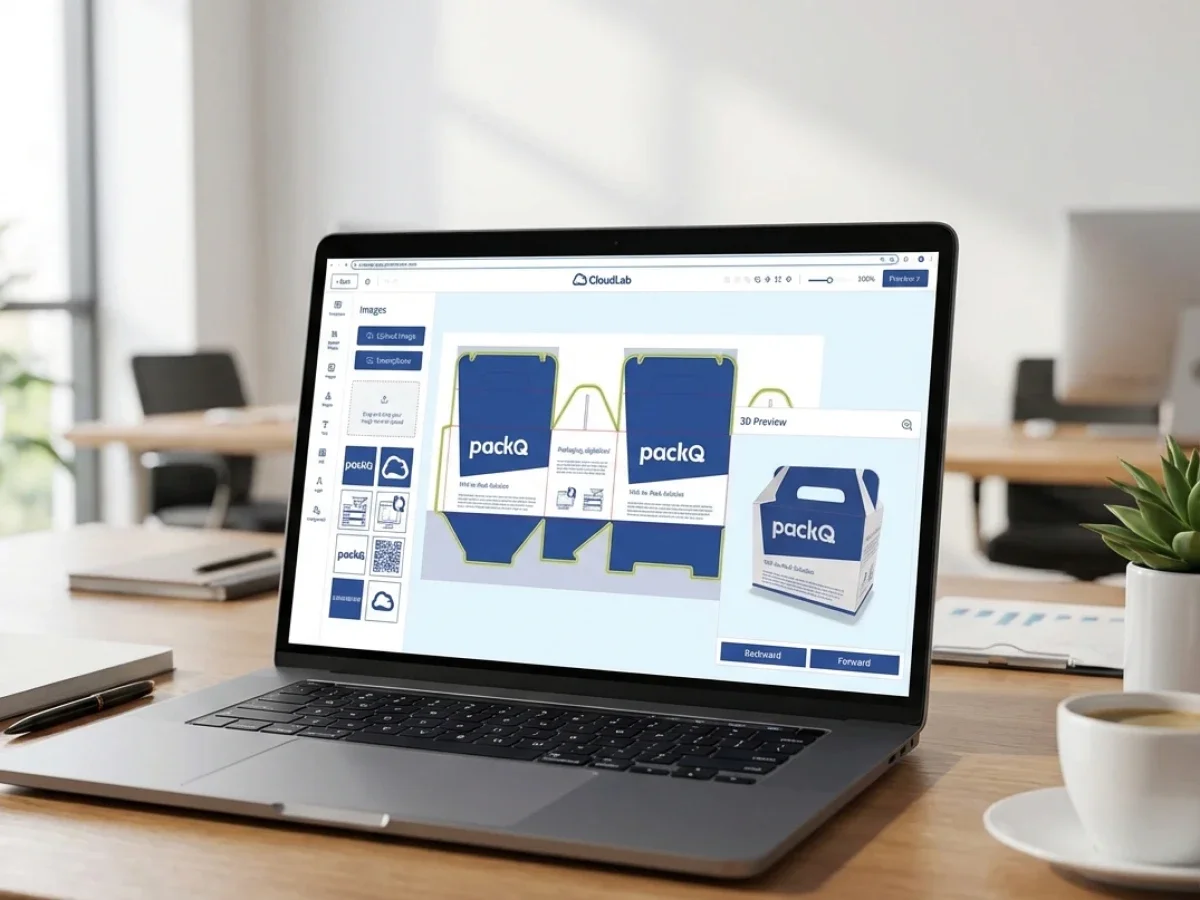
Print Previewer for Automated Print Production
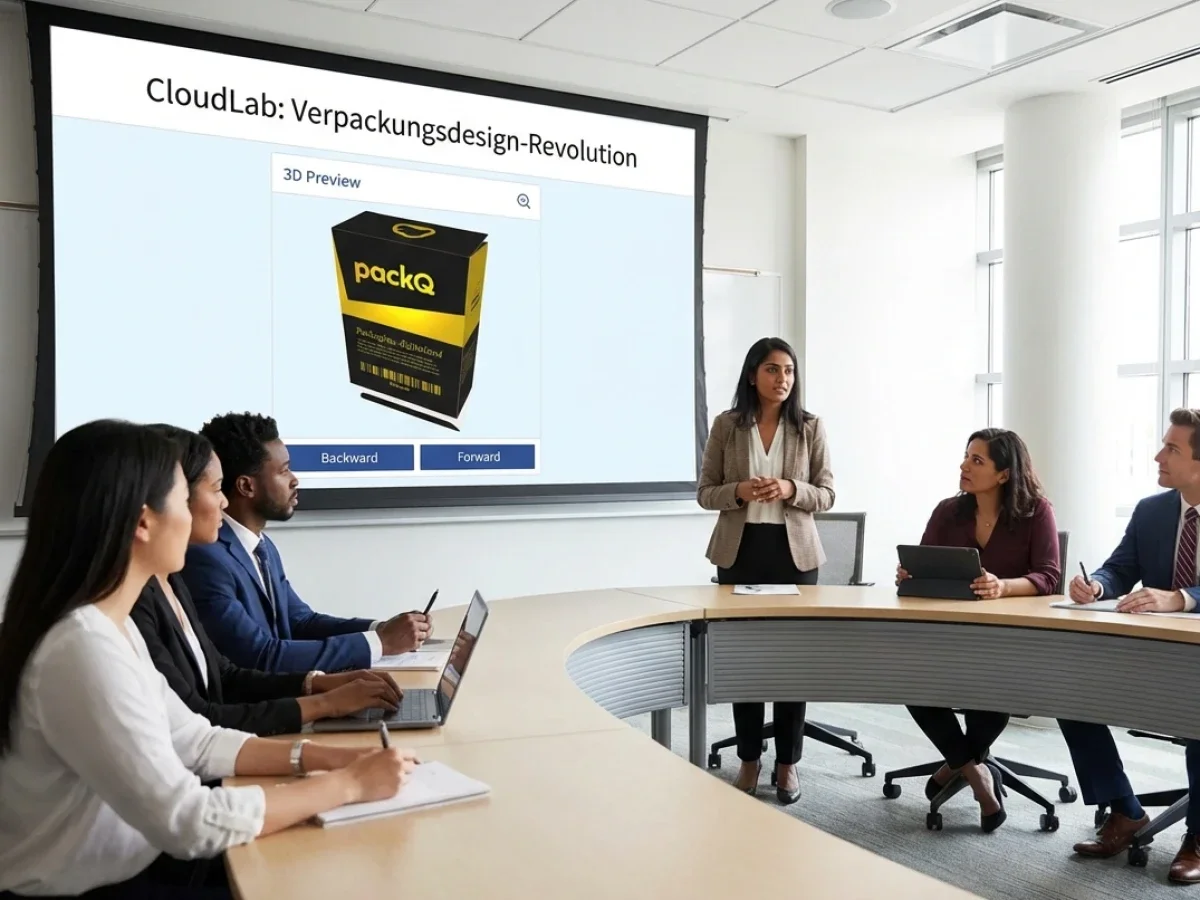
A print previewer is no longer a static proofing tool but a real-time decision engine within the print production workflow. Modern solutions combine 3D visualization, AI-assisted correction, and production logic. packQ embeds advanced print previewer capabilities directly into its Web-to-Pack platform to accelerate approvals, reduce errors, and automate production.
Print Previewer as a Strategic Component of Print Production
The role of the print previewer has changed fundamentally over the last decade. What was once a static PDF proof viewed at the end of a workflow has evolved into a dynamic system component that shapes decisions upstream.
In modern environments, preview technology directly influences approval speed, data quality, and production efficiency. A print previewer is no longer about “what it looks like” but about what will actually be produced.
For decision-makers, this shift turns previewing into a strategic capability rather than a prepress convenience.
Why Traditional Print Previewing Breaks Modern Workflows
Traditional previewing methods were designed for linear workflows. Files were created, reviewed, corrected, and then passed to production. Each step involved human intervention and time delays.
This model does not scale in today’s print production workflow. Orders arrive continuously, often outside business hours, and are created by non-experts. Manual proofing becomes a bottleneck.
Without a robust print previewer embedded directly into the workflow, errors propagate downstream and undermine automation.
The Print Previewer as a Trust Mechanism
In automated environments, trust replaces control. Production systems must trust that incoming data is correct. Customers must trust that what they approve is what they will receive.
A modern print previewer establishes this trust by visualizing the production-relevant reality, not a cosmetic approximation. Dimensions, folds, bleed, materials, and finishes must be represented accurately.
This trust is essential for eliminating manual checkpoints.
From 2D Proofs to 3D Print Previewers
Two-dimensional proofs are insufficient for complex products. Packaging, POS displays, and structural print products require spatial understanding.
A 3D print previewer provides context that flat previews cannot. It shows how graphics interact with structure, where folds occur, and how surfaces relate to each other.
This shift from 2D to 3D previewing marks a decisive step toward production-safe approvals.
Print Previewing in Packaging-Centric Workflows
Packaging exposes the limitations of traditional preview tools more clearly than any other segment. A flat PDF cannot convey folding logic, glue areas, or material thickness.
In a print production workflow that includes packaging, previewing must be structurally aware. Otherwise, approvals are speculative.
A print previewer that understands packaging geometry reduces misinterpretation and accelerates decision-making.
packQ as a Web-to-Pack Platform with Native Print Previewer Logic
packQ is a premium Web-to-Pack platform developed by CloudLab Solutions and recognized with the InterTech Technology Award. Unlike traditional Web-to-Print tools, packQ treats previewing as a core system function.
Its print previewer is not an external module. It is embedded into the configuration, validation, and approval process.
This integration eliminates the gap between preview and production.
Real-Time 3D Packaging Preview as a Decision Accelerator
At the core of packQ lies a browser-based 3D packaging designer with real-time rendering and synchronized 2D and 3D views. Every change to layout, dimensions, or structure updates instantly.
This real-time behavior turns the print previewer into an interactive decision tool. Users explore outcomes instead of waiting for regenerated proofs.
Approvals that once took days can be completed in minutes.
Synchronization Between Design and Structure
A critical weakness of many preview tools is decoupling. Artwork changes do not automatically reflect structural changes, or vice versa.
packQ synchronizes design and structure continuously. The print previewer always reflects the current production state.
This synchronization ensures that approvals remain valid even as configurations evolve.
ECMA and FEFCO Standards as the Backbone of Accurate Previewing
Accurate previewing depends on standardized construction logic. packQ integrates ECMA and FEFCO standards directly into the platform, covering approximately 120 ECMA folding cartons, 290 FEFCO corrugated designs, and 50 POS displays.
These standards define not only structure but also preview behavior. Folds, panels, and glue areas are rendered correctly.
This transforms standards from documentation into executable preview logic.
AI-Assisted Preview Quality Enhancement
Preview accuracy also depends on input quality. Low-resolution images, incorrect formats, or missing backgrounds distort previews and approvals.
packQ’s AI Designer Suite addresses this by stabilizing input data. Raster images can be vectorized, resolution enhanced using Crispify with four-times higher output resolution, and backgrounds removed directly in the browser.
Cleaner input leads to more reliable previews and fewer false alarms.
Print Previewer and Variable Data Complexity
Variable Data Printing introduces additional preview challenges. Each variant must be visualized correctly without manual effort.
packQ supports PDF/VT-based Variable Data Printing with preview logic that scales across variants. The print previewer reflects personalization dynamically.
This ensures that mass customization does not undermine preview reliability.
Previewing as Part of Automated Pricing Logic
Previewing and pricing are closely connected. Invalid configurations should not generate prices.
packQ integrates preview validation into dynamic pricing in real time. Only production-safe configurations displayed in the previewer can be priced.
This protects margins and prevents downstream corrections.
Print Previewer as an Error Prevention Tool
A previewer that merely displays content does not prevent errors. A previewer that enforces logic does.
packQ combines previewing with Dynamic Preflight Check. Resolution, color mode, bleed, fonts, and structural constraints are validated while the preview is generated.
Errors are corrected before approval, not after production planning.
Previewing in B2B and B2C Contexts
The role of the print previewer differs between B2B and B2C scenarios, but its value remains consistent.
In B2B environments, previewing supports formal approval workflows and reduces coordination effort. In B2C environments, it builds confidence for non-expert users.
Both rely on clarity and accuracy rather than visual polish alone.
Print Previewer as a User Guidance Interface
A modern print previewer guides users toward valid outcomes. Visual feedback, constraints, and validation messages work together.
packQ’s previewer does not simply show errors. It prevents invalid states from occurring.
This guidance reduces support effort and increases completion rates.
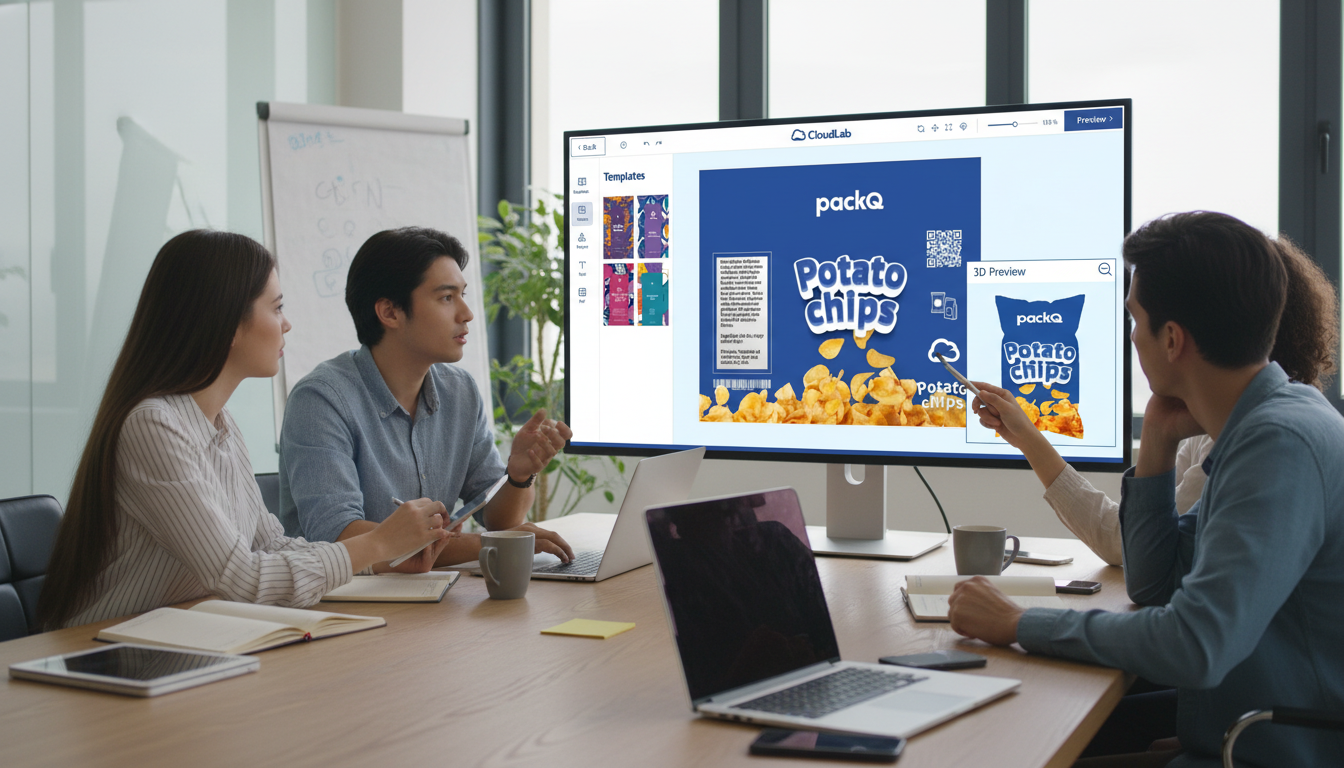
Preview Technology and the Print Production Workflow
Previewing must align with the entire print production workflow. Disconnected preview tools create inconsistencies between what is approved and what is produced.
packQ’s previewer feeds directly into production-safe PDF output and ERP/MIS integration. The approved preview is the production reality.
This alignment enables true end-to-end automation.
Print Previewer in End-to-End Print Production Workflows
A print previewer reaches its full value only when it is embedded into the complete print production workflow. Previewing cannot exist as an isolated visual step if the goal is automation. It must connect configuration, validation, pricing, approval, and production output into one continuous process.
When previewing is decoupled from production logic, inconsistencies emerge. Files that looked correct in a preview may fail in prepress or on the machine. This gap is one of the most common sources of rework in automated environments.
A print previewer that is part of the workflow eliminates this disconnect.
Previewing as the Link Between Customer Intent and Production Reality
In digital print workflows, customer intent is expressed through configuration choices. Production reality is governed by technical constraints. The print previewer sits between these two worlds.
Its task is to translate intent into a production-valid representation. Dimensions, materials, folds, and finishes must be shown exactly as they will be produced. Any abstraction undermines trust and automation.
packQ positions the print previewer as this translation layer, not as a cosmetic add-on.
Faster Approvals Through Visual Certainty
Approval cycles are a critical time factor in print production workflows. Delays often stem from uncertainty rather than disagreement. Stakeholders hesitate when previews leave room for interpretation.
A high-fidelity print previewer removes ambiguity. Decision-makers see the final product, not a proxy. This clarity accelerates approvals and reduces the need for follow-up explanations.
In distributed organizations, this speed advantage compounds across volumes.
Print Previewer in Open-Shop and Closed-Shop Scenarios
Open-shop and closed-shop models impose different demands on previewing. In open-shop scenarios, users are often non-experts. The previewer must be intuitive and forgiving while still enforcing rules.
In closed-shop environments, users are trained but expect precision. Previews must support formal approval workflows and auditability.
packQ supports both scenarios by adapting interaction depth without changing the underlying preview logic.
Preview Accuracy as a Quality Assurance Strategy
Quality assurance traditionally relies on downstream checks. Preview accuracy shifts quality control upstream.
When a print previewer reflects production logic accurately, many quality issues are resolved before files reach prepress. This reduces dependency on manual checks and stabilizes throughput.
In high-volume environments, this upstream quality control is essential for predictable operations.
Reducing Prepress Workload Through Intelligent Previewing
Prepress teams often act as correction hubs. Files arrive with issues that could have been prevented earlier.
An intelligent print previewer reduces this burden by guiding users during configuration. Invalid states are avoided. Warnings are contextual.
As a result, prepress effort shifts from correction to optimization.
Integration of Previewing with ERP and MIS Systems
Preview approval must translate directly into production orders. Any manual handoff introduces risk.
packQ integrates preview results into ERP and MIS systems through its headless, API-first architecture. Approved configurations generate production-safe PDF output automatically.
This integration ensures that what is approved is exactly what is produced.
Print Previewer as a Governance Instrument for Brands
Brand owners require consistency across campaigns and regions. A print previewer helps enforce this consistency visually.
packQ’s previewer works with controlled templates that lock critical brand elements. Users can customize content within boundaries while seeing the branded result immediately.
This visual governance reduces brand-related corrections significantly.
Previewing in Regulated and Industrial Environments
In regulated industries, preview accuracy carries compliance implications. Incorrect labeling, dimensions, or layout can have legal consequences.
packQ’s previewer reflects production constraints precisely, reducing compliance risk. Combined with preflight validation, it provides a double safety net.
Previewing becomes part of risk management.
Print Previewer and Industry 4.0 Alignment
Industry 4.0 and Print 4.0 emphasize digital twins, automation, and data integrity. A modern print previewer functions as a digital twin of the final product.
packQ’s real-time 3D preview reflects the same data that drives production output. This alignment enables automation without manual checkpoints.
Previewing is no longer a visualization step. It is a data-driven system component.
Strategic Value of Advanced Print Previewers
Organizations that invest in advanced previewing gain more than visual improvements. They gain speed, reliability, and scalability.
Fewer errors reach production. Approval cycles shorten. Customer confidence increases.
Over time, these advantages translate into competitive differentiation.
Print Previewer Revisited
A modern print previewer is not a luxury feature. It is a structural requirement for automated print production workflows.
Solutions that treat previewing as an afterthought struggle as complexity grows. Platforms that embed previewing into the core workflow scale more reliably.
packQ exemplifies this integrated approach.
A Preview for Print Production Workflow
A print previewer has evolved into a central decision engine within the print production workflow. Static proofs can no longer support the speed and complexity of modern print and packaging environments. packQ embeds advanced print previewer capabilities directly into its Web-to-Pack platform, combining real-time 3D visualization, AI-assisted input optimization, ECMA and FEFCO standards, Dynamic Preflight Checks, automated pricing, and deep ERP/MIS integration. This integration transforms previewing from a manual checkpoint into a strategic enabler for Print 4.0 automation.
packQ's modern print previewer is a critical component of automated print production workflows. It has evolved from static proofs to real-time, AI-assisted, and production-aware visualization. By embedding a high-fidelity print previewer into its Web-to-Pack platform, packQ combines real-time 3D previews, ECMA and FEFCO standardization, AI-powered design optimization, Dynamic Preflight validation, variable data support, automated pricing, and API-first ERP/MIS integration. The result is faster approvals, fewer errors, and scalable, production-safe print workflows aligned with Industry 4.0 principles.