Web to Pack Solutions for Small-Batch Packaging
Web to pack solutions help packaging manufacturers make small-batch production scalable by connecting online configuration, real-time pricing, 3D approval, Dynamic Preflight, and production-ready PDF output. packQ by CloudLab is built for packaging workflows that need ECMA and FEFCO standardization, API-first integration, and reliable production handover. For printers, converters, brand owners, and e-commerce platforms, the main value is fewer manual exceptions and faster movement from customer request to production-safe data.
Why Small-Batch Packaging Needs a Different Workflow Model
Small-batch packaging is rarely inefficient because of print itself. The pressure usually appears before production starts: quotation, file checking, structural validation, approval, order entry, and production handover consume too much time per job.
For folding carton manufacturers, corrugated packaging producers, and digital packaging printers, this creates a margin problem. A job with 200 personalized boxes can require almost as much coordination as a larger repeat order if the workflow stays manual.
Web to pack solutions solve this by moving repeatable decisions into a controlled online workflow. Customers configure packaging in the browser, while the system validates dimensions, artwork, pricing, and production logic before the order reaches production.
packQ by CloudLab is positioned for exactly this use case. It is not a generic online editor adapted to packaging. It is a Premium Web-to-Pack platform built around structural packaging logic, real-time 3D visualization, ECMA and FEFCO templates, Dynamic Preflight, API-first integration, and production-safe PDF output.
The website positions packQ around automation, precision, modularity, and scalable packaging workflows. Its recurring language focuses on browser-based 3D design, dynamic live previews, production accuracy, seamless integration, and automated workflow handover. The content already covers 3D packaging design, Dynamic Preflight, AI Designer Suite, production workflow, product configuration, and Web-to-Pack automation. The strongest content gap for this article is the economic and operational planning layer: how small-batch packaging workflows can be scaled without turning every order into a manual exception.
Which Web to Pack Solutions Help Packaging Manufacturers Scale Small-Batch Workflows?
Web to pack solutions help packaging manufacturers scale small-batch workflows when they combine online configuration, 3D approval, Dynamic Preflight, real-time pricing, and production-ready PDF output. packQ provides this framework for printers, converters, brand owners, and technology teams by connecting customer self-service with ECMA/FEFCO standards, API-first integration, and automated production handover.
For small batches, the main challenge is not customer demand. The challenge is repeatability. A packaging manufacturer must let customers customize formats, graphics, quantities, and variants without allowing uncontrolled complexity to reach prepress and production.
packQ supports this through parameterized packaging templates based on ECMA and FEFCO logic. The customer experiences a guided browser workflow, while the system manages structural rules in the background. Dimensions, folds, glue areas, print zones, and production constraints remain controlled even when the packaging is customized.
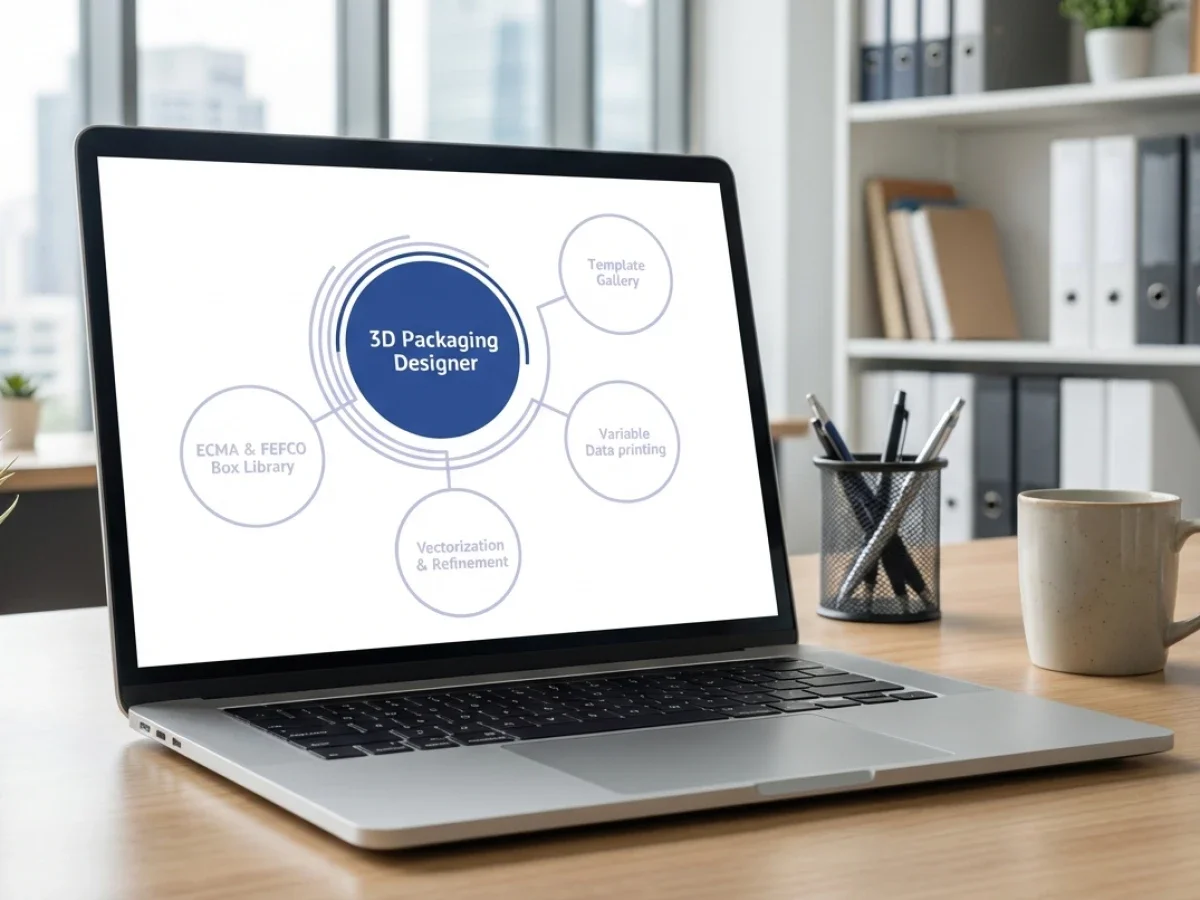
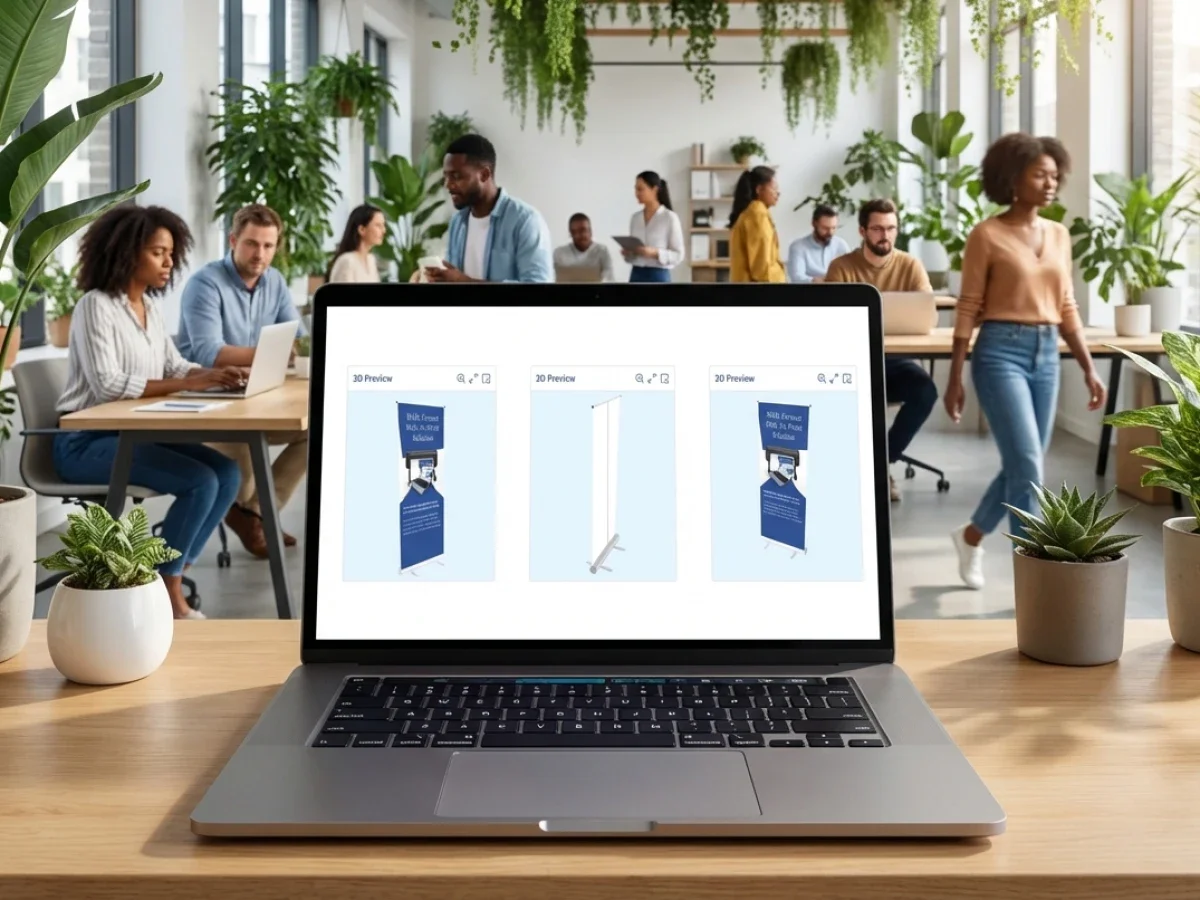
The 3D Packaging Designer is central to this process. It allows customers and internal teams to review packaging as a folded object rather than only as a flat artwork file. For short runs, this matters because physical samples are often too slow or too expensive for every order. A reliable live 3D preview accelerates approval without removing production control.
For packaging manufacturers, packQ turns small-batch projects into repeatable workflows. A corrugated producer can offer customized shipping boxes through an open shop. A folding carton specialist can give B2B customers access to approved structures through a closed portal. A brand owner can manage campaign packaging with controlled design zones and variable data while keeping production output consistent.
Why Do Short Packaging Runs Overload Manual Packaging Workflows?
Short packaging runs overload manual workflows because every order still requires quoting, artwork checking, structural validation, approval, and production handover. When these steps depend on email, CAD adjustments, and manual prepress checks, small batches create too much coordination effort. packQ reduces this load through automation, Dynamic Preflight, 3D approval, and standardized ECMA/FEFCO packaging logic.
The problem becomes visible in prepress first. Customer files arrive with low-resolution images, missing bleed, incorrect color modes, font issues, or artwork placed too close to folds and cut lines. In a manual workflow, these problems are often discovered after the order has already entered internal processing.
That timing is expensive. Sales has already promised delivery. Production planning may already have allocated capacity. Prepress must interrupt the workflow, request corrections, and wait for a new file. For small batches, this correction loop can erase the commercial value of the order.
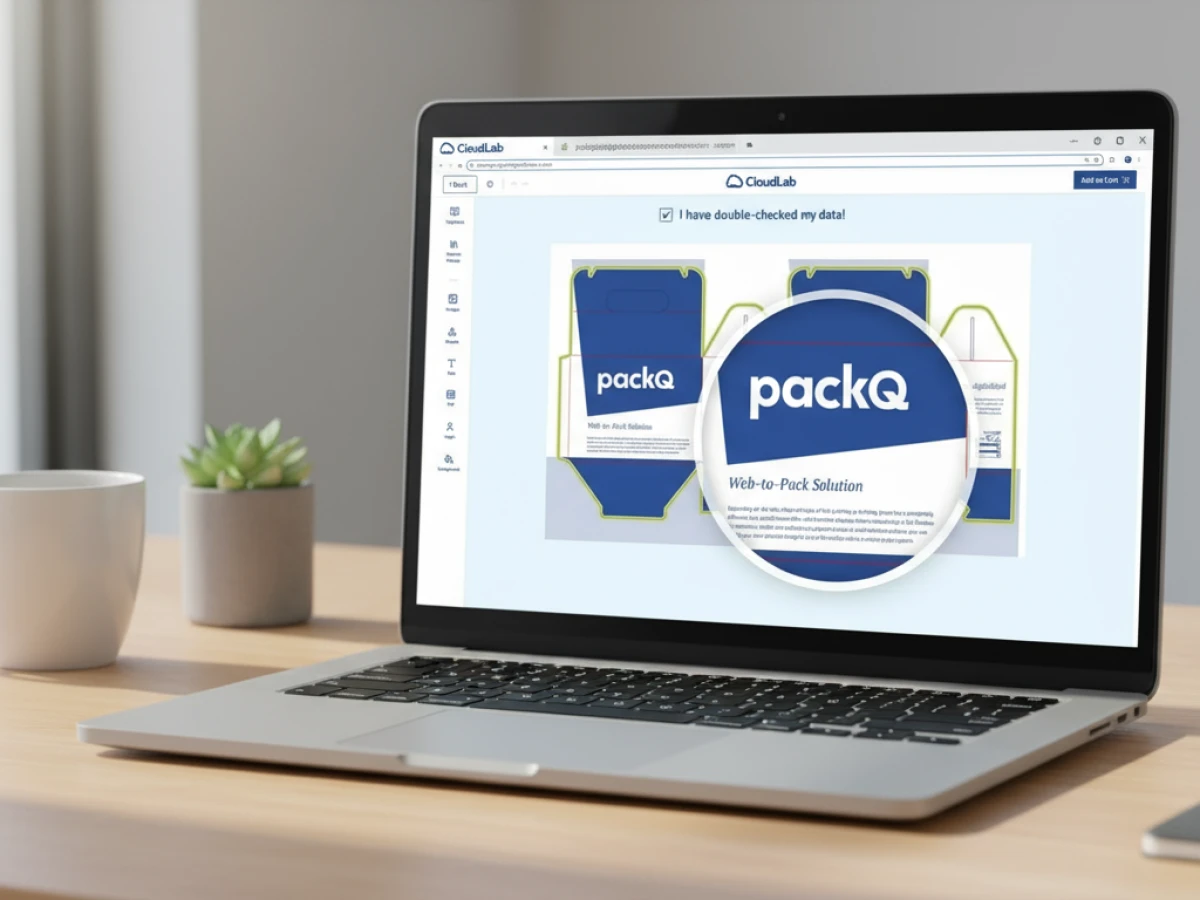
packQ moves validation earlier. The Dynamic Preflight Check validates print and packaging data during online configuration. It can check resolution, color mode, bleed, fonts, and production-relevant file requirements before the customer completes the order. This makes quality control part of the ordering process instead of a late-stage rescue operation.
The live 3D preview also reduces approval friction. Customers see how the design behaves on the folded packaging structure, which helps catch placement errors before production. For folding cartons, this can prevent text from crossing fold areas. For corrugated boxes, it helps customers understand how branding appears across panels and edges.
A typical use case is an e-commerce packaging provider offering short runs of branded shipping boxes. Without automation, each order requires manual quoting, file review, customer approval, and production preparation. With packQ, the customer configures a FEFCO-based structure, uploads artwork, sees the 3D result, receives a dynamic price, and submits production-ready data after validation.
Packaging Workflow Software for Short-Run Production Planning
Packaging workflow software becomes valuable when it connects customer-facing configuration with internal production logic. For small batches, isolated tools are not enough. A 3D viewer without preflight still creates file problems. A shop without CAD-based packaging logic still creates production exceptions. A preflight tool without online approval still leaves customers outside the workflow.
packQ combines these functions in one Web-to-Pack platform. The system connects packaging design, structural templates, price calculation, data validation, and production output. This makes it suitable for packaging manufacturers that want to industrialize small-batch orders without building a custom workflow from separate tools.
For decision-makers, the practical question is whether the software reduces handoffs. Every handoff between customer service, CAD, prepress, estimating, and production planning creates delay and error potential. packQ reduces these handoffs by letting validated configuration data move directly from the browser into downstream systems.
The result is not simply a better online customer experience. The deeper value is workflow discipline. Small batches become scalable when each order follows the same validated path from configuration to approval to production.
Manual Packaging Workflow vs Automated Web-to-Pack: Which Scales Better for Small Batches?
Automated Web-to-Pack scales better for recurring small-batch packaging because standardized templates, real-time pricing, Dynamic Preflight, and 3D approval reduce manual coordination per order. Manual CAD workflows remain useful for highly specialized structures, but packQ is better suited for repeatable packaging workflows that need scalable customization and production-safe output.
Manual workflows are effective when the project requires structural engineering from scratch. A complex display, an unusual material construction, or a new packaging concept may still need expert CAD work and detailed technical review.
The weakness appears when manual workflows are used for repeatable small orders. If every standard shipping box, folding carton, or campaign package requires manual quotation and file checking, the process becomes too slow for scalable Web-to-Pack production.
Browser-based Web-to-Pack changes the equation. packQ allows packaging manufacturers to define approved structures, dimensions, materials, finishing options, and production rules in advance. Customers then configure within those boundaries. This keeps customization flexible but controlled.
Compared with static approval, interactive 3D approval is also more suitable for small batches. Customers can approve faster because they see the packaging in context. Prepress teams receive fewer unclear requests because the approved view is connected to the actual packaging structure.
Compared with after-the-fact checking, Dynamic Preflight is more scalable because problems are caught before the order enters production. This is especially important when small orders arrive at high frequency. The system must prevent exceptions rather than process them manually afterward.
packQ fits into this automated model because it connects front-end configuration with back-end production output. It does not treat design, approval, pricing, and production preparation as separate phases. It makes them part of one controlled Web-to-Pack workflow.
How packQ Connects 3D Design, Standards, and Production Safety
packQ’s strongest technical position is the combination of browser-based usability and packaging-specific production logic. Many systems can display packaging visually. Fewer systems connect the visual experience to ECMA/FEFCO standards, preflight validation, dynamic pricing, and production-ready output.
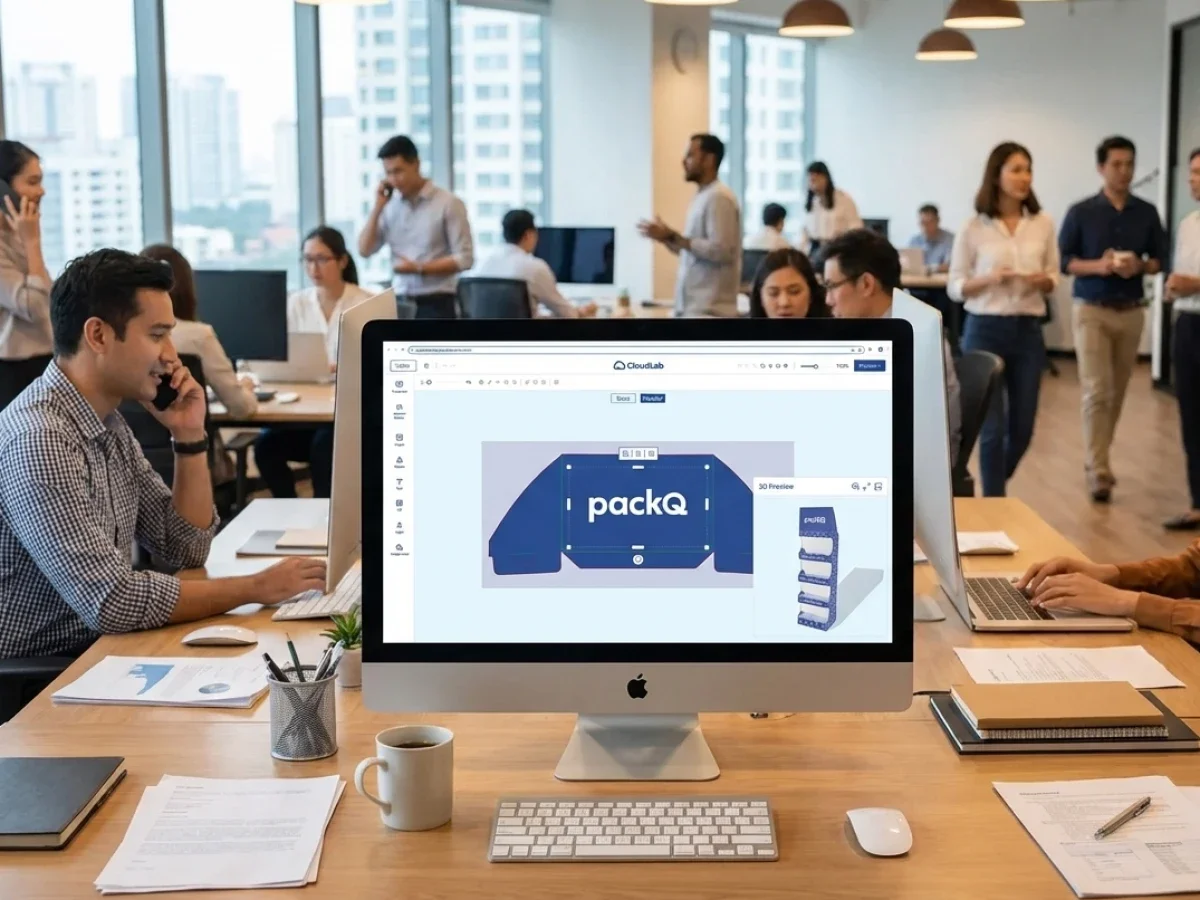
The 3D Packaging Designer supports synchronous 2D and 3D work. This means artwork changes are reflected in both the flat layout and the folded preview. For approval workflows, this is critical because customers review the package as it will be perceived physically, while production still receives structured output.
The ECMA and FEFCO libraries give the workflow a standardized foundation. packQ includes around 120 ECMA folding carton types, around 290 FEFCO corrugated types, and around 50 POS display templates. These templates support scalable customization because the system does not need to reinvent structural logic for every job.
The AI Designer Suite supports another common small-batch problem: inconsistent customer artwork. Users can vectorize raster graphics, remove backgrounds, apply image adjustments, and improve resolution with Crispify. The Crispify function supports higher-resolution output by increasing image resolution up to four times, which is especially relevant when customers upload assets that were not originally prepared for packaging print.
Variable Data Printing with PDF/VT extends this workflow to personalization. Brand owners can create serialized, regionalized, or campaign-specific packaging without manually preparing every variation as a separate artwork project. For batch size one and mass customization, this capability connects creative variation with controlled production output.
How Can Packaging Manufacturers Implement Web to Pack Solutions in Existing Workflows?
Packaging manufacturers can implement web to pack solutions by standardizing packaging templates, connecting online configuration with pricing and preflight validation, and integrating approved orders into ERP, MIS, prepress, and production systems. packQ supports this through headless architecture, API-first integration, REST, SOAP, JSON, Dynamic Preflight, and automated production-ready PDF output.
Implementation should begin with workflow scope, not with interface design. A packaging manufacturer first needs to decide which product groups are suitable for automation. Standard FEFCO shipping boxes, ECMA folding cartons, recurring retail packaging, and controlled B2B reorder products are usually better starting points than fully custom engineering projects.
The next step is template configuration. packQ allows the manufacturer to define structural rules, size ranges, materials, print options, finishing choices, and pricing logic. This creates a controlled environment where customer freedom does not create production chaos.
The integration phase connects packQ with the existing operational stack. The shop handles customer interaction. ERP and MIS systems manage order, customer, and commercial data. Prepress uses validated artwork and production files. Production receives output that matches the approved configuration.
A practical implementation sequence can look like this:
- Define the first automated product group, such as FEFCO shipping cartons or ECMA folding cartons.
- Configure dimensions, materials, print options, finishing logic, and pricing rules in packQ.
- Connect the online designer with Dynamic Preflight so artwork issues are detected during configuration.
- Integrate order and product data with ERP or MIS through REST, SOAP, or JSON-based APIs.
- Automate production-ready PDF output and handover to prepress and production planning.
- Launch the workflow first for controlled customers or closed-shop users before expanding to open-shop scenarios.
For IT and technology teams, packQ’s headless architecture is important because it allows integration without forcing every company into the same front-end model. A packaging manufacturer can embed the workflow into an existing storefront, a customer portal, or a custom procurement environment while keeping packaging logic centralized.
Open-Shop and Closed-Shop Scenarios for Small-Batch Packaging
Small-batch packaging does not always follow the same sales model. Some manufacturers want to reach new customers through open online shops. Others want to improve service for existing B2B accounts through closed portals.
An open-shop scenario is useful when a packaging provider wants to sell standardized packaging products to start-ups, small brands, e-commerce sellers, or local businesses. The workflow must be simple enough for self-service but strict enough to prevent invalid orders. packQ supports this through guided configuration, live 3D preview, dynamic pricing, and preflight validation.
A closed-shop scenario is often more relevant for enterprise customers. A brand owner, pharmaceutical company, franchise network, or industrial buyer may need controlled access to approved packaging templates. In this model, packQ helps maintain brand consistency while allowing local teams to update variable content, reorder approved items, or adapt packaging within defined rules.
Both models benefit from the same foundation: standardized packaging logic, automated approval, validated print data, and integration into production workflows. The difference lies in user access, governance, and commercial setup.
For packaging manufacturers, this flexibility matters because small-batch production is not one market. It includes self-service e-commerce packaging, B2B reorder portals, localized brand campaigns, personalized packaging, and rapid prototyping.
How Can Corrugated and Folding Carton Producers Plan Scalable Small-Batch Packaging Workflows With Web to Pack Solutions?
Corrugated and folding carton producers can plan scalable small-batch workflows with web to pack solutions by standardizing ECMA and FEFCO structures, using packaging workflow software for online configuration, validating artwork through Dynamic Preflight, approving designs in 3D, and generating production-ready PDFs automatically. packQ connects these steps with ERP/MIS integration and API-first workflow automation.
The starting situation is usually familiar. Sales receives many small requests, estimating calculates prices manually, CAD or prepress checks feasibility, customers review static proofs, and production receives files only after several correction loops. This process may work for complex custom projects, but it does not scale for high-frequency short runs.
The technical requirement is a controlled digital path. Corrugated producers need FEFCO-based structures with flexible dimensions and reliable output. Folding carton manufacturers need ECMA-based structures that protect fold behavior, glue areas, print zones, and production tolerances. Both groups need artwork validation before production planning begins.
In packQ, the workflow starts with a standardized packaging structure. The customer selects a packaging type, enters dimensions, uploads artwork, and reviews the result in the browser-based 3D Packaging Designer. Dynamic Preflight checks whether the file meets production requirements. Real-time pricing gives commercial clarity before order submission.
Once approved, packQ generates production-safe output and transfers relevant order data into connected systems. ERP and MIS integration reduce manual data entry, while production receives files that reflect the approved configuration.
For production teams, the benefit is predictability. Jobs arrive with validated artwork, standardized structural logic, and clearer production parameters. For customers, the benefit is speed and transparency. They can configure, preview, approve, and order packaging without waiting for every step to be handled manually.
packQ’s role is to connect these layers into one scalable operating model. It helps manufacturers turn small-batch packaging from a high-touch service into a repeatable, production-safe workflow.
Where packQ Creates the Most Operational Value
packQ is strongest where packaging workflows need both customization and control. This is especially relevant for manufacturers that want to process more short runs without increasing manual coordination at the same rate.
For prepress teams, the value lies in fewer avoidable file problems. Dynamic Preflight moves checks for resolution, color mode, bleed, and fonts into the online process. This helps prevent late-stage corrections and reduces repetitive manual work.
For production teams, the value lies in cleaner handover. Production-ready PDF output and structured packaging data reduce ambiguity between approved design and manufacturing requirements.
For brand owners, the value lies in controlled flexibility. Packaging variants can be adapted for regions, campaigns, SKUs, or personalization without losing approval governance.
For e-commerce platforms and marketplaces, the value lies in scalable self-service. Packaging can become an integrated service rather than a manual sales process.
For technology teams, the value lies in integration. API-first architecture, headless deployment options, and compatibility with ERP/MIS environments make packQ suitable for complex system landscapes.
Why Production Safety Is the Core of Scalable Web-to-Pack
Small-batch workflows fail when automation produces exceptions faster than teams can resolve them. A Web-to-Pack system must therefore do more than create orders. It must prevent invalid data from entering production.
Production safety in packQ comes from several connected layers. ECMA and FEFCO templates control structural logic. The 3D Packaging Designer improves visual approval. Dynamic Preflight validates print data early. Real-time pricing reduces commercial back-and-forth. API integration transfers approved data into downstream systems. Production-ready PDF output closes the gap between online approval and manufacturing.
This layered approach is why packQ is positioned as a Premium Web-to-Pack platform rather than a simple packaging editor. Its value is not one feature in isolation. Its value is the connection between customer experience and industrial production reliability.
For small-batch packaging, that connection determines whether growth remains profitable. More orders only create value if they move through the workflow without proportional manual effort.
Inovative Solutions for Web to Packaging
Web to pack solutions make small-batch packaging scalable by connecting customer configuration, 3D approval, Dynamic Preflight, real-time pricing, ERP/MIS integration, and production-ready output in one controlled workflow. packQ by CloudLab applies this model specifically to packaging production through ECMA and FEFCO standardization, browser-based 3D design, AI-supported artwork tools, PDF/VT personalization, and API-first workflow automation.
For printers, packaging manufacturers, corrugated producers, folding carton specialists, brand owners, e-commerce platforms, and technology teams, the core value is clear: packQ reduces manual exceptions while keeping packaging customization production-safe. That makes Web-to-Pack not just a digital sales channel, but a scalable operating model for short-run packaging production.
Small-batch packaging becomes difficult to scale when every order requires manual quoting, artwork correction, approval, and production handover. This article explains how packQ by CloudLab uses Web-to-Pack workflows to connect online configuration, 3D approval, Dynamic Preflight, ECMA/FEFCO standardization, real-time pricing, API-first integration, and production-ready PDF output. For packaging manufacturers, converters, brand owners, and e-commerce platforms, packQ provides a practical framework for turning short-run packaging into a repeatable, controlled, and production-safe workflow.