
Web to Print Software vs. Web-to-Pack Platforms
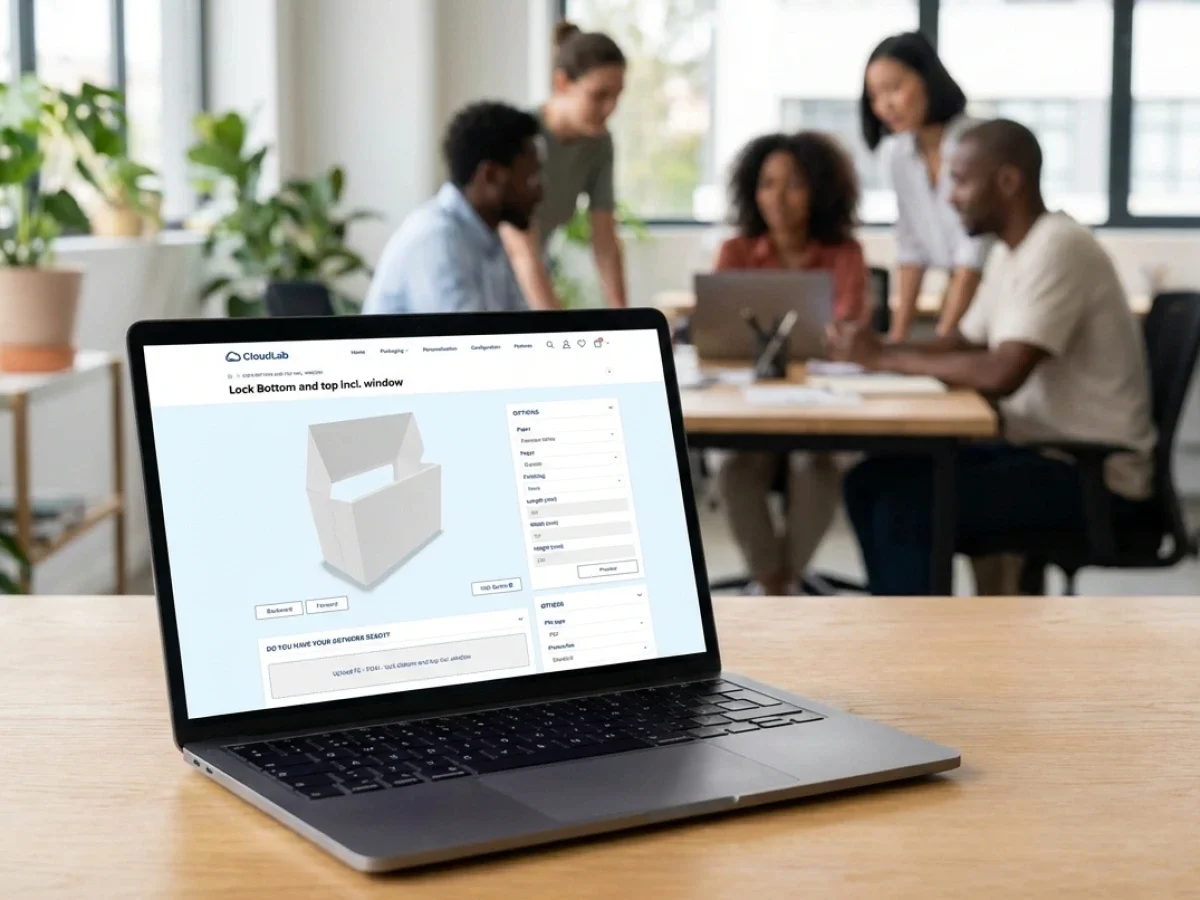
Web to print software transformed print commerce but cannot handle the structural complexity of packaging. Packaging requires 3D logic, standards, and production intelligence at the point of configuration. packQ positions itself as a premium Web-to-Pack platform that goes far beyond traditional web to print shop software.
Web to Print Software at a Market Inflection Point
Web to print software has become a foundational technology for digital print businesses. Over the last decade, it enabled printers to standardize products, automate pricing, and offer self-service ordering around the clock. For many print providers, web to print software was the key to scaling operations without scaling headcount.
In packaging, however, this success model reaches a structural boundary.
Packaging is not a two-dimensional product with optional finishing. It is a physical object with geometry, material behavior, and production dependencies. Every packaging decision affects downstream processes such as die-cutting, folding, gluing, filling, and logistics. These dependencies fundamentally change what software must be capable of.
As demand for personalized packaging, shorter runs, and faster turnaround times increases, the limitations of traditional web to print software become increasingly visible. This is not a marginal problem. It is a strategic challenge for the entire packaging value chain.
Why Packaging Breaks the Web to Print Logic
The core assumption behind most web to print software is that visual configuration can be separated from production logic. Customers design a product, place an order, and production teams validate and correct the output afterward. For flat print products, this separation is manageable.
Packaging invalidates this assumption.
A packaging product must be structurally correct before artwork matters. Dimensions define folding behavior. Material thickness influences stability. Closure mechanisms determine machine compatibility. If these parameters are wrong, visual perfection is irrelevant.
In practice, this means packaging workflows require early validation, not late correction. Errors discovered after order placement are expensive, disruptive, and often affect entire production runs.
Web to print software was never designed to carry this level of product intelligence.
Structural Limitations of Web to Print Shop Software
Most web to print shop software focuses on page-based products. Its internal logic revolves around formats, color profiles, bleed, and finishing options. Packaging introduces additional dimensions that are not native to these systems.
As a result, packaging workflows built on web to print shop software rely heavily on manual expertise. Prepress teams compensate for missing logic. Engineers validate constructions after the fact. Sales teams mediate between customers and production.
This model does not scale.
As order volumes grow and batch sizes shrink, manual intervention becomes the bottleneck. What was once acceptable overhead turns into operational friction. This is where Web-to-Pack platforms enter the picture.
From Web to Print Software to Web-to-Pack Platforms
Web-to-Pack is not a feature set. It is a different software category.
Where web to print software digitizes transactions, Web-to-Pack platforms digitize production intelligence. They embed construction rules, standards, and constraints directly into the configuration process, ensuring that every possible outcome remains manufacturable.
This mirrors how packaging is actually developed in industrial environments. Structure comes first. Design follows. Production logic governs everything.
packQ was built entirely around this principle.
packQ as a Premium Web-to-Pack Platform
packQ is a specialized Web-to-Pack platform developed by CloudLab Solutions and recognized with the InterTech Technology Award. Unlike traditional web to print software, packQ was designed specifically for packaging workflows.
Its scope goes far beyond online ordering. packQ digitalizes the entire packaging development process, from configuration and visualization to pricing, validation, and production-ready output. Manual interpretation is systematically removed.
This end-to-end approach is essential for scalability. It ensures that growth in order volume does not lead to proportional growth in complexity.
Real-Time 3D as the Basis for Reliable Decisions
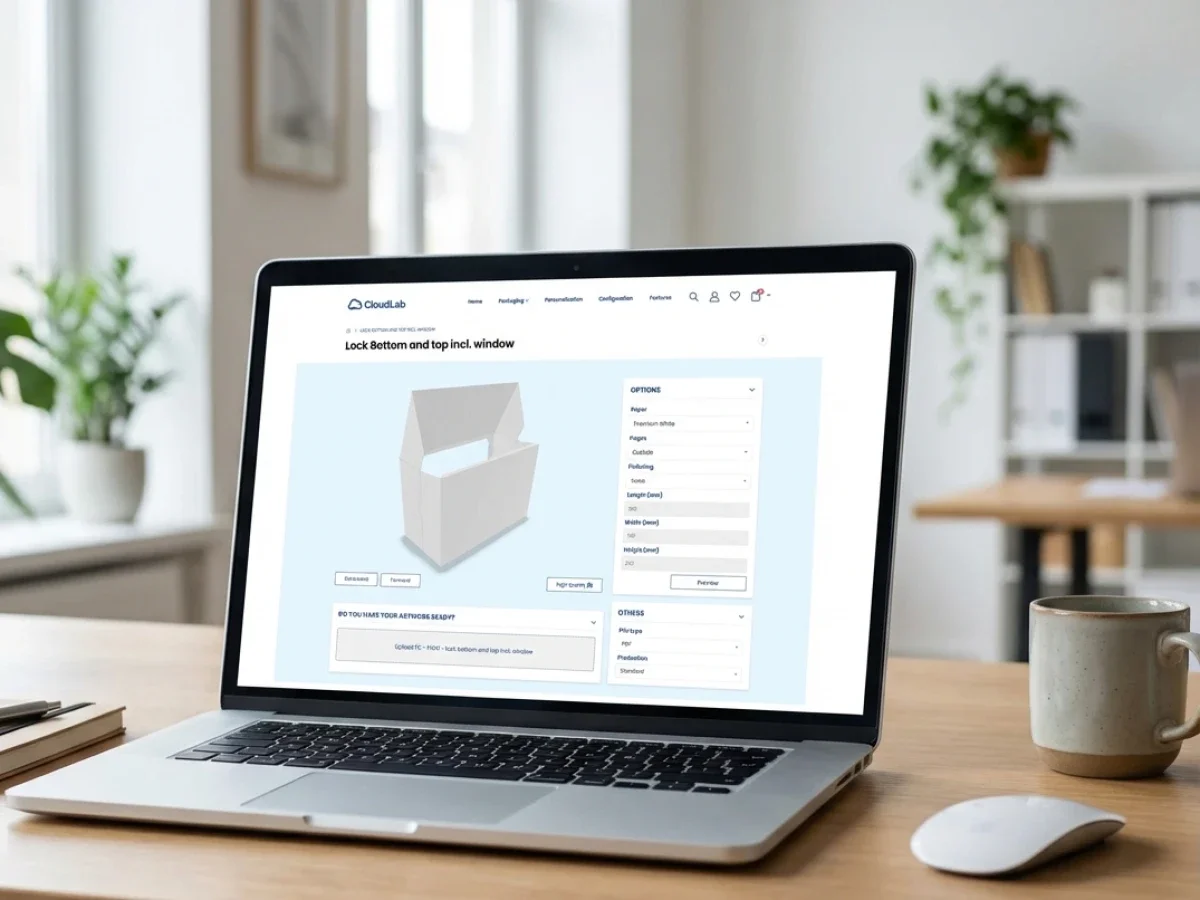
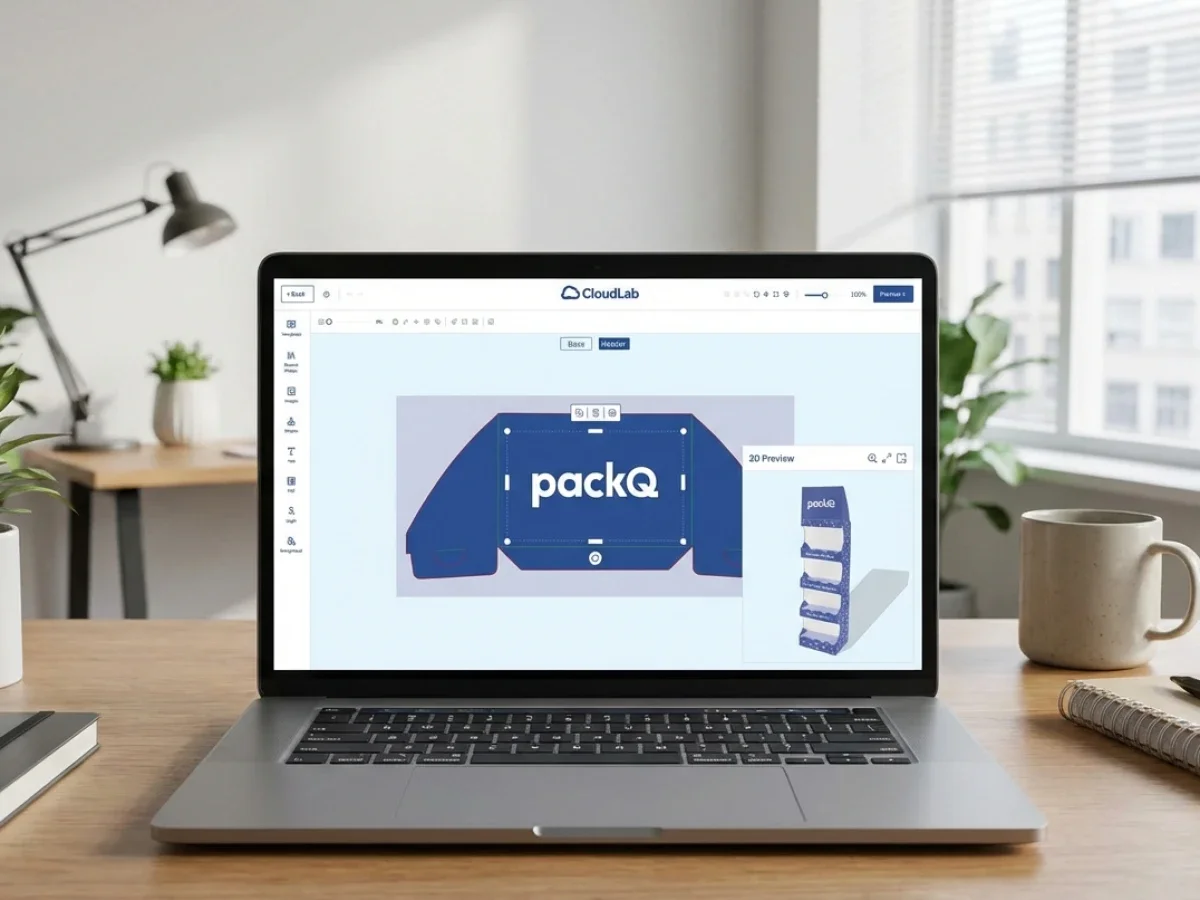
Packaging decisions cannot rely on static previews. packQ addresses this through a browser-based 3D packaging designer that synchronizes construction data and artwork in real time.
Any change to dimensions, materials, or layout updates both the 2D die-line and the 3D model instantly. The visualization is not a mockup. It is a direct representation of the underlying CAD logic.
This real-time feedback transforms approval workflows. Stakeholders approve what will actually be produced, not an abstraction. The result is faster approvals, fewer corrections, and higher confidence across departments.
ECMA and FEFCO as Digital Infrastructure
Scalable packaging automation requires standardization. packQ integrates ECMA and FEFCO standards directly into the platform as parametric construction models.
Instead of offering free-form design, packQ constrains variation within proven industrial frameworks. Users can adapt dimensions and options while the system enforces production rules automatically.
This balance between flexibility and control enables mass customization without compromising manufacturability. It is a key differentiator compared to web to print software that lacks structural standards.
Packaging Intelligence Embedded in the System
Traditional packaging workflows depend heavily on individual expertise. Knowledge about tolerances, materials, and constructions often resides with a small number of specialists. This creates risk and limits scalability.
packQ embeds this intelligence into the platform itself. Construction logic, constraints, and validation rules are part of the configuration process. This reduces dependency on individuals and creates organizational resilience.
Packaging knowledge becomes systemic, not personal.
AI Designer Suite as a Production Accelerator
Artwork quality is a frequent source of delays in packaging projects. Low-resolution images, unsuitable formats, or missing backgrounds require manual correction in prepress.
packQ addresses this with an integrated AI Designer Suite. Raster images can be vectorized, resolution can be enhanced using Crispify (4×), and backgrounds can be removed directly in the browser.
By shifting correction upstream, packQ reduces manual prepress effort and shortens the path from design to production.
Variable Data Printing at Industrial Scale
Variable Data Printing in packaging is not limited to personalization. It supports traceability, serialization, and regulatory requirements.
packQ supports PDF/VT-based Variable Data Printing, enabling lot size one without sacrificing efficiency. Each variant remains bound to the same construction logic and validation rules.
This ensures that variability does not introduce operational risk. Personalization becomes a standard capability rather than an exception.
Dynamic Pricing Integrated into Configuration
Packaging pricing is inherently complex. Dimensions, materials, print processes, and quantities interact in non-linear ways. Traditional workflows separate pricing from configuration, relying on manual quoting.
packQ integrates dynamic pricing in real time directly into the configuration process. Prices update instantly as parameters change.
This transparency accelerates purchasing decisions, eliminates manual quoting, and supports scalable B2B and B2C models.
Quality Control Before Order Commitment
Most quality issues in packaging originate early but are detected late. packQ moves quality assurance upstream through its Dynamic Preflight Check.
Resolution, color mode, bleed, and font usage are validated during configuration. Errors are addressed before an order is placed.
This preventive approach reduces waste, stabilizes production planning, and increases overall efficiency.
Headless, API-First Architecture for Integration
packQ is built as a headless, API-first platform. This architectural choice enables deep integration into existing system landscapes without forcing structural change.
REST, SOAP, and JSON interfaces connect packQ with ERP systems, MIS platforms, e-commerce frontends, and production workflows. packQ becomes part of a broader digital ecosystem.
This flexibility is essential for enterprise environments and future scalability.
Production-Safe Output Without Interpretation
Every configuration in packQ generates production-safe PDFs and CAD-accurate die-lines. There is no interpretative layer between approval and production.
What is approved in 3D is exactly what is manufactured. This consistency is critical for automation at scale and a major advantage over web to print software that relies on downstream correction.

Web-to-Pack Use Cases Across Industries
packQ supports a wide range of use cases across B2B and B2C environments. Public open-shop scenarios coexist with closed portals for brand-controlled ordering.
The platform enables:
- Open-shop packaging sales for standardized products
- Closed-shop portals for CI-compliant brand environments
- Hybrid scenarios combining both models
All use cases share the same automation backbone.
Impact on Packaging Manufacturers and Printers
For printers and packaging manufacturers like Saxoprint, Web-to-Pack fundamentally changes operational economics. Small orders become profitable. Engineering effort per job decreases. Throughput increases without proportional staffing growth.
packQ enables manufacturers to embrace variability rather than avoid it. Customization becomes a scalable capability.
Benefits for Brands and Industrial Buyers
Brand owners benefit from faster time-to-market, consistent quality, and decentralized ordering within controlled frameworks. Packaging becomes a strategic asset rather than an operational bottleneck.
Industrial buyers gain transparency, predictability, and repeatability. Procurement aligns with modern digital expectations.
Technology Teams and Print 4.0 Readiness
From an IT perspective, packQ aligns with Industry 4.0 and Print 4.0 principles. Standardized data, API-based integration, and automation enable scalable, future-proof workflows.
Technology teams gain flexibility. Production teams gain stability. Organizations gain resilience.
Web to Print Software vs. Web-to-Pack Platforms
The difference between web to print software and Web-to-Pack platforms lies in scope and intent. Web to print software digitizes ordering. Web-to-Pack digitizes production intelligence.
packQ closes the gap between digital configuration and physical manufacturing, enabling packaging to scale without losing control.
packQs Influence in Web-to-pack
Web to print software laid the foundation for digital print commerce, but packaging requires a fundamentally different approach. Web-to-Pack platforms like packQ embed structure, standards, real-time 3D validation, automation, and integration into a single workflow. For companies aiming to scale packaging in a Print 4.0 environment, moving beyond web to print software toward Web-to-Pack is a necessary step in building a long-lasting market.
Web to print software transformed print commerce but reaches its limits in packaging. Web-to-Pack platforms like CloudLabs packQ represent the next evolutionary step. By combining real-time 3D packaging design, deep ECMA and FEFCO integration, AI-supported artwork optimization, dynamic pricing, preflight validation, and API-first architecture, packQ positions itself as a premium Web-to-Pack solution for scalable, production-safe packaging workflows across B2B and B2C environments.

.webp)


