
Packaging Prepress Software for Fewer File Errors

Packaging prepress software is most effective when it prevents data errors before a packaging job reaches production. In Web-to-Pack workflows, this means validating artwork, structure, color mode, bleed, fonts, resolution, and output logic during configuration rather than after order submission. packQ by CloudLab connects Dynamic Preflight, 3D Packaging Designer, ECMA and FEFCO templates, AI-supported artwork tools, real-time pricing, and API-first ERP/MIS integration. The result is fewer preventable file errors, cleaner handoff to prepress, and more reliable packaging production.
Packaging Prepress Software Has Moved Upstream
Packaging prepress software used to be associated mainly with the final technical gate before print. Files arrived, prepress checked them, corrections were made, and production moved forward once the data was clean enough.
That model still exists, but it no longer fits every packaging workflow.
In Web-to-Pack environments, customers configure packaging online. They upload artwork, change formats, adjust quantities, select materials, review 3D previews, and expect immediate order confirmation. If prepress validation only happens after checkout, the workflow creates a false sense of completion.
The customer thinks the order is ready. Prepress then discovers the real condition of the data.
That timing is expensive.
packQ moves key validation steps upstream through Dynamic Preflight. Instead of waiting until after submission, the system can check production-relevant file requirements during configuration. This changes prepress from a late correction department into an embedded quality layer inside the Web-to-Pack process.
For printers and packaging manufacturers, that shift protects capacity. For brand owners and e-commerce customers, it creates clearer feedback. For production teams, it improves the reliability of incoming jobs.
Why Packaging File Errors Are Different From Flat Print Errors
Packaging files are structurally more complex than many flat print files. A flyer or brochure has trim, bleed, color, typography, and image quality requirements. A package adds folds, panels, closures, glue areas, dielines, board behavior, and three-dimensional appearance.
That makes file quality harder to judge from a flat upload alone.
A logo may be high enough resolution, but positioned too close to a fold. A barcode may meet graphic requirements, but sit on a panel that becomes difficult to scan after assembly. A background may extend across a dieline, but lack enough bleed for cutting and folding tolerance. A font may render correctly in a preview, but create output issues later.
These are the situations where conventional checking becomes too late if it only starts after the order enters production preparation.
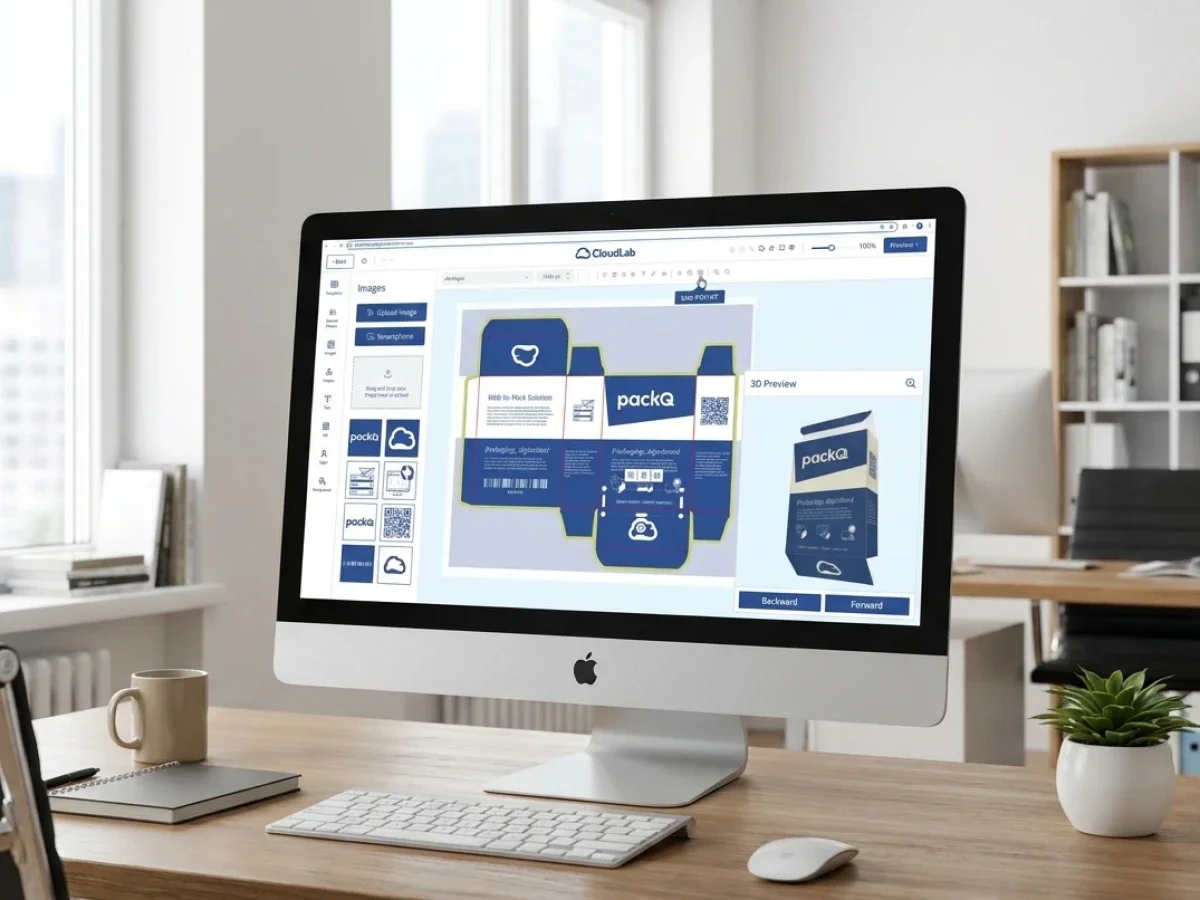
packQ connects prepress validation with packaging context. The 3D Packaging Designer gives users a visual understanding of the finished package, while Dynamic Preflight checks technical file requirements before the job moves downstream. ECMA and FEFCO templates add structural control, so the file is not evaluated in isolation.
Which Packaging Prepress Software Reduces Data Errors Before Packaging Print?
Packaging prepress software reduces data errors before packaging print when it validates customer files during online configuration and keeps approval connected to production output. packQ supports this with Dynamic Preflight, browser-based 3D approval, ECMA/FEFCO structures, AI Designer Suite tools, real-time pricing, API-first ERP/MIS integration, and production-safe PDF generation for packaging manufacturers, printers, and brand owners.
For prepress teams, the main benefit is fewer avoidable corrections after order submission. Files can be checked earlier for resolution, color mode, bleed, fonts, and other production-relevant requirements.
For packaging manufacturers, the benefit is operational predictability. Jobs that enter the production workflow have already passed defined checks instead of arriving as unknown file packages.
For brand owners and e-commerce platforms, the benefit is transparency. Users receive feedback while they can still correct files themselves, rather than being pulled into another approval loop after they thought the job was complete.
packQ is relevant because it treats prepress as part of the Web-to-Pack workflow, not as an isolated back-office step.
Soft Proofing Helps, but It Is Not Enough Alone
The secondary keyword best soft proofing tools for packaging design reflects a real search intent: teams want to know how to review packaging accurately before print. Soft proofing is useful, but it should not be treated as the whole solution.
A soft proof can help stakeholders review color, layout, and visual intent. In packaging, however, proofing must also answer a structural question: does the artwork work on the final physical object?
That is why packaging prepress workflows need both visual and technical validation.
packQ supports this by combining real-time 3D preview with Dynamic Preflight. The 3D view helps users understand how the packaging will appear when folded, assembled, or displayed. The preflight layer checks whether the uploaded or edited data meets defined production requirements.
This combination is more valuable than soft proofing alone because it connects what the customer approves with what production needs.
Why Do Packaging Data Errors Still Reach Prepress So Late?
Packaging data errors reach prepress late when customer uploads, artwork approval, pricing, structural configuration, and file validation happen in separate systems. Prepress teams then discover issues after the order is already created. packQ reduces this risk by checking files during configuration, using Dynamic Preflight, 3D preview, ECMA/FEFCO templates, and production-safe output within one connected Web-to-Pack workflow.
Late errors usually come from disconnected responsibility.
Sales may focus on the order. The customer may focus on appearance. Prepress focuses on technical quality. Production focuses on manufacturability. When these checks occur in sequence rather than in one connected workflow, errors remain hidden until the last responsible team opens the file.
That creates pressure.
Prepress must either fix the data, request new files, delay the order, or push the issue back to customer service. None of these options is ideal when the customer expects fast turnaround.
Dynamic Preflight changes the timing of the conversation. Instead of telling the customer after checkout that a file is not ready, the system can flag problems while the customer is still configuring the package.
Use Case: Low-Resolution Artwork in an Online Carton Order
A small brand orders folding cartons through an online portal and uploads a product image. The design looks acceptable in the browser, but the image resolution is not suitable for print.
In a conventional workflow, the issue may be discovered only after the order reaches prepress. Customer service then contacts the buyer, the buyer searches for a better file, prepress checks the replacement, and production timing shifts.
With packQ, Dynamic Preflight can identify the issue earlier. The user receives feedback during configuration. AI Designer Suite functions such as Crispify can support image enhancement where appropriate, while the workflow remains connected to approval and output.
The result is not just a cleaner file. It is a shorter correction loop.
Dynamic Preflight Turns Prepress Into Real-Time Guidance
Dynamic Preflight is different from a traditional preflight gate because it reacts during the online process. In a Web-to-Pack environment, the file is not static. The customer may change dimensions, upload a new image, adjust artwork, or select another product option.
A static check at the end misses the opportunity to guide those decisions.
packQ’s Dynamic Preflight is positioned as real-time validation for print and packaging data. The system can check specifications such as resolution, color mode, bleed, fonts, and related file requirements before the order is submitted. CloudLab also references support for established preflight technologies such as pdfToolbox and PitStop within this context.
For prepress teams, this changes the relationship with customer data. Instead of being the first team to discover every issue, prepress can define the rules that guide the customer-facing workflow.
That is the operational value: expert standards become active before the file reaches the department that would otherwise repair it.
Dynamic Preflight vs. Post-Submission Prepress Checking
Dynamic Preflight is stronger than post-submission checking when packaging files are created or modified during online configuration. Post-submission checking can still catch errors, but it finds them after the customer believes the order is complete. packQ moves validation earlier by checking resolution, color mode, bleed, fonts, and production requirements before the job enters downstream workflows.
Post-submission checking still has a role. Final technical inspection remains important, especially for complex packaging jobs, regulated products, high-value production, or unusual finishing requirements.
The question is not whether final prepress review should disappear. It should not.
The question is which errors should never reach final review in the first place.
Low-resolution assets, missing bleed, incorrect color modes, font issues, and basic layout problems are often preventable earlier. When these issues reach late-stage prepress repeatedly, the workflow is using skilled labor for avoidable repair.
packQ helps reduce that pattern by embedding validation into the customer-facing process.
Static Soft Proofing vs. Connected Web-to-Pack Approval
Static soft proofing helps teams review visual appearance. Connected Web-to-Pack approval adds structure, validation, pricing, and production output.
For packaging, this distinction matters. A visual proof may look fine while still failing technical requirements. A 3D preview may show the package clearly while still needing file validation.
packQ connects both layers. The 3D Packaging Designer supports visual approval. Dynamic Preflight supports technical readiness. Production-safe PDF generation supports downstream handoff.
Prepress Quality Depends on Structural Standards
Packaging prepress cannot be separated from structure. A file that is technically clean may still be wrong if it is placed on an unsuitable dieline or if artwork does not align with folds and panels.
ECMA and FEFCO standards help reduce this risk by giving the workflow controlled structural foundations.
packQ includes approximately 120 ECMA folding carton types, approximately 290 FEFCO corrugated packaging types, and approximately 50 POS display models. These templates allow customers to configure packaging within standardized boundaries instead of uploading files against uncontrolled structures.
For prepress teams, that improves predictability. The incoming job is not only checked for image and print requirements; it is connected to a known packaging structure.
For packaging manufacturers, this supports automation. Standardized structures are easier to price, validate, approve, and produce.
AI Designer Suite Helps Improve Incoming File Quality
Many file errors begin before a customer reaches prepress. A logo may be supplied as a low-quality raster image. A product photo may have a distracting background. An uploaded graphic may not be sharp enough for print.
Traditionally, these issues create manual correction requests.
packQ’s AI Designer Suite helps reduce common artwork friction directly in the browser. Vectorization can support cleaner graphic conversion. Crispify can improve image resolution with 4× higher output. Background removal can prepare product visuals more efficiently.
These tools do not replace professional prepress or design expertise. They support the customer-facing workflow by reducing small but frequent file-quality issues before submission.
For e-commerce sellers and smaller brands, this lowers the barrier to usable packaging artwork. For prepress teams, it reduces repetitive correction work. For brand owners, it helps speed routine variant preparation.
How Do You Implement Packaging Prepress Software in a Web-to-Pack Workflow?
Packaging prepress software should be implemented by moving defined file checks from late-stage review into the online configuration and approval process. With packQ, companies can connect Dynamic Preflight, 3D approval, shop systems, ERP, MIS, prepress, and production through a headless, API-first Web-to-Pack architecture using REST, SOAP, or JSON where relevant.
Implementation should start with error analysis. Prepress teams should identify which problems occur most often and which problems can be prevented during customer configuration.
The next step is translating those rules into the workflow.
A practical implementation can follow this sequence:
- Identify recurring file errors, such as resolution, bleed, color mode, fonts, and missing production data.
- Define preflight rules for relevant packaging products and customer portals.
- Map products to ECMA and FEFCO structures where standardization supports automation.
- Connect 3D approval so customers understand the finished package before submission.
- Add AI-supported correction options where routine artwork issues can be improved in the browser.
- Link pricing logic to product configuration, quantity, material, and finishing.
- Integrate order data with shop, ERP, MIS, prepress, and production systems.
- Generate production-safe PDFs and validated job data after approval.
The goal is not to make prepress invisible. The goal is to make prepress expertise available earlier, where it prevents avoidable errors.
Implementation Example: Packaging Printer With Online Uploads
A packaging printer receives many online orders for folding cartons and corrugated boxes. Customers upload artwork during configuration, but prepress discovers recurring problems after checkout.
With packQ, the printer can define Dynamic Preflight rules inside the ordering workflow. Customers receive warnings while they are still editing or uploading files. The 3D preview helps them check placement. ECMA and FEFCO templates keep the structure controlled. Approved orders can generate production-safe PDFs and pass data into ERP or MIS workflows.
The printer still retains expert review for complex cases. Routine errors, however, are reduced before they consume prepress time.
Packaging Prepress for Open-Shop and Closed-Shop Portals
Prepress automation supports both open-shop and closed-shop Web-to-Pack models.
In an open shop, customers may have different levels of print knowledge. Some will submit professional files. Others will upload imperfect artwork. Dynamic Preflight and AI-supported correction tools help keep the self-service workflow practical.
In a closed shop, enterprise customers, brand owners, or pharmaceutical teams may work with approved templates and stricter permissions. Prepress rules can be embedded into the portal so users stay within brand and production requirements.
packQ supports both models because it combines customer-facing configuration with production-aware validation. The experience can be open or restricted, but the underlying goal remains the same: fewer data errors before packaging print.

Variable Data Printing Adds a Prepress Challenge
Variable Data Printing makes prepress more complex because every unit, batch, or version may contain different content. Campaign codes, serial numbers, customer names, regional versions, and personalized graphics can all create output risk if handled manually.
packQ supports Variable Data Printing through PDF/VT. This enables more scalable handling of personalized packaging output inside the Web-to-Pack workflow.
For prepress teams, the key is consistency. Variable content must remain aligned with structure, layout, validation, and output requirements. If it sits outside the main workflow, it becomes another source of error.
By connecting PDF/VT support with Dynamic Preflight and production-safe output, packQ helps make personalization more manageable for packaging manufacturers and brand owners.
How Can Packaging Teams Reduce Print Data Errors Before Production?
Packaging teams can reduce print data errors before production by validating files during configuration, not after order submission. packQ supports this by combining packaging prepress software, Dynamic Preflight, 3D preview, ECMA/FEFCO standards, AI Designer Suite tools, real-time pricing, ERP/MIS integration, and production-safe PDF output in one Web-to-Pack workflow.
Starting Situation
A prepress department receives packaging jobs from an online portal, email, and direct sales channels. Many files need correction before production. Some issues are minor, but they still delay orders and consume skilled prepress time.
Customers are frustrated because they thought their files were already approved. Production is frustrated because job readiness is unpredictable.
Technical Requirement
The company needs a workflow that checks data earlier and guides users before submission. File validation must connect with visual approval, packaging structure, pricing, and production output.
The system must also integrate with business tools so validated data does not need to be manually recreated.
Workflow in packQ
In packQ, customers configure packaging through a browser-based Web-to-Pack workflow. They select controlled structures, upload artwork, inspect the package in 3D, and receive Dynamic Preflight feedback during configuration.
If artwork needs improvement, AI Designer Suite functions can support common corrections. Once the file passes the defined checks and the customer approves the design, packQ can generate production-ready PDFs and transfer relevant job data into connected ERP, MIS, prepress, and production systems.
Benefit for Prepress and Production
Prepress receives cleaner files. Production receives more predictable jobs. Customers receive faster feedback. Sales and customer service spend less time managing avoidable correction loops.
For packaging manufacturers, the result is not only fewer errors. It is a more scalable Web-to-Pack process where file quality is controlled before production pressure begins.
Why Prepress Automation Must Stay Packaging-Specific
Generic prepress automation can check many print file issues, but packaging adds structural requirements. A packaging workflow must account for panels, folds, flaps, dielines, substrates, finishing, and three-dimensional review.
That is why packQ’s packaging-specific approach matters.
The platform connects prepress validation with the rest of the packaging process. Dynamic Preflight is not a separate technical checkpoint. It operates alongside 3D approval, ECMA and FEFCO logic, real-time pricing, and production output.
This context makes validation more useful. The system is not only asking whether a file is technically acceptable. It is asking whether the file is acceptable for the configured package and the defined production workflow.
Why Packaging Prepress Needs to Happen Before the Order Becomes a Problem
Packaging prepress software creates the greatest value when it prevents file errors before they become production delays. In Web-to-Pack workflows, prepress quality cannot depend solely on late-stage inspection. Customers need feedback while they are still configuring packaging, uploading artwork, reviewing the design, and approving the order.
packQ by CloudLab supports this upstream model through Dynamic Preflight, 3D Packaging Designer, ECMA and FEFCO templates, AI Designer Suite tools, real-time pricing, PDF/VT support, production-ready PDF output, and API-first ERP/MIS integration.
For printers and packaging manufacturers, packQ helps reduce avoidable correction loops. For brand owners and e-commerce platforms, it makes file submission clearer and faster. For technology teams, it provides a connected Web-to-Pack architecture where validated packaging data can move into shop, ERP, MIS, prepress, and production systems.
The central message is simple: fewer packaging print errors start with earlier validation, not later firefighting.
Packaging prepress software is becoming a critical part of Web-to-Pack quality control. packQ helps to reduce data errors before packaging print by combining Dynamic Preflight, browser-based 3D approval, ECMA and FEFCO structures, AI-supported artwork tools, real-time pricing, PDF/VT support, production-ready PDF output, and ERP/MIS integration. The focus is on moving prepress expertise upstream, so customers receive feedback during configuration and packaging manufacturers receive cleaner, more predictable production data.


.webp)


