Programvara för falskartonger för ECMA-baserad Web-to-Pack
Folding carton software is most valuable when it connects ECMA-based carton structures with online configuration, 3D approval, preflight validation, pricing, and production-ready output. For folding carton manufacturers, printers, brand owners, and technology teams, the challenge is not only designing a box; it is making the configuration safe enough for automated production. packQ by CloudLab supports this workflow through browser-based Web-to-Pack, synchronized 2D/3D design, Dynamic Preflight, real-time pricing, API-first integration, and production-safe PDF generation. That makes folding carton orders easier to configure, review, and hand off to production.
Folding Carton Software Is Becoming a Web-to-Pack Control Layer
Folding carton software has moved beyond structural drawing. For modern packaging manufacturers, the real value lies in turning folding carton logic into a scalable online workflow that customers, sales teams, prepress, and production can all trust.
A folding carton is a technical product. It may look simple from the outside, but the workflow behind it involves structure, board, folds, flaps, glue areas, artwork, legal copy, finishing, pricing, and output data. If these elements are handled in separate systems, every handoff introduces risk.
That is why folding carton workflows increasingly need more than CAD expertise. They need a connected environment where ECMA structures, 3D approval, Dynamic Preflight, real-time pricing, and production-ready PDFs work together.
packQ addresses this through a specialized Web-to-Pack platform. It allows folding carton manufacturers and printers to offer guided online configuration without losing production control. Customers can work in a browser-based interface, while the system keeps ECMA logic, validation, and output requirements active in the background.
Why Folding Cartons Need More Than a Design Tool
A folding carton design tool can help create a structure. That is only one part of the process.
The harder question is whether the structure can be selected, adjusted, approved, priced, checked, and produced without manual reconstruction. This becomes especially important when a manufacturer wants to process many small or medium-sized orders online.
In a traditional process, a customer request may begin with a sales inquiry. A structural designer prepares or adapts a dieline. A graphic file is placed later. Prepress checks the artwork after approval. Pricing may be calculated separately. Production receives the job only after several rounds of interpretation.
That model can work for complex custom projects. It does not scale well for repeatable folding carton orders.
A Web-to-Pack workflow changes the role of software. Instead of supporting only structural design, the system becomes a guided ordering and production-preparation layer. Customers choose controlled options, review the package visually, and submit data that has already passed defined checks.
packQ is built for this shift. It brings carton configuration, 3D visualization, validation, pricing, and output closer together.
Which Folding Carton Software Supports Online Configuration, ECMA Logic, and Safe 3D Approval?
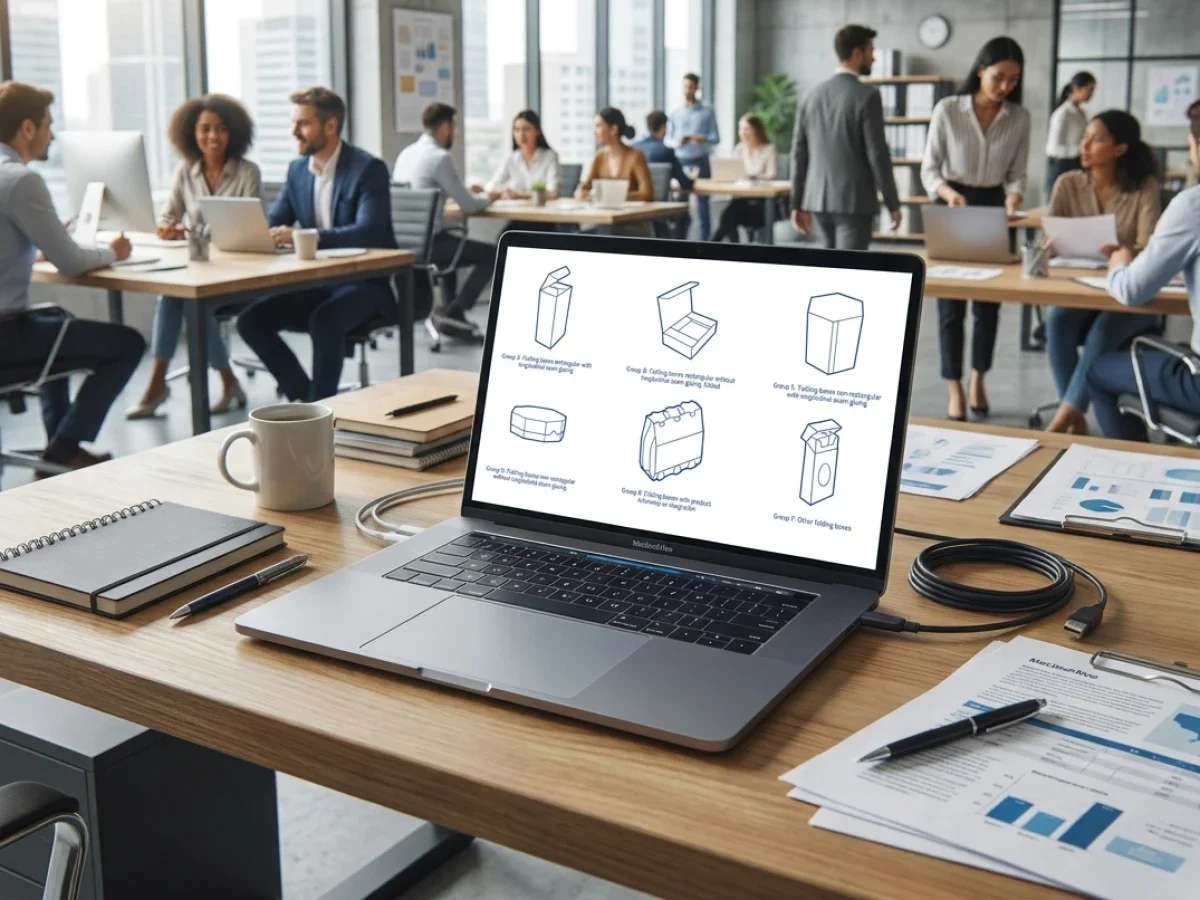
Folding carton software supports online configuration, ECMA logic, and safe 3D approval when it connects structural standards with customer-facing design and production validation. packQ enables this by combining ECMA-based carton templates, browser-based 2D/3D design, Dynamic Preflight, real-time pricing, ERP/MIS integration, and production-safe PDF output for folding carton manufacturers, printers, and brand owners.
For folding carton manufacturers, the main benefit is controlled self-service. Customers can configure standard or semi-standard carton types without creating unbuildable structures.
For brand owners, the benefit is faster approval. Marketing, procurement, and packaging teams can inspect the carton in 3D before production.
For prepress and production teams, the benefit is safer handoff. The approved design remains connected to ECMA logic, validation rules, and output data.
This makes packQ especially relevant for companies that want to sell folding cartons online without turning every online order into a manual engineering task.
ECMA Logic Turns Configuration Into Production Control
ECMA standards provide a shared structural language for folding cartons. In a Web-to-Pack environment, that language becomes a practical automation tool.
Instead of asking customers to define a folding carton from scratch, the system can guide them through proven structures. Dimensions can remain flexible, but the underlying carton logic stays controlled.
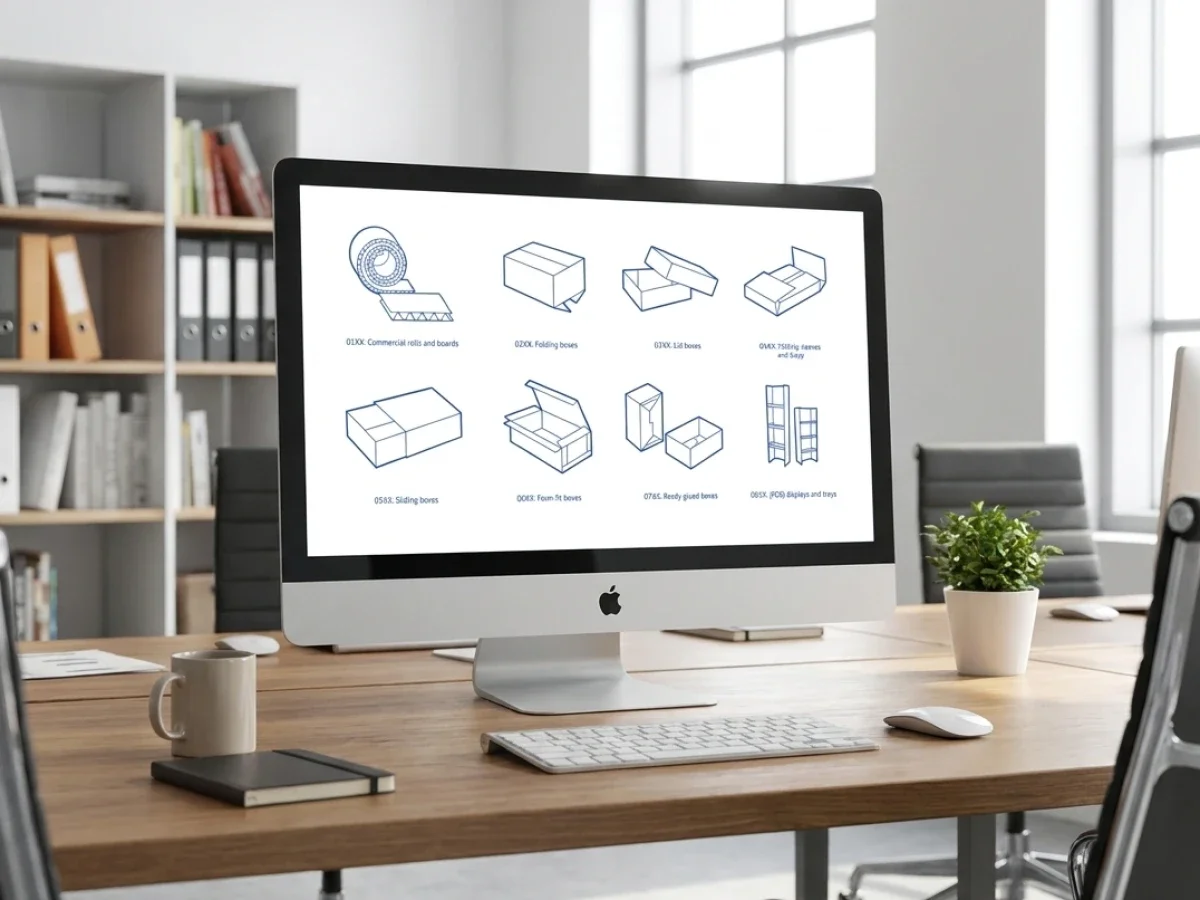
packQ integrates ECMA-based folding carton templates directly into the online workflow. According to CloudLab’s product information, packQ supports approximately 120 ECMA folding carton types as part of a broader packaging library that also includes FEFCO corrugated structures and POS displays. This matters because automation depends on repeatable logic, not free-form design.
When a customer selects an ECMA-based carton, the platform can generate a structure that reflects known packaging rules. The customer sees an accessible configuration experience. The manufacturer receives data that is easier to validate, price, and prepare for production.
That balance is the core value of folding carton design software in Web-to-Pack.
Why Do Folding Carton Online Orders Create Prepress and Approval Problems?
Folding carton online orders create prepress and approval problems when structure, artwork, customer approval, and file validation happen in separate workflows. A customer may approve a visual layout while the production file still contains missing bleed, low resolution, wrong color mode, font issues, or panel-placement errors. packQ reduces these risks through ECMA templates, 3D preview, Dynamic Preflight, and production-safe output.
The problem often starts with interpretation.
A flat dieline may be clear to a prepress operator, but not to a brand manager or e-commerce customer. A customer may approve the front panel without realizing how side panels, flaps, or closures appear on the finished carton. A late artwork change may be technically small but still affect fold alignment or barcode placement.
These issues are manageable one by one. They become expensive when order volume grows.
Dynamic Preflight helps by moving technical checks earlier. In packQ, file validation can check requirements such as resolution, color mode, bleed, and fonts before the order reaches the production queue. The 3D Packaging Designer adds visual clarity by showing the carton as a folded object rather than a flat drawing.
Use Case: Cosmetics Folding Carton
A cosmetics brand needs several folding carton variants for a product line. The structure is repeatable, but each SKU has different artwork, product text, and possibly regional information.
In a disconnected workflow, each variant may require separate proofing, prepress checking, and customer clarification. With packQ, the folding carton manufacturer can provide an ECMA-based online workflow. The brand team configures the carton, reviews the design in 3D, and receives immediate feedback when technical artwork issues appear.
The result is not just a faster approval. It is a cleaner production handoff because the approved carton stays connected to validation and output logic.
Safe 3D Approval Depends on Structural Accuracy
3D approval is useful only if the 3D model represents a producible carton.
A generic mockup can support early visual discussions, but it cannot carry a production workflow. Folding carton approval requires accurate relationships between panels, folds, flaps, glue areas, and artwork placement.
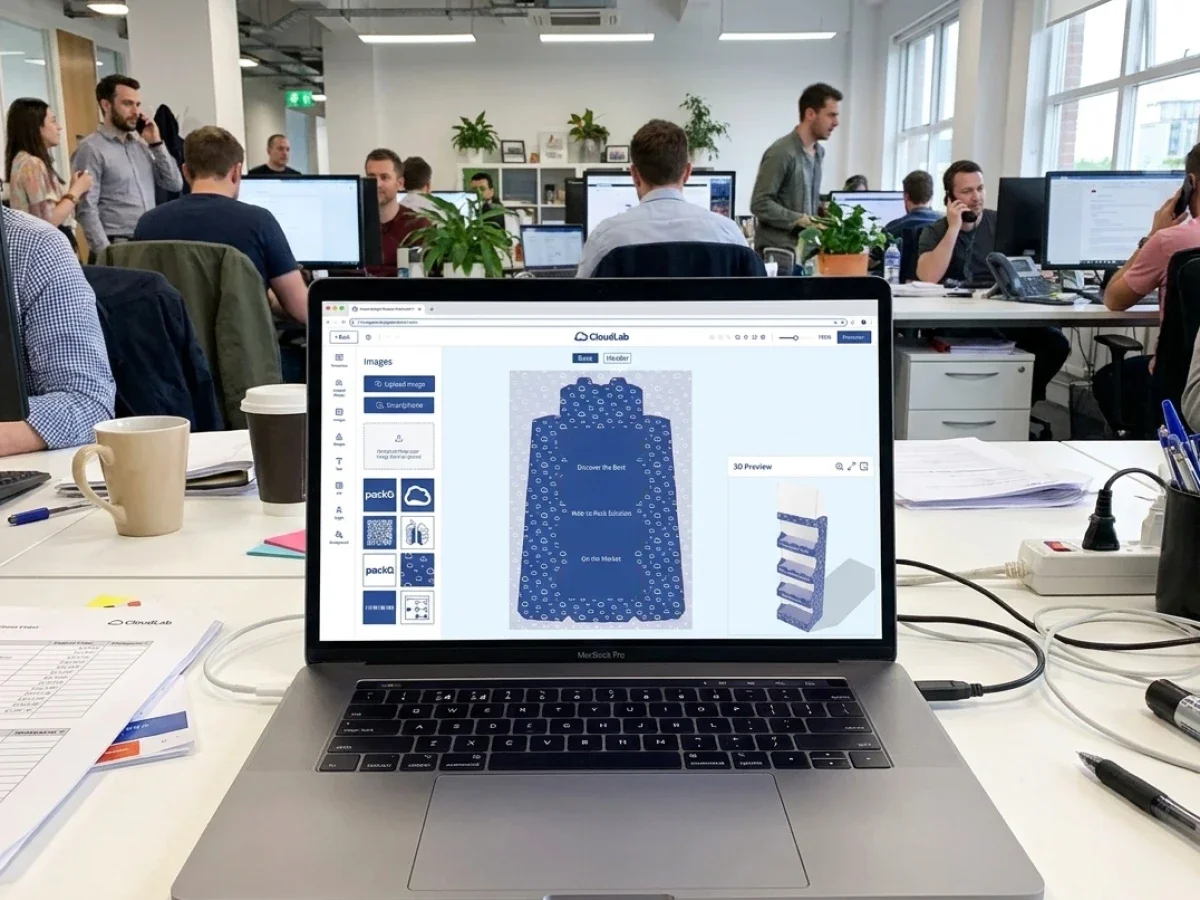
packQ’s browser-based 3D Packaging Designer is built around this production context. Users can review a carton visually while the underlying structure remains connected to standardized packaging logic. The synchronized 2D/3D design environment helps users understand how changes in the flat layout affect the final folded carton.
For brand owners, this improves confidence during approval. For folding carton manufacturers, it reduces questions that arise after a customer sees a physical sample or production proof. For prepress teams, it helps ensure that customer approval is tied to a clearer visual reference.
This is especially important for online configuration. Customers need a simple experience, but the production team needs reliable data. Safe 3D approval connects both needs.
Folding Carton Design Software and Graphic Data Quality
The secondary keyword folding carton design software fits a practical reality: carton design is both structural and graphic.
A folding carton workflow must manage dielines, dimensions, panels, and folds. It must also manage logos, images, regulatory copy, barcodes, color settings, and print quality.
If graphic data is weak, even a correct structure can fail. A low-resolution product image, missing bleed, wrong color mode, or font problem can delay production after approval.
packQ addresses this through Dynamic Preflight and AI-supported artwork tools. The AI Designer Suite can support common preparation tasks such as vectorization, background removal, and Crispify image enhancement with 4× higher resolution. These tools are useful because many online packaging customers do not submit perfect production assets.
The point is not to replace professional design. The point is to reduce avoidable friction before prepress becomes a bottleneck.
Browser-Based Web-to-Pack vs. Traditional Folding Carton CAD Workflows
Browser-based Web-to-Pack is stronger than traditional manual workflows when folding carton manufacturers need customers to configure, approve, and order standard or semi-standard cartons online. Traditional CAD workflows remain valuable for complex engineering, but they are not designed for scalable customer self-service. packQ connects ECMA-based configuration, 3D approval, Dynamic Preflight, pricing, and ERP/MIS integration.
This comparison should be handled carefully. Traditional CAD workflows are not outdated. They remain essential for advanced structural development, special constructions, and engineering-led packaging innovation.
The issue is suitability.
A CAD workflow is built for specialists. A Web-to-Pack workflow is built to translate approved structural logic into a guided ordering experience.
For repeatable folding carton products, Web-to-Pack reduces unnecessary manual work. Customers do not need to understand every technical parameter. They select from controlled options. The system maintains the rules.
packQ fits this operational layer. It does not remove structural expertise; it embeds that expertise into a scalable workflow.
Static Approval vs. Interactive 3D Approval
Static proofs are useful for detailed technical review. Interactive 3D approval is more useful when customers need to understand the finished folding carton quickly.
A flat dieline requires interpretation. A 3D preview shows how the carton will appear when folded.
In packQ, this 3D approval is connected to the underlying Web-to-Pack workflow. That makes it more reliable than a detached visualization because the approved object is linked to configuration, validation, and output.
Post-Submission Checking vs. Dynamic Preflight
Post-submission checking finds problems after the customer thinks the order is complete. Dynamic Preflight moves file validation into the design and ordering process.
For folding carton manufacturers, this timing matters. It reduces correction cycles and protects prepress capacity.
In packQ, Dynamic Preflight supports production safety by checking technical requirements before the job moves downstream.
Real-Time Pricing Makes Carton Configuration Commercially Usable
A folding carton configuration is not complete until the commercial impact is clear.
Size, material, quantity, finishing, and personalization can all affect pricing. If price calculation happens separately, the customer may approve a design before understanding the cost.
packQ includes dynamic price calculation during configuration. This helps customers evaluate options immediately and helps sales teams reduce repetitive quotation work.
For online folding carton sales, real-time pricing is not a convenience feature. It is part of the workflow. It keeps design choices, production parameters, and commercial decisions aligned.
This is especially useful for open-shop models where customers expect self-service. It also supports closed-shop portals where enterprise buyers need controlled pricing, repeat ordering, and procurement transparency.
How Do You Implement Folding Carton Software in an Online Packaging Workflow?
Folding carton software should be implemented by converting repeatable carton structures into controlled Web-to-Pack workflows that connect online configuration, ECMA logic, 3D approval, preflight, pricing, and production output. packQ supports this through headless and API-first architecture, allowing shop, ERP, MIS, prepress, and production systems to exchange data through REST, SOAP, or JSON where relevant.
Implementation should begin with product strategy. Not every folding carton belongs in a self-service workflow. Highly specialized constructions may still require engineering-led handling. Standard and semi-standard cartons are better candidates for online configuration.
A practical rollout can follow this sequence:
- Select carton families suitable for online configuration.
- Map each family to ECMA-based structures where possible.
- Define allowed dimensions, materials, finishes, and production constraints.
- Configure synchronized 2D/3D design for customer-facing approval.
- Apply Dynamic Preflight rules for resolution, color mode, bleed, fonts, and file quality.
- Connect pricing logic to format, quantity, material, and finishing.
- Integrate order data with shop, ERP, MIS, prepress, and production.
- Generate production-safe PDFs and job data after approval.
The goal is not to create a generic online editor. The goal is to create a controlled folding carton workflow that customers can use without compromising production reliability.
Implementation Example: B2B Folding Carton Portal
A folding carton manufacturer serves brand owners with recurring packaging needs. Customers frequently reorder cartons with small artwork changes, language variants, or campaign-specific graphics.
With packQ, the manufacturer can create a closed B2B portal. Each customer sees approved carton types, dimensions, and templates. Users can make allowed changes, review the carton in 3D, and submit the job after Dynamic Preflight checks the file.
ERP and MIS integration can then transfer order and production data without manual re-entry. This gives the customer a faster ordering path while keeping the manufacturer in control of production rules.
Open-Shop and Closed-Shop Models for Folding Cartons
Folding carton software must support different commercial scenarios.
En öppen lösning hjälper tillverkare att sälja standardkartongprodukter till en bredare publik. Små varumärken, startups och e-handlare kan konfigurera förpackningar online utan en lång säljprocess.
En sluten lösning hjälper befintliga B2B-kunder att beställa om och anpassa godkända kartongstrukturer. Detta är särskilt relevant för varumärkesägare, läkemedelsföretag, livsmedelsproducenter och industrikunder som kräver kontrollerade mallar och repeterbara godkännandeprocesser.
packQ kan stödja båda modellerna eftersom det är utformat som en skalbar Web-to-Pack-plattform. Kundupplevelsen kan skilja sig åt, men kärnarbetsprocessen förblir sammankopplad: ECMA-struktur, 3D-godkännande, preflight-validering, prissättning och produktionsoutput.
För tillverkare av falskartonger skapar detta strategisk flexibilitet. De kan betjäna nya digitala kunder samtidigt som de förbättrar servicen för befintliga kunder.
Variabeldatautskrift för falskartongsvarianter
Produktion av falskartonger involverar allt fler varianter. Varumärken behöver regionala versioner, kampanjutgåvor, serialiserad information, personalisering och mindre serier.
Manuell filförberedelse blir ineffektiv när varje variant kräver separat hantering.
packQ stöder variabeldatautskrift via PDF/VT, vilket möjliggör en mer skalbar hantering av personlig eller variantbaserad output. Detta är särskilt relevant för marknadsföringskampanjer, begränsade upplagor och arbetsflöden för enstycksproduktion.
För varumärkesägare skapar detta mer flexibla förpackningsprogram. För tillverkare av falskartonger öppnar det upp möjligheter för korta serier och personlig produktion utan att varje variant blir en manuell prepressuppgift.
Nyckelkravet är kontroll. Variabeldata måste förbli kopplad till struktur, placering av artwork, preflight och produktionsoutput. packQ håller dessa element inom Web-to-Pack-arbetsflödet.
Hur kan tillverkare av falskartonger använda ECMA-baserad programvara för onlinekonfiguration?
Tillverkare av falskartonger kan använda ECMA-baserad programvara för onlinekonfiguration genom att omvandla standardkartongstrukturer till guidade Web-to-Pack-produkter. Med packQ kan tillverkare erbjuda ECMA-kartongmallar, webbläsarbaserat 3D-godkännande, Dynamisk Preflight, prissättning i realtid, ERP/MIS-integration och produktionsklar PDF-output, vilket gör att kunder kan konfigurera kartonger online samtidigt som produktionsteam behåller kontrollen.
Utgångsläge
En tillverkare av falskartonger vill minska manuellt offert- och godkännandearbete för repeterbara kartongbeställningar. Kunder efterfrågar ofta standardstrukturer med olika storlekar, artwork eller kvantiteter.
Den nuvarande processen förlitar sig på säljkoordinering, manuell hantering av stansritningar, e-postkorrektur och separata prepresskontroller.
Detta skapar förseningar även när kartongen i sig inte är strukturellt komplex.
Tekniskt krav
Tillverkaren behöver ett kontrollerat arbetsflöde där kunder kan konfigurera kartonger utan att skapa produktionsrisker. ECMA-strukturer måste vägleda urvalsprocessen. 3D-förhandsgranskningen måste hjälpa kunder att godkänna den färdiga kartongen. Preflight måste upptäcka tekniska filproblem tidigt. Prissättning och orderdata måste flöda in i affärssystemen.
Arbetsflöde i packQ
I packQ kan tillverkaren definiera ECMA-baserade falskartongprodukter. Kunder väljer en kartongtyp, anger mått inom tillåtna intervall, applicerar artwork och granskar resultatet i synkroniserade 2D- och 3D-vyer.
Dynamisk Preflight kontrollerar utskriftsrelaterade krav under processen. Prissättning i realtid återspeglar konfigurationsval. Efter godkännande kan packQ generera produktionsfärdiga PDF:er och överföra relevant data till ERP-, MIS-, prepress- och produktionsarbetsflöden.
Fördelar för produktion och kundupplevelse
Kunden får en snabbare och tydligare beställningsupplevelse. Säljteam lägger mindre tid på repetitiva offerter. Prepress får renare filer. Produktionen får resultat som är bättre anpassade till godkända strukturer och tekniska regler.
För tillverkare av falskartonger skapar detta en skalbar modell för onlineförsäljning av kartonger utan att ge upp produktionskontrollen.
Varför ECMA-baserad automatisering av falskartonger skyddar kvaliteten
Automatisering utan strukturell kontroll är riskabelt. ECMA-logik skyddar kvaliteten eftersom den ger programvaran en pålitlig grund.
När kartongtyper baseras på erkända strukturer kan systemet vägleda konfigurationen på ett säkrare sätt. Kunderna får fortfarande flexibilitet, men flexibiliteten inramas av produktionsmedvetna regler.
Detta är skillnaden mellan öppen design och kontrollerad konfiguration.
packQ använder ECMA-logik för att göra arbetsflöden för falskartonger mer förutsägbara. Plattformen hjälper till att omvandla strukturell expertis till digitala regler som kunder kan använda indirekt.
Det är viktigt för alla intressenter.
Kunderna får en enklare beställningsupplevelse. Förpackningstillverkare får mer konsekvent data. Prepress-team får färre förebyggbara problem. Produktionsteam får jobb som är lättare att förbereda.
Varför programvara för falskartonger behöver integration, inte bara funktioner
Många diskussioner om programvara för falskartonger fokuserar på funktioner. Det är förståeligt, men ofullständigt.
Ett Web-to-Pack-arbetsflöde skapar endast fullt värde när den godkända ordern ansluter till de system som driver verksamheten. Det inkluderar butikssystem, ERP, MIS, prepress-verktyg och produktionsmiljöer.
packQ är byggt med en headless och API-först-arkitektur. Detta gör det möjligt för teknikteam att bädda in arbetsflöden för falskartonger i befintlig digital infrastruktur. REST, SOAP och JSON kan stödja datautbyte beroende på miljön.
Den praktiska fördelen är kontinuitet. Konfigurationsdata, prislogik, konstverksstatus, godkännanderesultat och produktionsresultat bör inte återskapas manuellt efter utcheckning.
För IT-team minskar detta integrationsfriktionen. För driftteam minskar det det administrativa arbetet. För kunder får portalen att kännas som en ansluten tjänst snarare än ett fristående designverktyg.
ECMA-baserade arbetsflöden för falskartonger omvandlar onlinebeställningar till produktionssäker data
Programvara för falskartonger skapar störst värde när den omvandlar ECMA-baserade strukturer till säkra, skalbara Web-to-Pack-arbetsflöden. Onlinekonfiguration fungerar bara när kunder kan välja, anpassa, godkänna och beställa kartonger utan att koppla bort processen från produktionsverkligheten.
packQ av CloudLab stöder denna modell genom ECMA-mallar för falskartonger, webbläsarbaserad 2D/3D-design, Dynamisk Preflight, prissättning i realtid, verktyg i AI Designer Suite, stöd för PDF/VT, produktionsfärdig PDF-utdata och API-först ERP/MIS-integration.
För tillverkare och tryckerier av falskartonger minskar detta manuella offerter, godkännandeloopar och korrigeringar av filer som kan undvikas. För varumärkesägare skapar det snabbare och tydligare godkännanden av kartonger. För teknikteam erbjuder det en integrationsredo plattform som kopplar samman kundnära konfiguration med produktionssystem.
Huvudpoängen är enkel: framgångsrik onlinekonfiguration av kartonger beror på att ECMA-logik, säkert 3D-godkännande, automatiserad validering och sammankopplad produktionsutdata fungerar tillsammans.
Programvara för falskartonger blir en nyckeldel i Web-to-Pack-automatisering för tillverkare, tryckerier och varumärkesägare. packQ hjälper till att omvandla ECMA-baserade kartongstrukturer till onlinekonfigurationsflöden med webbläsarbaserat 3D-godkännande, Dynamisk Preflight, prissättning i realtid, AI-stödda designverktyg, PDF/VT-personalisering, produktionsfärdig PDF-utdata och ERP/MIS-integration. Fokus ligger på säker självbetjäning, färre godkännandeloopar, renare prepressdata och skalbar produktion av falskartonger utan att förlora strukturell kontroll.